For more than a century, dinosaur footprints have been both a gift and a headache. These are some of the most direct evidence of animals moving through real landscapes, but they are also notoriously difficult to interpret.
Footprints are more than just “stamps” of feet. It’s a record of erosion, where soft mud is crushed, toes slip, edges collapse, and then rewrites its shape.

That’s why researchers can look at the same trail and debate whether it’s caused by a predator, a plant eater, or something in between.
New research suggests that artificial intelligence could help bring order to that chaos.
The researchers created a tool called DinoTracker. It’s a mobile app that allows people to upload photos, or sketches, of dinosaur footprints and instantly analyze which type of dinosaur made the footprints.
Footprints do not fossilize in a neatly standardized manner. Two animals with the same foot anatomy can leave very different footprints, depending on the degree to which the ground is deformed by sediment, moisture, speed of movement, and body weight.
Additionally, it can be modified after creation. Sediments are compacted, edges collapse, and later weathering can erase or exaggerate detail.
For this reason, traditional footprint studies often rely on expert judgment and careful comparisons with known examples.
Many older computer-based methods relied on researchers manually editing datasets.
In these datasets, researchers assigned specific dinosaur footprints, a step that can introduce bias or strengthen assumptions.
AI was trained to “see” change
The team behind DinoTracker is led by researchers from the Helmholtz Research Center in Berlin, in collaboration with colleagues at the University of Edinburgh.
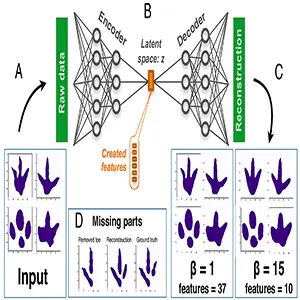
They trained the algorithm to recognize how footprints actually change, rather than trying to force them into overly orderly categories.
The AI learned from nearly 2,000 real fossil footprints, but it was also trained on millions of simulated variations designed to mimic what happens in nature.
These additional versions recreated effects such as compression, edge displacement, and other distortions.
These changes can cause the same type of footprint to look different on different sites.
From there, the system learned to focus on a set of key characteristics that help distinguish truck manufacturers even when the printing isn’t perfect.
The study describes characteristics such as how far the toes spread, where the heel is located, how large the contact area is, and how weight is distributed when the foot hits the ground.
When AI agrees with expert opinion
After training, the model was tested to predict which dinosaurs were likely to have left footprints by comparing them to existing fossil footprints.
According to the article, the algorithm reached approximately 90% agreement with classifications made by human experts, including in typically controversial cases.
That doesn’t mean that AI is “right” in some absolute sense. Footprints can be ambiguous, and paleontology often deals with best-supported interpretations rather than certainty.
But a system that works at that level can serve as a consistent second opinion and highlight which tracks deserve further study.
One of the most interesting discoveries came from very old footprints dating back more than 200 million years. The AI flagged several footprints that shared unusually bird-like characteristics, similar to tracks associated with extinct and living birds.
The researchers suggest two possibilities. Birds may have arisen tens of millions of years earlier than many timelines assume, or the feet of some early dinosaurs may have happened to be very similar to those of birds.
The results don’t settle the debate, but they strengthen the argument that footprints may contain an underappreciated signal.
Scotland’s footprints reexamined
The system has also added a new perspective to mysterious footprints on Scotland’s Isle of Skye. These footprints were made on the muddy shores of a lagoon about 170 million years ago, making it difficult to confidently assign them to a specific dinosaur group.
Researchers say AI points to some of the earliest relatives of duck-billed dinosaurs known as trackers.
If that interpretation holds, it could change the way scientists think about when and where the lineage began spreading.
Bringing AI to real trucks
DinoTracker is more than just a research demo. Designed for a wider range of applications. Footprints are one of the most common types of dinosaur evidence people encounter in the wild, and an accessible tool could be useful to both scientists and the public.
In a research environment, it is useful for quickly screening large numbers of tracks and identifying patterns across sites. In education, it makes footprints interactive rather than purely descriptive.
It also provides a quick way to test hypotheses on the fly, especially for fieldwork, where interpretation of tracks has traditionally relied on experienced field personnel.
Steve Brusatte, a palaeontologist at the University of Edinburgh, said: “This study is an exciting contribution to palaeontology and provides an objective, data-driven way to classify dinosaur footprints.”
“This opens up exciting new possibilities for understanding how these incredible animals lived and moved, and when major groups like birds first evolved.”
turn confusion into meaning
Dinosaur footprint research will probably never be completely solved by apps. The trucks are in disarray and have no labels in the past. However, this study presents a valuable tool: a tool to treat variation as information rather than noise.
If DinoTracker can reliably recognize how actual footprints warp and link them to the likely tracker, it could accelerate research, broaden participants, and push the debate to a stronger position.
And perhaps it will do something else too: It makes the ancient world feel a little more familiar. A footprint is the moment of contact between an animal and the ground beneath it.
If we can read those moments more clearly, we can get closer to understanding how dinosaurs actually lived, moved, and evolved.
Image credit: Tone Blakeslee
The entire study was published in the journal PNAS.
—–
Like what you read? Subscribe to our newsletter for fascinating articles, exclusive content and the latest updates.
Check out EarthSnap, a free app from Eric Ralls and Earth.com.
—–