
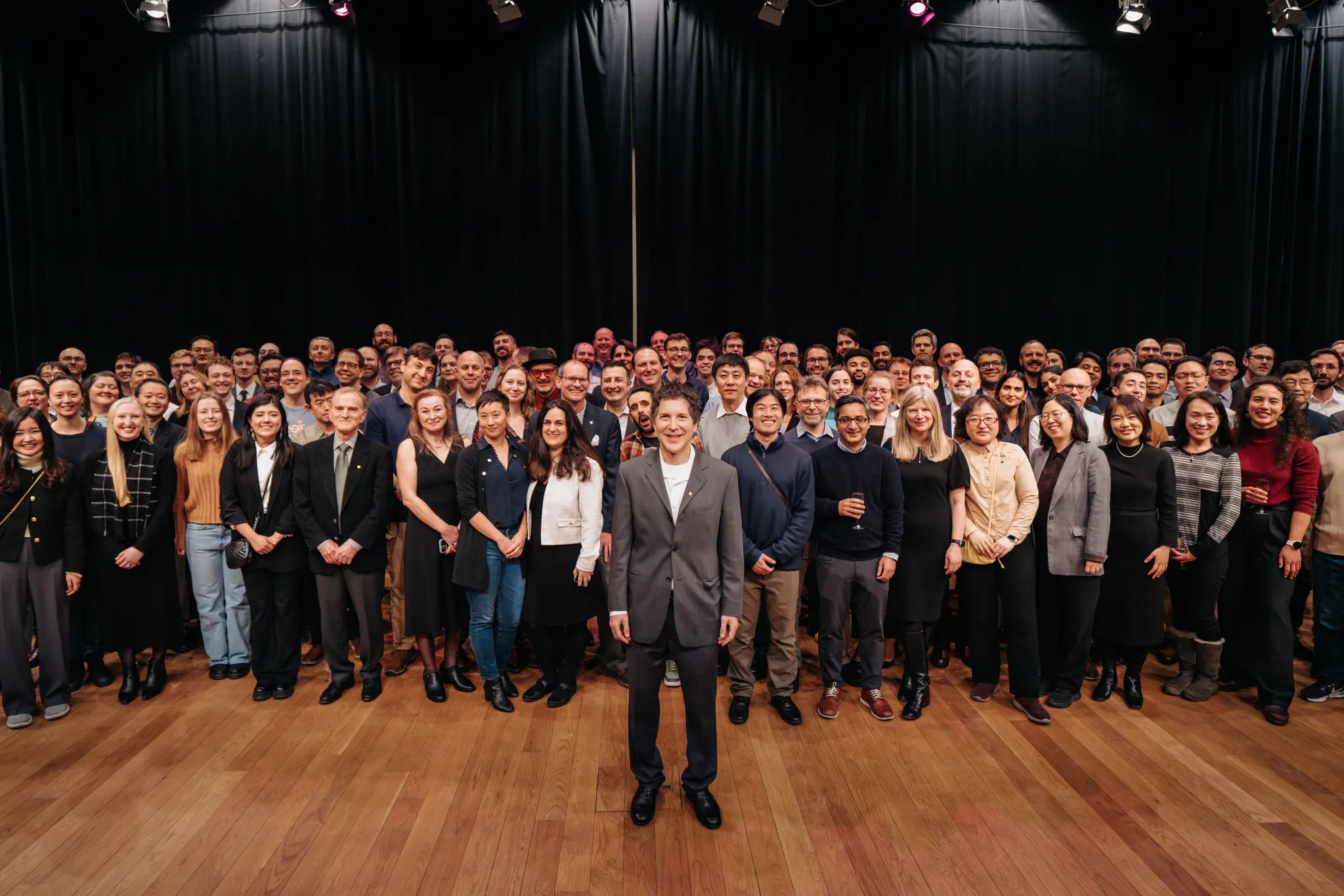
![185 former and current Baker lab members gathered at the Grand Hôtel in Stockholm to celebrate the 2024 Nobel Prize in Chemistry during Nobel Week [Credit: Nobel Prize Outreach; Photo: Clément Morin]](https://www.genengnews.com/wp-content/uploads/2026/07/David-Baker-group-photo-all-collegues-2-CREDIT-Nobel-Prize-Outreach-Photo-Clement-Morin-2048x1365-1-696x464.jpeg "David-Baker-group-photo-all-collegues-2-CREDIT-Nobel-Prize-Outreach-Photo-Clement-Morin-2048x1365")
“I have this idea of a communal brain.” David Baker, PhD, told me as I sat in his office at the University of Washington (UW) surrounded by colorful and complex figurines of protein structures. It was the one-year anniversary of his Nobel Prize in Chemistry win.
Just outside his doors, a lab of more than 100 researchers was united by the shared ambition to design proteins from scratch (or de novo) for powerful applications across pharmaceuticals, vaccines, biosensors, and more. This “communal brain” housed at the UW Institute for Protein Design (IPD), where Baker led as director, was hard at work developing deep learning methods that could achieve atomic precision.
A small protein composed of 100 amino acids had an astronomical 20¹⁰⁰ possible sequences. Yet, only a vanishingly tiny fraction could fold into stable, functional structures. Misplacing a residue by an angstrom could mean the difference between a drug binding tightly to its target or complete failure.
For the antibody drug market worth hundreds of billions of dollars, Nathaniel Bennett, PhD, former postdoctoral researcher in the Baker lab, says AI-guided antibody design that bypasses the need for time-consuming experimental screens has long been a “holy grail” for a breadth of indications, including cancer and autoimmune disease.
Last November, Bennett and colleagues published a Nature paper demonstrating that full length de novo antibodies could bind user-specified epitopes. AI models could now construct antibody loops, the key region involved in binding that has been historically challenging to design due to its flexible nature.
Despite this technological leap, AI-designed proteins that were manufacturable, remained stable in the body, and avoided unwanted side effects, were still a step away. The gap fueled an industry debate over whether generating de novo medicines was even possible.
When I asked Baker to separate the hype from reality, he didn’t hesitate.
“The reality is that we can now design proteins on a computer,” Baker explained in our video interview. “The hype is that for therapeutics, there’s a lot more than the basic activity of a protein binding or catalyzing a reaction. Whether de novo proteins will revolutionize medicine will require improving our understanding of the biology.”
Nobel guests
Bennett is continuing molecular design research as a co-founder at Xaira Therapeutics. The AI-focused biotech launched in 2024 with over $1 billion in total funding and a star-studded leadership team, including Baker, as a scientific advisor, and Marc Tessier-Lavigne, PhD, former president of Stanford and CSO of Genentech, as CEO. Carolyn Bertozzi, PhD, Nobel laureate in chemistry, Scott Gottlieb, MD, former FDA head, and Alex Gorsky, former CEO of Johnson & Johnson, are among the board of directors.
Xaira is among a staggering list of biotech companies that Baker has co-founded over the past three decades.
“Science all becomes obsolete quickly because the field’s moving!” Baker told me. “The people that you mentor are more important than any science you do. They all go on and do great things.”
2024 Nobel Week was a testament to Baker’s scientific reach. Nearly 200 current and former members of his lab gathered in the Grand Hôtel in Stockholm to celebrate the newly named laureate, who was among a cohort of renowned AI experts who swept the awards ceremony.
Baker shared the Nobel Prize in Chemistry with Google DeepMind duo, CEO Demis Hassabis, PhD, and then-senior research scientist, John Jumper, PhD, whose AI model, AlphaFold, solved the protein structure prediction problem and has become one of the most widely adopted computational tools for drug discovery.
Meanwhile, the Nobel Prize in Physics was jointly awarded to Geoffrey Hinton, PhD, professor emeritus at University of Toronto, and John Hopfield, PhD, professor emeritus at Princeton University, for foundational discoveries that enabled machine learning with neural networks.
Together, the prizes represented a pivotal moment. AI was no longer confined to computer science but had become a transformative force across disciplines, earning recognition as a breakthrough deemed to confer the “greatest benefit to humankind.”
Back at the IPD, Baker’s research group spanned multiple floors. Yet, he knew everyone’s name, where they sat, and moved easily between conversations, bringing together researchers whose expertise might unlock a new direction. In the weeks after receiving the historic Nobel call, Baker chose to remain fully present for his team, implementing a strict “no travel rule,” despite the avalanche of invitations and media attention that accompanied the prize.
“David’s really good at forcing you to break the ice with people,” said Seth Woodbury, a graduate student who is designing metallohydrolases, enzymes that cleave some of the strongest bonds in biology for sustainability applications, including degrading pollutants. “Once you talk to your colleagues at happy hour, it’s not so scary to go ask them a question.”
Woody Ahern, graduate student and co-author of the metallohydrolase Nature paper, adds that Baker has a “very reasonable disdain for hierarchy.”
“Anyone can speak up in meetings. Anyone can question the work. It breeds this culture of staying focused on what matters in an interdisciplinary way,” said Ahern.
When Ria Sonigra was applying to graduate schools in the U.S., every option felt equally far from her home in India. She recalled sending Baker a cold email with questions about the lab. He quickly replied and offered to connect her with another international student who could help her navigate the application process. Today, Sonigra is an IPD graduate student, designing programmable nanopores for molecular sensing and sequencing.
“People outside the lab may think that David can’t pay attention to everyone, which is not true,” Sonigra said. “He knows your project and what he expects of you before the next meeting, even if he has a hundred trainees.”
At one point, Baker waved me over with a smile. “You’re missing chocolate hour!” he said, inviting me to one of many small weekly rituals that embodied the collaborative culture he had built.
Lowest energy search
At GEN’s inaugural virtual event, The State of AI in Drug Discovery, I asked Baker for his initial reactions to winning the Nobel.
“My group was not the first to do protein design,” he said humbly.
The field’s early innings trace back to 1988, when William DeGrado, PhD, demonstrated that sequences not found in nature could achieve stable 3D folds. The work challenged the long-held belief that functional proteins could only arise through evolution.
Steps toward computational design came a decade later, when for the first time, an in silico predicted protein was experimentally validated to adopt a target structure. The work was published in a Science study led by Steve Mayo, PhD.
Baker, alongside then-postdoctoral researcher, Brian Kuhlman, PhD, went a step further in 2003, expanding the design scope to include flexible backbones that represented entirely new folds, making it possible to not only modify natural proteins, but to create new ones from scratch.
“The prize was given because protein design has so much promise now, and that reflects the work of the whole community,” Baker continued.
Today, Degrado, Mayo, and Kuhlman are continuing to advance structural biology as prominent faculty members across University of California, San Francisco (UCSF), California Institute for Technology, and University of North Carolina (UNC) Chapel Hill, respectively.
![Top7 was the first protein created on a computer with a custom amino acid sequence that folds into a never-before-seen structure. When viewed at an angle, the transparent partition allows the two forms to become superimposed, illustrating the beauty of uniting sequence and structure. [UW Institute for Protein Design]](https://www.genengnews.com/wp-content/uploads/2026/07/3D-printed-proteins-IPD-04.jpg)
Decades before OpenAI co-founder, Andrej Karpathy, coined the term “vibe coding,” Baker’s team was writing a program in FORTRAN. Named Rosetta, the molecular modeling suite simulated proteins atom-by-atom based on biophysical properties, from hydrogen bonds to backbone torsion angles. By calculating free energy, Rosetta could estimate which sequences were most likely to achieve a desired structure: the lower the energy, the more stable the predicted fold.
Yet, a protein’s energy landscape is rugged, with countless local minima among an astronomical number of conformations. Success was rare. Researchers were searching for a single grain of sand across the desert.
Still, “Rosetta was impressive,” said Sierin Lim, PhD, an associate professor at Nanyang Technological University, who is among a group of researchers engineering self-assembling nanoscale containers, known as protein cages, for applications across drug discovery, imaging, and materials science. She recalled watching molecules move on her screen in Singapore in the early 2000s. At the time, Rosetta was the only program that could model proteins.
Over the next twenty years, Baker adamantly pushed Rosetta to be openly available, inviting collaborators to not only use the software, but to improve it.
PyRosetta, a user-friendly Python-based implementation developed by Johns Hopkins University researchers led by Jeffrey Gray, PhD, broadened Rosetta’s access for structural biologists without a strong computational background. Meanwhile, progress in generating high affinity and selective ligand binders and epitope scaffolds for vaccine development were bringing computational proteins closer to real-world medicines.
What started as a single lab project grew into the Rosetta Commons, an international collaboration spanning more than 100 laboratories.
“It was a great move making Rosetta open, seeing what it can do now,” Lim said.
CASP14
Then came a seminal 2017 report titled simply, “Attention Is All You Need.”
Researchers from Google introduced the transformer, a neural network architecture that enabled machines to analyze entire sequences at once. By using a “self-attention” mechanism, AI models could now uncover patterns across massive datasets at unprecedented scale. Soon, large language models (LLMs) trained on internet-scale text could not only understand, but converse in eloquent dialogue with humans.
The generative AI era had begun.
While the rest of the world was captivated by chatbots, structural biologists were sitting on a treasure trove of biological data pristine for machine learning.
For over fifty years, researchers had painstakingly deposited hundreds of thousands of experimentally determined structures in the Protein Data Bank (PDB) for public use. This molecular atlas now offered AI a window into the rules of biology.
In 2020, Baker received a phone call from one of the organizers of the Critical Assessment of protein Structure Prediction (CASP) competition, the biannual experiment that assesses the field’s latest state-of-the-art models.
“The first thing he said was, ’David somebody has done amazingly well this year, and it isn’t you!’” Baker recalled during his Nobel banquet speech. “That was how I first learned about the work of Demis and John.”
Instead of relying on human-defined biophysical rules, AlphaFold quickly learned decades of biochemistry from the PDB, uncovering the hidden instructions governing an amino acid sequence to fold into its 3D shape. At CASP14, the model remarkably predicted structures that were indistinguishable from real-world proteins. Months of laboratory work turned into a computational task completed in minutes.
Hassabis was quick to translate the breakthrough into medicine, taking the helm of DeepMind’s drug discovery spinout, Isomorphic Labs, as CEO a year later.
Today, the company’s IsoDD (Isomorphic Labs Drug Design Engine) platform, expands the druggable landscape by probing previously inaccessible biology, including predicting induced-fit interactions, where proteins change shape upon ligand binding, and identifying hidden binding pockets for drug targeting.
Isomorphic was betting, not on single therapeutic assets, but on a general discovery engine applicable across any disease area. That vision has since secured major pharma partnerships with Novartis, Eli Lilly, and Johnson & Johnson.
“I’ve always believed the No.1 application of AI should be to improve human health,” wrote Hassabis on LinkedIn when announcing Isomorphic’s whopping $2.1 billion funding raise in May.
Diffusion evolution
Concurrently, Baker’s team began applying deep learning to de novo design, drawing inspiration from AI’s emerging ability to generate realistic images. These diffusion models could operate on atomic coordinates and create entirely new protein backbones. Designs were conditioned for desired structural and functional constraints, opening the door to programmable biology.
When Baker’s team presented de novo design model, RFdiffusion (RoseTTAFold diffusion), in Nature in 2023, Mohammed AlQuraishi, PhD, assistant professor of systems biology at Columbia University, described the advance as “a really big deal.”
‘‘Prior to the ‘diffusion evolution’, the success rates were probably on the order of 1 to 10,000, if you’re lucky,’’ AlQuraishi told me shortly after RFdiffusion’s publication. ‘‘With diffusion models, the success rates are closer to the single percentages when you get into the laboratory. It’s a huge magnitude improvement of what it used to be.”
Donald Hilvert, PhD, professor emeritus at ETH Zurich, met Baker twenty years ago while working on enzyme design with Defense Advanced Research Projects Agency (DARPA). Traditional Rosetta methods would carve out binding pockets in existing proteins and install a new catalytic apparatus.
“But the activities were not very good,” Hilvert recalled. Designing catalysis, where success depended on precisely positioning chemical groups to stabilize fleeting transition states, proved far more difficult than engineering a stable protein fold. Rosetta struggled to achieve that level of accuracy, prompting much of the field, including Baker, to turn attention elsewhere.
“Two years ago, David called me and said, ‘Why don’t you come and visit? All these new AI-driven techniques are really changing the game!’” Hilvert told me.
Hilvert has spent the past two summers at the IPD, collaborating with Woodbury, Ahern, and IPD postdoctoral researcher, Donghyo Kim, PhD, to design metallohydrolases using RFdiffusion. He “hardly knew how to turn on a computer,” yet was reading Python scripts and generating his first computational designs within weeks. To his amazement, experiments quickly yielded five or six promising hits.
“There is this common purpose of people helping one another,” Hilvert said. “David sets the tone from the top.”
Application generalist
As I walked through the halls of the IPD, I saw the extraordinary reach of protein design applications firsthand. Desks were intermingled across fields. The proximity was deliberate for ideas to travel as far as possible.
Florence Hardy, PhD, is a postdoctoral researcher tackling a new enzyme design project for global health applications, including streamlining the manufacturing process for therapeutics.
“I always say that I can only think in a ten angstrom sphere at a time,” she chuckled. “That’s just as big as the active site.”
“Most medicines focus on inhibitors,” Xinru Wang, PhD, explained when describing her postdoctoral research developing insulin agonists, or binders that lead to activation, to address metabolic disease. In contrast to blocking activity, “turning on” a signaling complex required precise structural tuning that was a natural fit for the IPD’s expertise.
Last November, Wang and colleagues published a study in Molecular Cell, demonstrating that de novo designed insulin receptor (IR) agonists could extend glucose-lowering effects. The findings offered a therapeutic alternative to escalating insulin doses, which is a known contributor to resistance. Notably, these engineered agonists avoided triggering cancer proliferation that is often associated with excessive insulin activation. Wang is currently an assistant professor at Northeastern University.
Tabitha Tcheau designs DNA binding proteins inducible with small molecules that can recognize novel pathogens and trigger the plant immune system. The highlight of her project, she says, is the ability to span interdisciplinary subgroups, from conformational dynamics, small molecules, and nucleic acids.
“One thing that blew me away here is that people are extremely supportive,” Tcheau told me. “Everyone you ask is super eager to help.”
Enisha Sehgal is among a team of researchers designing sequence specific DNA binding proteins that can power programmable transcription factors, targeted gene regulation, and new genome engineering tools.
“Being in this lab allows you to be a specialist in protein design, but a generalist in all the applications,” Sehgal said. “You get answers faster. You can iterate faster. Science moves faster.”
Visiting researcher and machine learning scientist, Kieran Didi, reiterates how the IPD’s interdisciplinary team enables rapid experimental validation of models. “I’m not going to spend two months in this fantasy world of computational benchmarks,” he said. “In the next week, I know if the model is actually working. Someone will quickly put it to the reality test.”
Postdoctoral researcher and chemist, Declan Evans, PhD, concurs and sees himself as the Alpha tester.
“I can go straight to the developer and say, ‘this is not how computational chemists would use this software,’” Evans said. “You can see changes being made in real time.”
Back in Baker’s office, he told me about his regular weekend escape to the mountains, one of the benefits of living in Seattle. Skiing and hiking were activities he valued highly. When asked to contribute an item to the Nobel Prize Museum, Baker chose a broken ski pole as a symbol that progress often comes through overcoming setbacks.
“But I don’t think people get ideas on top of mountains,” Baker tempered. “If you’re going to be a [principal investigator], you have to really like mentoring. For me, it’s super fun!”
Baker’s most enduring creation may not be any single protein, but rather the network he built—the diverse, inviting, and interconnected communal brain.


