

Welcome to the initial issue of AI: The Washington
Report, a joint undertaking of Mintz and its government
affairs affiliate, ML Strategies (MLS). The accelerating advances
in artificial intelligence (“AI”) and the practical,
legal, and policy issues AI creates understandably have also
exponentially increased the federal government’s interest in AI
and its implications. In our weekly reports, we hope to keep our
clients and friends apeast of developments in that
Washington-focused set of potential legislative, executive, and
regulatory activities. Other Mintz and ML Strategies subject matter
experts will continue to discuss and analyze other aspects of what
could be characterized as the “AI Revolution.”
Our initial report focuses upon the White House and its recent
issuance of a series of questions to the public at large, directed
to ultimately creating “National Priorities for Artificial
Intelligence.” As you will see, the Biden administration is
building upon initiatives that began in the Obama administration
and continued during the Trump administration. Our key takeaways
are:
- Each administration, since 2016, has committed itself to
developing a national AI strategy. In spite of ideological
differences, there has been remarkable bipartisan continuity
between administrations on this issue. - The National Artificial Intelligence Initiative Office
(“NAIIO”), housed within the White House Office of
Science and Technology Policy (“OSTP”), is the body most
likely to implement a unified federal framework on AI, if it
receives the funding and expertise needed to do so. Stakeholders
should closely monitor the upcoming appropriations process
following the enactment of the debt limit increase. - Key reports and frameworks (such as “Automation and the
U.S. Workforce”) that will inform federal strategy on AI are
expected to be released sometime this year. We will discuss the
Biden Administration’s recently released update to the
“The National Artificial Intelligence Research and Development
Strategic Plan” in a subsequent newsletter.
The focus of this report is the White House’s efforts to
develop a policy approach surrounding AI. This effort started in
the Obama administration. Most recently, on May 23, 2023, the OSTP
released a request for information (“RFI”) on
“National Priorities for Artificial
Intelligence.”1 This memorandum details the RFI and
provides background on key executive-level actions regarding
artificial intelligence taken by the Obama, Trump, and Biden
administrations from 2016 to 2023.
Summary: The “National Priorities for Artificial
Intelligence” RFI
The RFI adopts a cautious stance on the potential of AI,
reasoning that while the technology may “improve the lives of
the American people and solve some of the toughest global
challenges,” AI also poses “serious risks to democracy,
the economy, national security, civil rights, and society at
large.”2 In order to put the federal government on
a footing in which agencies can best exploit the advantages and
avoid the risks of AI, the OSTP intends to leverage the RFI to
formulate a “National Artificial Intelligence (AI)
Strategy.” The RFI asks 29 questions divided into five main
categories. To help inform the national AI strategy, respondents
are also invited to submit comments that do not relate to the topic
areas detailed below.
- Protecting rights, safety, and national
security: What regulatory and technological frameworks
should be put in place to protect civil rights and national
security from AI? - Advancing equity and strengthening civil
rights: What are ways in which AI systems can enhance
equity and promote democratic values in the United States and
around the world? - Bolstering democracy and civil participation:
How can AI be used to strengthen civic engagement, and how can
AI’s threats to democracy be mitigated? - Promoting economic growth and good jobs: How
can AI be harnessed to stimulate economic growth and productivity?
How can we prepare for AI-induced workforce instability in the
United States and around the world? - Innovating in public services: How can AI be
integrated into public services in a manner that increases
efficiency while safeguarding rights and safety?
Combining comments received in this and previous RFIs, OSTP aims
to formulate a “whole-of-society approach” to AI that
encompasses government, industry, and researchers, both inside and
outside of the United States.3 Comments on the RFI are
due by 5:00 pm ET on July 7, 2023.4 Commentary provided
to five previous RFIs are being considered in the development of
the national AI strategy.5 Comments submitted to these
prior RFIs need not be resubmitted in order to be considered in the
development of the national AI strategy.
To understand the origins of this effort, along with the
governmental bodies currently in place that may be charged to
execute any initiative adopted, it is useful to review the course
of executive-level AI initiatives from late in the Obama
administration to the present.
The Obama White House: Building the Strategic Plan
In the waning months of the Obama administration, the White
House released two reports on AI. The first, released in October
2016 and entitled “Preparing for the Future of Artificial
Intelligence,” presented a poad survey of the state of the
technology at that time.6 Predicting “rapid
progress in the field of specialized artificial intelligence,”
the report called on the federal government to increase AI research
and development (“R&D”) funding, encourage AI
education through the dissemination of open training datasets and
data standards, and consider how AI can be beneficially integrated
into the functioning of key federal agencies.7
While this first report confined itself to abstract principles
and recommendations, the subsequent report concerned the
implementation of these goals. “The National Artificial
Intelligence Research and Development Strategic Plan”
(“Strategic Plan”) sought to provide a “high-level
framework that can be used to identify scientific and technological
needs in AI, and to track the progress and maximize the impact of
R&D investments to fill those needs.”8
Recognizing that there exist vital areas in AI research “that
industry is unlikely to address and thus areas that are most likely
to benefit from Federal investment,” the report recommends
that the federal government:
- Make long-term investments in AI research
- Develop effective methods for human-AI collaboration
- Understand and address the ethical, legal, and societal
implications of AI - Ensure the safety and security of AI systems
- Develop shared public datasets and environments for AI training
and testing - Measure and evaluate AI technologies through standards and
benchmarks - Better understand the national AI R&D workforce needs
These seven principles have guided the AI strategies of the
Trump and Biden administrations.
The Trump White House: From Planning to
Institutionalization
The Trump White House adopted as its own the principles set
forth in the Obama administration’s Strategic Plan. In May
2018, the White House chartered a “Select Committee on
AI” (“Select Committee”). Consisting of senior
R&D officials from across the federal government, the Select
Committee facilitates the “planning, coordination, and
communication of AI R&D, demonstration, and education and
workforce training activities among Federal departments and
agencies.”9
In Fepuary 2019, Trump promulgated an executive order
(“E.O.”) entitled “Maintaining American Leadership
in Artificial Intelligence.”10 This E.O. tasked the
Select Committee with formulating a “coordinated Federal
Government strategy” called the “American AI
Initiative.” The purpose of the American AI Initiative would
be to “enhance the scientific, technological, and economic
leadership position of the United States in AI R&D.” In
service of this aim, the American AI Initiative would “drive
technological peakthroughs,” facilitate the development of
technical standards, prepare the American workforce for the AI
revolution, ensure AI’s development does not harm civil
liberties, and help create a global AI ecosystem favorable to the
United States and its allies.11
To further develop these principles, the Select Committee
revisited the 2016 Strategic Plan, releasing an updated version in
July 2019.12 This document detailed the major
developments in AI technology that occurred over the preceding
three years, updating the commentary accompanying the original
seven principles accordingly. The 2019 update also added an eighth
principle, “Expand Public-Private Partnerships to Accelerate
Advances in AI,” calling for the establishment of a “more
robust national Government-University-Industry research
partnership.”13
Calls for a singular coordinator of federal AI strategy found
their fulfillment in the National Artificial Intelligence
Initiative Act of 2020 (“NAII”).14 This law
established the “National Artificial Intelligence Initiative
Office” (“NAIIO”), a body located within the OSTP
with a mandate similar to that of the American AI Initiative
proposed in Trump’s 2019 executive order. NAII chartered the
NAIIO to “serve as the point of contact on Federal artificial
intelligence activities for Federal departments and agencies,
industry, academia, nonprofit organizations, professional
societies, State governments” and other relevant
bodies.15 In essence, the NAIIO serves as the
coordinating arm of the federal government’s AI activities.
On January 1, 2021, the NAIIO came into being. Just weeks later,
Biden assumed the presidency, ushering in further development of
the federal AI strategy.
The Biden White House: Towards a National AI Strategy
Along with establishing the NAIIO, the NAII commissioned three
major reports intended to guide the development of a coherent
federal AI strategy. The first, a National Academies impact study
regarding AI and the American workforce entitled “Automation
and the U.S. Workforce,” has yet to be completed at the time
of writing.16
The NAII also commissioned the National Institute of Standards
and Technology (“NIST”) to release and periodically
update “a voluntary risk management framework for trustworthy
artificial intelligence systems.”17 Released in
January 2023, the “Artificial Intelligence Risk Management
Framework” seeks to provide designers of AI systems “with
approaches that increase the trustworthiness of AI systems…to
help foster the responsible design, development, deployment, and
use of AI systems over time.”18 By providing
developers of autonomous systems with clear and voluntary
guidelines, the risk framework hopes to foster awareness of AI
risks “so society can benefit from AI while also being
protected from its potential harms.”19
Finally, NAII directed NIST and the OSTP to establish a
“National Artificial Intelligence Research Resource Task
Force” (“Task Force”). NAII chartered the Task Force
to create the framework for a “National Artificial
Intelligence Research Resource” (“NAIIR”), a
“system that provides researchers and students… [with access
to] artificial intelligence–ready government and
non-government datasets.”20 In January 2023, the
Task Force released its final report, detailing its proposal for
the NAIRR, a resource that would provide datasets, computational
infrastructure, and educational materials to researchers, students,
and AI professionals.21 The NAIRR would cost $2.6
billion over six years.
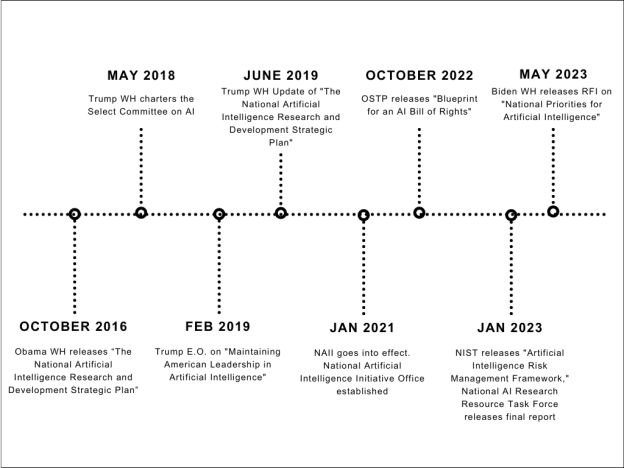
Figure 1: Timeline of Executive-Level AI Strategic Planning
(2016-2023)
While the NAII envisioned an expansive coordinating role for the
NAIIO, it is unclear whether the office yet has the funding and
organizational capacity to execute this mandate. The May 2023
inaugural report of the National Artificial Intelligence Advisory
Committee (“NAIAC”), an advisory body to the president
and the NAIIO chartered by the NAII, calls for additional funding
for the NAIIO, the filling of key vacancies (including that of
director) at the NAIIO, and the appointment of a chief AI officer
in the NAIIO who would coordinate the implementation of AI
frameworks with relevant federal agencies.22
In addition to overseeing the studies commissioned by the NAII,
the Biden administration commissioned the OSTP to publish an RFI on
an “AI Bill of Rights.”23 After a year of
consultation, the OSTP released the “Blueprint for an AI Bill
of Rights” in October 2022, a document containing five
principles that “should guide the design, use, and deployment
of automated systems to protect the American public in the age of
artificial intelligence.”24 These principles
are:
- Safe and Effective Systems: AI systems should
be designed with appropriate diligence, consultation with relevant
stakeholders, safety measures in place, and without “an intent
or reasonably foreseeable possibility” of endangering
individuals’ safety.25 - Algorithmic Discrimination Protections:
Designers of algorithmic systems should implement “proactive
and continuous measures” to ensure that their products are
neither directly nor indirectly discriminating against certain
populations.26 - Data Privacy: “Designers, developers, and
deployers of automated systems should seek your permission and
respect your decisions regarding collection, use, access, transfer,
and deletion of your data in appropriate ways and to the greatest
extent possible…”27 - Notice and Explanation: Individuals impacted
by the use of AI systems, “should know that an automated
system is being used and understand how and why it contributes to
outcomes” that concern them.28 - Human Alternatives, Consideration, and
Fallback: Individuals subject to AI systems should be able
to, “opt out from automated systems in favor of a human
alternative, where appropriate.”29
Conclusion: The “National Priorities” RFI in
Context
Despite rapid technological changes and stark ideological
differences between administrations, there is remarkable continuity
between the Strategic Plan released by the Obama administration,
the various institutions put in place by the Trump administration,
and the initiatives launched by the Biden administration. For each
of the eight R&D strategies laid out in the Obama and Trump
Strategic Plans, there exists a corresponding institution or
framework put in place during the Trump or Biden
administration.
|
AI & R&D
|
Implementation
|
|
1. Make long-term investments in AI research
|
NAIRR
|
|
2. Develop effective methods for human-AI collaboration
|
NAIIO
|
|
3. Understand and address the ethical, legal, and societal
|
AI Bill of Rights
|
|
4. Ensure the safety and security of AI systems
|
AI Risk Management Framework
|
|
5. Develop shared public datasets and environments for AI
|
NAIRR
|
|
6. Measure and evaluate AI technologies through standards and
|
Select Committee on AI
|
|
7. Better understand the national AI R&D workforce needs
|
Automation and the U.S. Workforce
|
|
8. Expand public-private partnerships to accelerate advances in
|
Select Committee on AI
|
Figure 2: Institutions and Frameworks Responding to Obama
and Trump AI R&D Strategies
In its proper context, then, the May 2023 RFI on “National
Priorities for Artificial Intelligence” is better understood
as an executive step rather than a starting point for the federal
government’s strategic response to AI. If such a strategy is
eventually formulated, the body likely in charge of coordinating
its implementation, the NAIIO, will have had years of experience
behind it.
Footnotes
1. Office of Science and Technology Policy, Request for Information: National Priorities for
Artificial Intelligence, May 23, 2023.
2. Request for Information: National Priorities for
Artificial Intelligence, 2.
3. Request for Information: National Priorities for
Artificial Intelligence, 2.
4. Office of Science and Technology Policy, Request for
Information: National Priorities for Artificial Intelligence.
Comments can be submitted through the public comment portal here:
https://www.regulations.gov/document/OSTP-TECH-2023-0007-0001.
5. These RFIs are as follows: OSTP’s RFI to the
Update of the National Artificial Intelligence Research and
Development Strategic Plan, the National Telecommunication and
Information Administration’s RFI on AI Accountability Policy,
the OSTP’s RFI on Implementing Initial Findings and
Recommendations of the National Artificial Intelligence Research
Resource Task Force, OSTP’s RFI on Automated Worker
Surveillance and Management, and OSTP’s RFI on Public and
Private Sector Uses of Biometric Technologies.
6. The White House, Preparing for the Future of Artificial
Intelligence, Executive Office of the President, National
Science and Technology Council Committee on Technology, October
2016.
7. Preparing for the Future of Artificial
Intelligence, Forward.
8. The White House, The National Artificial Intelligence Research
and Development Strategic Plan, National Science and
Technology Council, Networking and Information Technology Research
and Development Subcommittee, October 2016.
9. The White House, Charter of the Select Committee on Artificial
Intelligence, January 5, 2021.
10. Executive Order 13859, Maintaining American Leadership in Artificial
Intelligence, February 11, 2019.
11. Executive Order 13859 of February 11, 2019,
3967.
12. The White House, The National Artificial Intelligence Research
and Development Strategic Plan: 2019 Update, A Report by
the Select Committee on Artifical Intelligence of the National
Sciences & Technology Council, June 2019.
13. Strategic Plan (2019 Update), 40.
14. National Artificial Intelligence Initiative Act of
2020, Pub. L. 116-283.
15. National Artificial Intelligence Initiative Act of
2020, 5.
16. The National Academies of Sciences, Engineering, and
Medicine, Automation and the U.S. Workforce: An
Update, pending study.
17. National Artificial Intelligence Initiative Act of
2020, 14.
18. National Institute of Standards and Technology, Artificial Intelligence Risk Management
Framework (AI RMF 1.0), January 2023.
19. Artificial Intelligence Risk Management Framework
(AI RMF 1.0), 2.
20. National Artificial Intelligence Initiative Act of
2020, 11.
21. National Artificial Intelligence Research Resource
Task Force, Strengthening and Democratizing the U.S.
Artificial Intelligence Innovation Ecosystem: An Implementation
Plan for a National Artificial Intelligence Research
Resource, January 2023.
22. National Artificial Intelligence Advisory
Committee (NAIAC) Year 1 report, May 2023.
23. Request for Information: National Priorities for
Artificial Intelligence.
24. The White House, Blueprint for an AI Bill of Rights Making
Automated Systems Work for the American People, October
2022.
25. Blueprint for an AI Bill of Rights,
15.
26. Ibid, 5.
27. Ibid, 6.
28. Ibid, 6.
29. Ibid, 7.
The content of this article is intended to provide a general
guide to the subject matter. Specialist advice should be sought
about your specific circumstances.


