When the hype about a technology has subsided a bit, it’s the perfect time to think deeply about it.
Generative AI, and AI in general, is clearly here to stay. Accepting this existence does not mean uncritically believing that technology should be tolerated or that it is inevitable.
Conversely, we need to discuss how we govern AI. We must demand law and governance, and advocate for the need to democratize it and make it a transparent and inspectable technology. This is the most important challenge we have to face, far more important than copyright issues.
But we have to face a simple fact. AI doesn’t disappear like a bubble. This is more than just hype. This is not just a marketing sales technique. Even if you need to train yourself to recognize what is a marketing or storytelling technique and what is not.
That’s why newsrooms need to start thinking about how to use AI technology to engage readers in ongoing, transparent conversations.
interdisciplinary approach
I reached out to Mr. Mattia Peretti, former Journalism AI manager at the Ministry of Media and Communications Police. “I think the most useful and appropriate approach is the interdisciplinary approach,” he said. The guidelines are important, but by no means cover every possible case study or application of these technologies. ”
Collaboration with Peretti Guardian To draft a policy for journalists and readers, it said: “At The Guardian, first and foremost, we ask ourselves, ‘What are our core principles?'” How can we translate them into concrete examples? But they try not to treat journalists with an immature “you can do this, you can’t do this” attitude. This approach is rather of type. These are our principles and we know you can put them into practice. And if in doubt, we can discuss it. ”
“We are looking at the editorial part, the product part, the legal part (especially the text-to-image generative AI), how we combine the editorial part with the more engineering part,” Peretti continues. Between these two divisions, the gap to be filled is mutual and capillary knowledge. ”
“I don’t think all journalists necessarily have to have advanced technical skills,” he argues. “But at least they need to understand how ChatGPT works and understand the basics and statistical nature of these machines. And while the ethical component is essential, it has to be part of the overall conversation, and we don’t even need a separate department dedicated solely to AI ethics. It has to be the foundation.”
Peretti believes there needs to be more cooperation between newsrooms because it doesn’t make sense to keep these kinds of stories confidential. “We need to discuss it together,” he says.
But Mario Tedeschini Lari, another former Italian journalist, added: “There’s nothing wrong with a little deontological competition.” In fact, publishing how these technologies are being used, and the newsroom’s discussion of it, can make a difference in the eyes of readers. Creating and disseminating a policy is a way to win back your readers’ trust and a way to establish your position with them.
Policy recommendations
To address the challenges and opportunities posed by generative AI in journalism, I propose the following policy recommendations.
- transparency: Newsrooms need to be transparent about their use of AI-generated content to ensure readers know the technology behind the stories they watch. This may include labels for AI-generated content (the main recommendation is the same, do not create articles from scratch using these tools).
- AI Ethics and Governance: Media organizations should establish guidelines for their use of AI, including provisions for fairness, accountability, and transparency. In addition, we must actively participate in the development of industry-wide ethical standards and best practices.
- data privacy: Data privacy is paramount, as AI algorithms often rely on large datasets to operate. Newsrooms must adopt robust data protection measures and respect user privacy.
- human surveillance: Journalists must remain involved in the newsmaking process to ensure that all content is verified, accurate, unbiased and adheres to ethical standards. Continued training and skill development are essential for the journalist to adapt to her AI era.
- legal framework: Policy makers should work with media organizations, technology companies and other stakeholders to develop a comprehensive legal framework regulating the use of AI in journalism. These frameworks should address issues such as copyright, misinformation and liability.
Future tasks
Despite its potential benefits, the use of generative AI in the newsroom also presents some challenges that need to be recognized.
- Prejudice and Misinformation: AI algorithms can inadvertently perpetuate biases and produce false information.
- Job change: The rise of AI could lead to job losses in journalism. Retraining and retraining programs need to be implemented to enable journalists to adapt to changing circumstances.
- public trust: The use of AI in journalism could undermine public trust in the news. This is yet another argument in favor of transparency regarding the use of AI. Additionally, newsrooms need to focus on a less-is-more approach, emphasizing their commitment to journalism ethics and quality reporting.
In addition, newsrooms should encourage:
- Cross-industry collaborationAcademia, technology companies, nonprofits, and others to share best practices and develop common guidelines for AI use
- public forum: News outlets should encourage public debate about the use of AI in journalism, engaging readers and other stakeholders to discuss the ethical implications and potential consequences of using AI-generated content. You need to let them participate in transparent conversations.
Policy: Examples and Conversations
Wired was one of the first publications to include an article titled “How WIRED Uses Generative AI Tools,” which provides an overview of what the editorial staff does with these tools and what they do with them. It clearly explains what not to do.
These are the rules suggested by WiredNewsroom of:
- Don’t publish AI-generated text unless the AI aspect is the focus of the story.
- Editing requires human judgment, so don’t publish AI-edited text.
- AI-generated headlines and social media posts can also be used, but require human approval.
- AI-generated story ideas can be used, but human evaluation is still essential.
- AI can be used as a research or analytical tool, but newsrooms must maintain the same standards as traditional research and independent reporting.
- Due to possible legal issues and copyright infringement, do not publish AI-generated images or videos.
You don’t have to agree on a single point on this list, but it’s important to discuss, share, and be transparent about these considerations.
of slow newsThe Italian digital magazine, which I direct, is working in different directions.
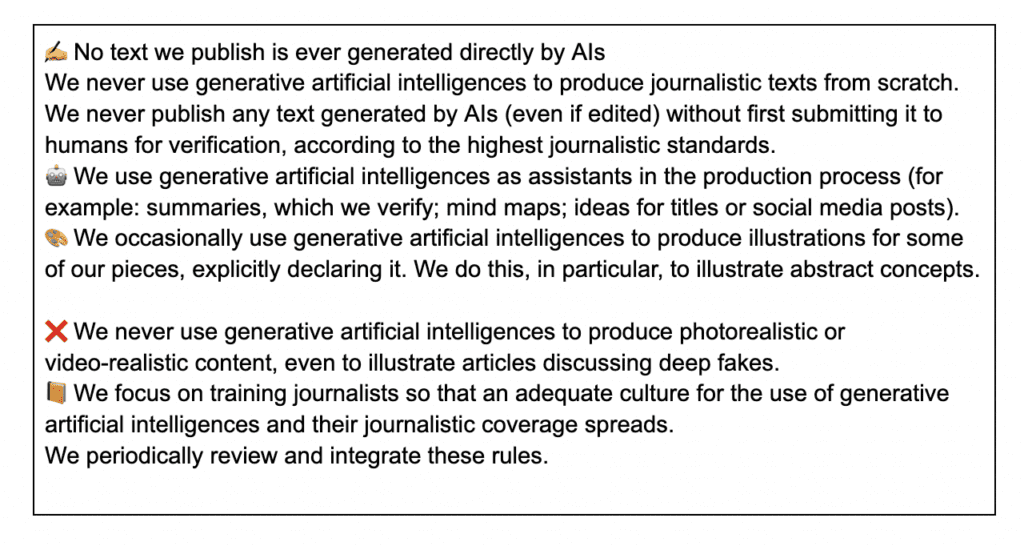
- We have created and constantly update public policies that describe our thoughts on generative AI and how we use it. For example, one of our differences is Wired That is, it uses text-to-image AI on images that show abstract, pictorial, or other descriptive concepts. For transparency reasons, we always indicate that the image was created with the generating software.
- We do not use AI-generated hyper-realistic images or videos for any reason. Unless the image contains accurate and irremovable language such as “AI-generated fake image” directly on the image. That’s because the image moves very quickly. Faster than the whole article. On this subject, Peretti told me: “I think not using this kind of surreal imagery is the only sensible approach. We need to be aware of how the general public consumes our content.” It’s the same thing we’ve been talking about headlines all our lives: we know that most readers only read the title, but we still need the content to attract them and make them click. I use titles that do not represent the We must recognize that we cannot cheat by saying that the
- We have created a shared document for discussion with other editors and colleagues and the public on how to improve our policy. Anyone can participate in the conversation, leave comments, ask questions, or contribute their own ethical, technical, or intellectual contributions simply by using this Google Doc (even anonymously). (translated into English and available to Fix readers). that too).
- We are constantly studying the evolution of these tools and have courses (which, by the way, are also monetization opportunities for our editorial staff) explaining generative AI and how to use it, as well as the various updates it requires. doing. context and the evolution of these technologies.
- We will update the policy whenever necessary or when we feel it is time to do so.
Discussing these topics is essential. The purpose is also to stimulate discussion about finding ways to define and update policies for these tools.
Should we journalists also play a role in media literacy? “I really think so,” says Mattia Peretti. “Perhaps this is my personal bias, but I remain a strong believer in the educational role of journalism. is still left, and it is our responsibility to recognize it.”
Albert Priafit
This work originally appeared in The Fix and is republished with permission.


By the Fix
Our stories aim to shed light on the media itself, business practices and economic trends. Analyze success stories and understand what can be learned from failures.