
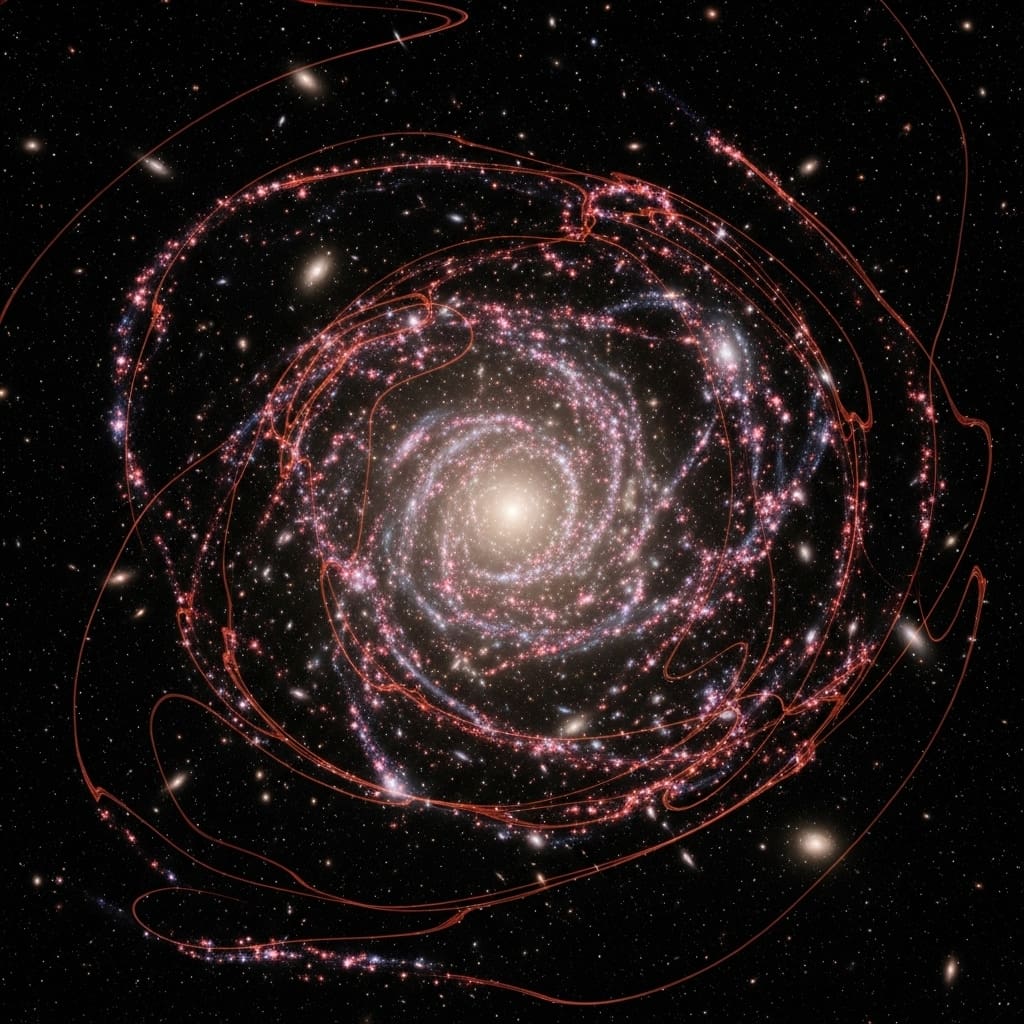
Scientists are grappling with the enormous data challenges posed by the Vera C. Rubin Observatory’s Legacy Survey of Space and Time (LSST) and its potential to unlock the secrets of dark energy and dark matter. Eric Aubourg (Paris Cite University, CNRS, CEA, Astroparticles and Cosmology), Camille Avestruz (University of Michigan), Matthew R. Becker (Argonne National Laboratory), along with Biswajit Biswas, Rahul Biswas, and colleagues, conducted a comprehensive assessment of how to best integrate artificial intelligence and machine learning (AI/ML) into LSST. Dark Energy Science Collaboration (DESC) workflow. This study is important because it goes beyond simply applying AI/ML to critically examining the need for robust uncertainty quantification and reproducible pipelines, which are essential for reliable cosmological results from this groundbreaking investigation. The team will identify key research priorities and explore how new technologies, including large-scale language models, have the potential to revolutionize data analysis if implemented with careful evaluation and governance.
Additionally, scientists are developing physics-based methods to integrate known physical laws into AI/ML algorithms to improve accuracy and generalizability.
Validation frameworks are also central, designed to rigorously evaluate the performance and reliability of these AI/ML tools across a variety of datasets and scenarios. Researchers are actively employing active learning techniques for discovery and strategically selecting the most informative data points for training AI/ML models, maximizing efficiency and minimizing the need for large labeled datasets. This includes careful consideration of the potential biases and limitations inherent in these advanced AI systems. To successfully implement these new methodologies, DESC is addressing critical software, computing infrastructure, and human capital requirements. This collaboration recognizes that processing large LSST datasets and training complex AI/ML models requires significant computational resources. Additionally, the team fosters a collaborative environment to share knowledge, tools, and best practices, ensuring the reproducibility and reliability of scientific results, making DESC an ideal testbed for robust AI/ML practices in fundamental physics.
AI/ML is essential for LSST cosmological probe analysis
Extracting robust cosmological constraints requires methods that provide reliable uncertainty quantification, remain robust to systematic effects and model misspecification, and scale across petabyte-scale studies. Experiments revealed that the same core AI/ML methodologies and fundamental challenges are repeated across different scientific cases within DESC. Results show that advances in cross-cutting challenges benefit multiple probes simultaneously, prompting the identification of key methodological research priorities. Data show that there is a strong emphasis on Bayesian inference, with researchers investigating both explicit likelihood-based and implicit likelihood-based Bayesian a posteriori inference techniques.
This study highlights the importance of addressing model misspecification and covariate shifts, recognizing that these issues can have a significant impact on the reliability of cosmological constraints. Measurements confirm the need for a robust validation framework to evaluate inference results and ensure the trustworthiness of AI/ML-driven analytics. Scientists have documented that hybridization of generative modeling and physical models offers a promising avenue for improving the accuracy and interpretability of cosmological inferences. This breakthrough opens possibilities by combining agent AI systems with new technologies such as data foundation models and large-scale language models (LLMs).
Tests have proven that the underlying model, trained on vast astronomical datasets, can significantly accelerate scientific discovery within DESC. Researchers are investigating training objectives and architectural innovations to optimize these models for specific cosmological tasks, using carefully defined metrics to assess performance. This collaboration recognizes the importance of AI/ML not only for analytical power but also for maintaining the scientific accountability and transparency essential to precision cosmology. The authors acknowledge that there are limitations regarding computational resources, data access, and human expertise required for successful implementation, as well as potential risks related to model misspecification and systematic bias. LSST DESC is intended to build on existing simulation infrastructure and scientific standards and serve as a testbed for developing robust AI/ML practices that can be applied to fundamental physics. Ultimately, this strategy aims to expand the contributions of researchers, improve collaboration, and enhance accessibility within the field, with AI/ML serving as a powerful complement to human expertise rather than a replacement.


