
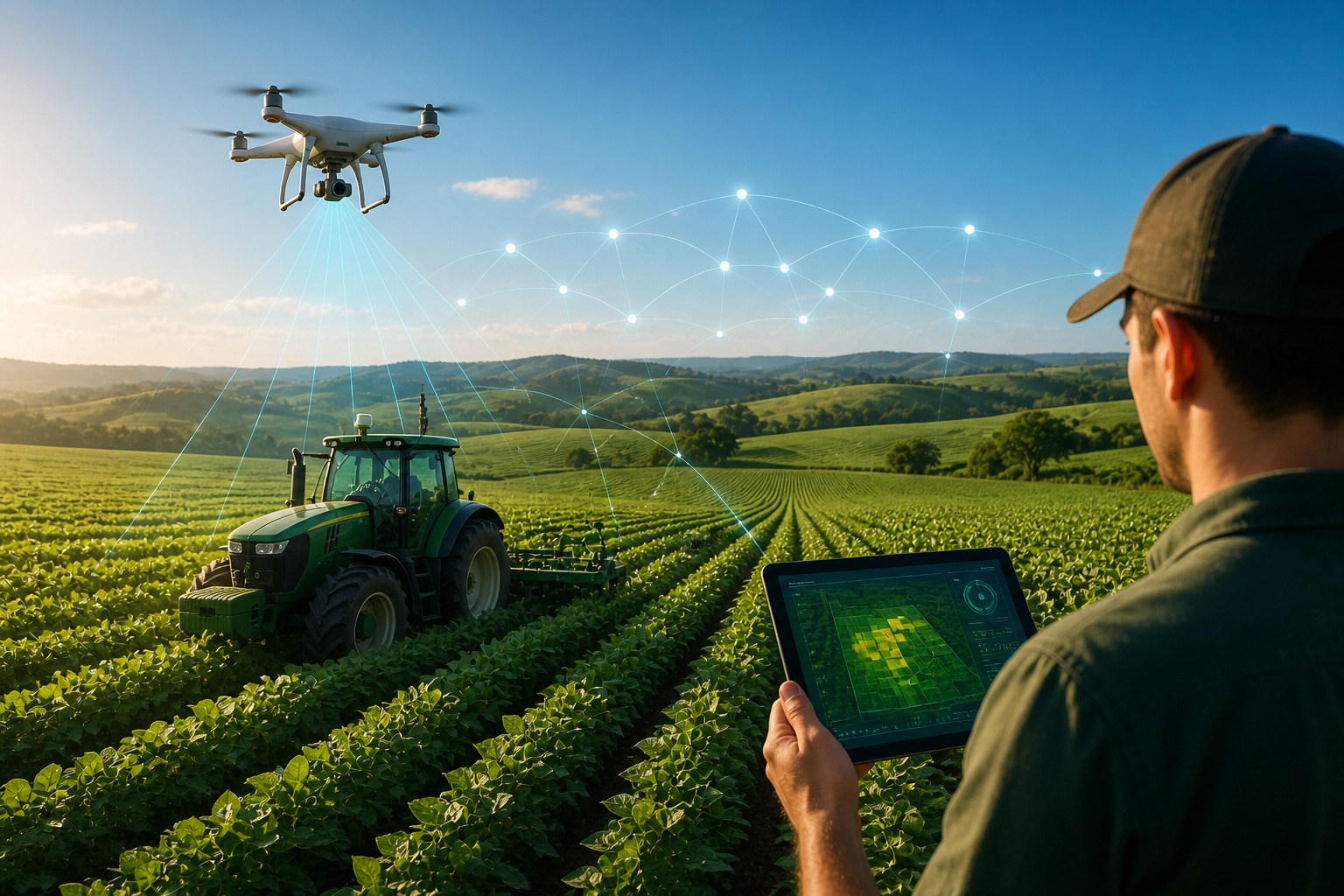
The adoption of AI in Brazilian agribusiness is accelerating significantly, and the state of Paraná stands out as one of the key hubs of this transformation. With the increasing use of drones, smart sensors, and data analysis systems, rural producers are changing the way they plant, monitor, and harvest crops.
This advancement comes as the industry seeks greater efficiency to address challenges such as climate change, rising costs and the need for productivity. In this scenario, AI emerges as a strategic tool that can optimize processes and reduce losses, taking the agricultural sector to a new technological level.
AI enables faster and more accurate decisions in the field
One of the main benefits of AI in agribusiness is its ability to transform data into actionable decisions. Through soil-based sensors, drones, and satellite imagery, growers can monitor the health of their crops in real time.

This information is processed by intelligent systems to indicate the best times to irrigate, apply fertilizer, control pests, and more. As a result, decisions are no longer based solely on experience, but on accurate analysis.
In practice, this reduces waste, improves operational efficiency, and allows producers to use resources more strategically.

Drones and robots automate activities and reduce costs
The use of drones is one of the most prominent applications of AI in this field. Equipped with advanced cameras and sensors, these devices can map large areas in minutes and identify crop failures, diseases, and changes in crop growth.
Additionally, agricultural robots are becoming popular for repetitive tasks such as spraying and monitoring. This automation reduces the need for manual labor in operational tasks and improves the accuracy of actions in the field.
Combined with AI, these devices learn from the data collected and continuously improve performance, resulting in increased productivity over time.
AI increases productivity and reduces crop losses
Another direct impact of AI is increased productivity. By identifying problems before they become critical, the system enables faster and more efficient intervention.
For example, areas with nutrient deficiencies can be treated locally, avoiding wastage of inputs. Similarly, pest control will be more aggressive and cause less damage to production.
This precision agriculture model represents a significant change from traditional practice, where many decisions were made in a generalized manner.
Real-time data usage revolutionizes agribusiness
By integrating various technologies, producers can gain complete visibility into their assets. Weather data, soil conditions, plant growth, and even market forecasts can be analyzed simultaneously.
AI cross-references this information and generates recommendations to help maximize your results. This transforms the field into a highly connected environment, where every decision is based on hard data.
This level of control not only improves productivity but also predictability, allowing for more efficient harvest planning.

Parana State stands out as a reference for agricultural innovation
Paraná has established itself as a benchmark in the implementation of AI in agribusiness. Home to cooperatives and technologically advanced producers, the region has invested in innovative solutions to increase its competitiveness.
Research institutes and technology companies are also playing an important role in this progress, developing tools adapted to the realities of Brazilian agriculture.
This ecosystem is conducive to AI adoption, and the state is an example of how technology can transform the agriculture sector.
AI also contributes to the sustainability of agribusiness
In addition to economic benefits, AI has a direct impact on sustainability. Using inputs more efficiently reduces waste and minimizes environmental impact.
For example, local application of fertilizers and pesticides prevents excessive presence of chemicals in soil and water. This contributes to more responsible agricultural practices in line with environmental requirements.
As pressure for sustainable production increases, AI becomes a key ally in balancing productivity and conservation.
Challenges continue to limit AI progress in the field
Despite progress, AI adoption still faces challenges. The high initial cost of some technologies can hinder access for small-scale producers.
Additionally, rural connectivity remains limited in some areas, impairing the system’s use of real-time databases.
Another point is the need for training. Effective use of AI requires technical knowledge and requires training and adaptation on the part of producers.

The future of agribusiness will become increasingly digital
AI continues to advance in agribusiness, becoming increasingly accessible and integrated into field operations. New technologies are expected to further expand analytics and automation capabilities.
As a result, local producers will leverage data and technology to act more strategically and maximize results. This field is no longer just operational, but a highly technical environment.
This move is in line with the global trend of digitalization of agriculture, driven by the need to produce more with fewer resources.

AI redefines the role of rural producers
With the advent of AI, the role of producers is also changing. They no longer just perform tasks, they now manage information and make data-driven decisions.
This transformation will require new skills, but it will also create opportunities to improve productivity and profitability.
At the same time, technology provides greater control over production, reduces risks, and improves operational safety.
AI establishes itself as a key element in Brazil’s new agriculture
Advances in AI in Paraná state show that the technology is already a reality in Brazilian agriculture. It is not just a trend, but has become an essential tool to address the challenges in this field.
By increasing productivity, reducing costs, and increasing sustainability, AI is establishing itself as a key element in creating a more efficient and competitive agriculture.
This scenario shows that the presence of AI in agribusiness will further increase in the coming years, completely redefining the way the sector operates and develops.


