At Deutsche Telekom's booth at Mobile World Congress, I'm watching a generative AI tool build a custom phone interface to help book flights in real time. It's breathtaking and takes in way too much most of the time, but in a good way.
The technology, now called “T Phone,” is a joint development between the German telecommunications company and San Francisco-based artificial intelligence company Brain.AI.
When Jerry Yue, CEO of Brain.AI, showed us what the T Phone could do, he told the device to book a flight for two in first class from here in Barcelona to Los Angeles on March 12th. I was instructed to do so. The phone pauses for a minute and then displays a neatly arranged list of flights on the home screen. Once Yue finds the perfect ticket, you can pay for it using your mobile payment system of choice, without having to switch to another app or service.
“Today, when we use app systems, we typically have a lot going on in our heads,” Yue said. “Now you can just throw an idea at the AI and have it build the entire flow for you.”
A little more than a year after the era-defining release of ChatGPT, the 2024 edition of MWC is all about the promise of AI. Beyond the hype, the most interesting approaches involve building AI into devices and harnessing their computing power to do exciting new things, some of which are easier to understand than others. It's easy to do.
The concept of T Phone is as follows. Instead of a phone designed around apps that we're used to, this phone uses generative, interactive AI to create a natural experience that helps you navigate tasks. This device has an AI button on the side that launches the AI assistant. Your AI assistant is like your personal genie, waiting to spring into action and execute your commands.
Is it our destiny to live in a world without apps? Tim Hetges, CEO of Deutsche Telekom, certainly thinks so. Speaking at MWC on Sunday, he predicted that phone apps will disappear within the next five to 10 years. His reasoning? The AI is going to kill them.
And his evidence? T phone.
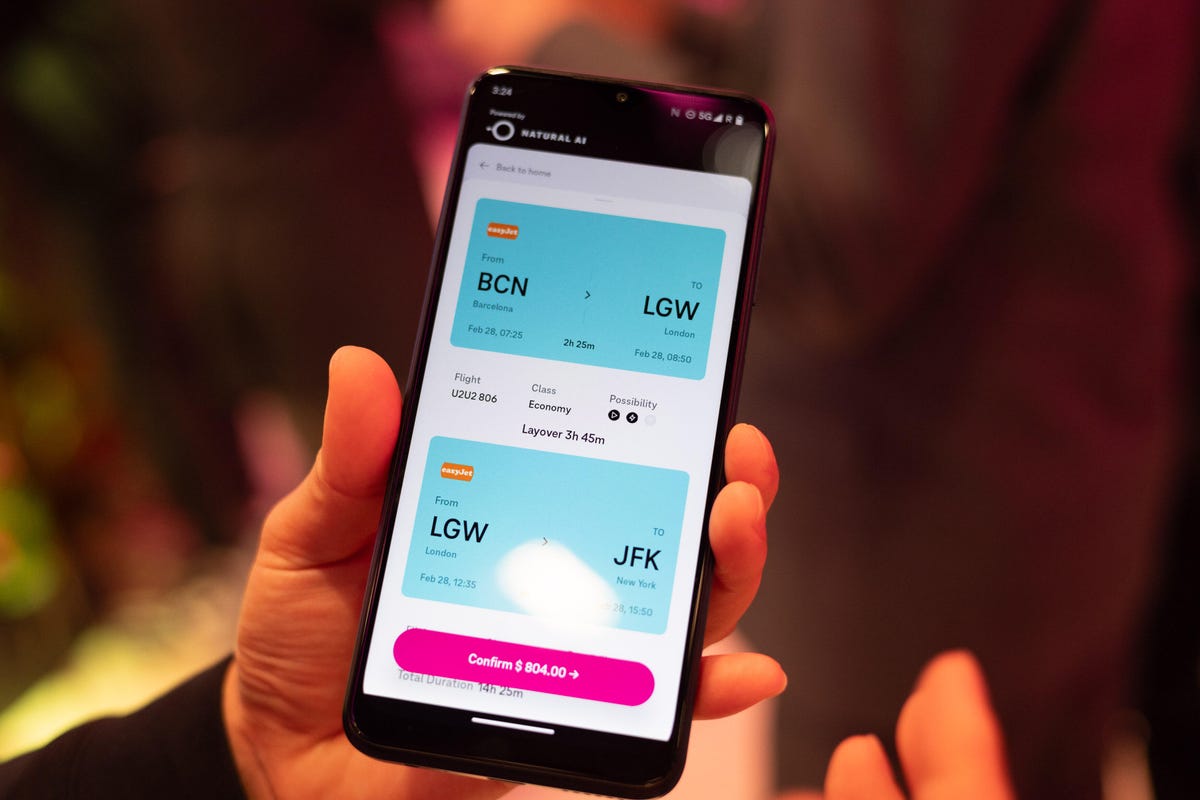
T Phone generated this interface on its own.
AI on the fly
Watching Yue's demo, it's hard at first to wrap my head around the idea that the phone isn't just jumping back and forth between Skyscanner, the browser, and the Amazon app at his request. But instead, it gathers all the information it thinks it needs and places it on the home screen in a display format that it thinks is most useful.
“As you can see, this is like building an interface on the fly based on a contextual understanding of who you are,” Yue says. “Your words generate this interface.”
This is the first time I've seen a phone that works like this, and I'm sure this technology has a long way to go before it actually becomes the default way to interact with your phone, but once you get your hands on it, Seems like it really makes sense. This feels like the most radical rethinking of how we interact with our smartphones since Apple introduced its App Store for iPhone over 15 years ago. Rather than making an app the core of the phone experience, the phone's AI leverages the service's API to determine what tools and information are useful and necessary to respond to a particular command.
The idea is that the technology can work on many different types of phones, including low-cost devices where computing happens in the cloud. However, to run on high-end devices, the AI calculations are done on the phone itself with the help of the Qualcomm Snapdragon 8 chipset. Ziad Asghar, who oversees Qualcomm's AI roadmap, praises his T Phone's ability to compress seemingly easy tasks into one experience for him.
He uses the example of making restaurant reservations, which requires constant switching between Google Maps, Yelp, OpenTable, calendars, and messaging apps. “He would have to use five different applications to do this, but with a virtual assistant-like interface on the device he should be able to do all of this,” he says.
The next step in Yue's demo is to generate a new interface based on the one that T Phone has already generated. “We call it whatever it is,” Yue says. I braced myself for another mess.
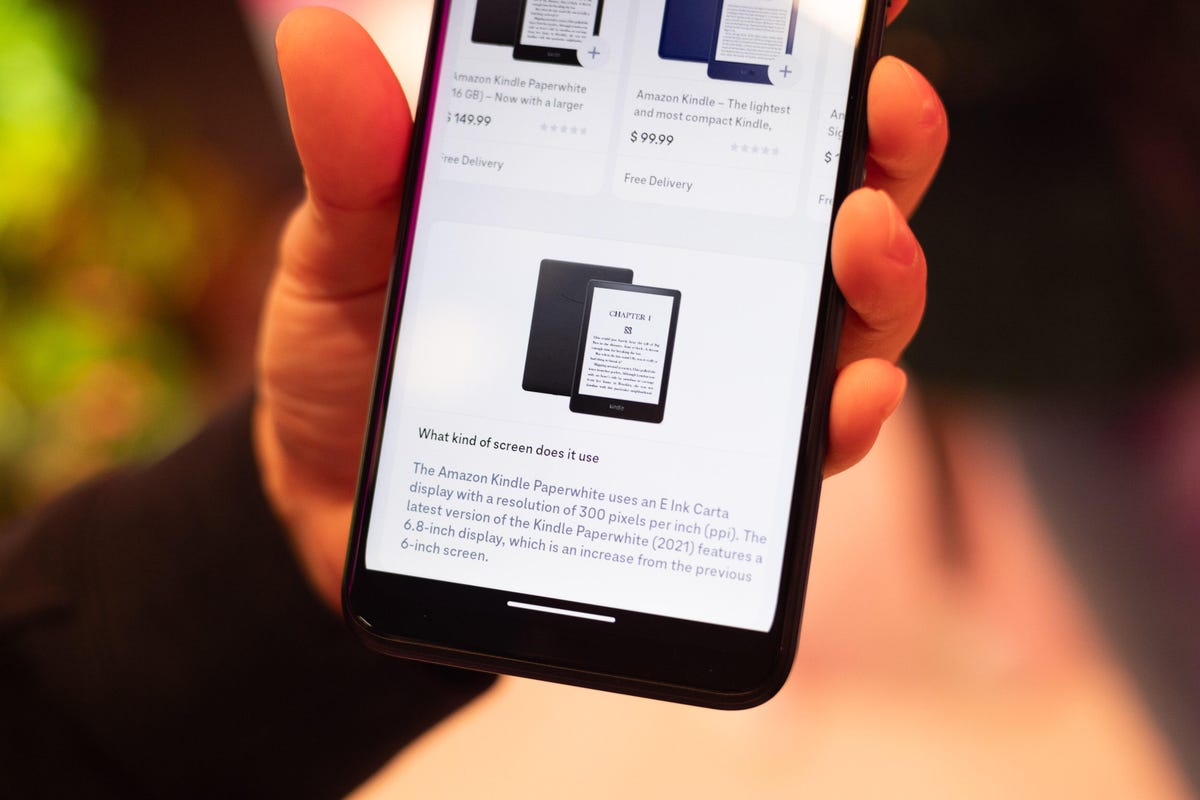
Brain.AI displays recommended products from over 7,000 retailers.
Yue showed me what that meant by thumbing the Kindle suggested in the shopping results and having the T Phone show me an unboxing video. The screen will be split down the middle and her YouTube videos will be displayed in the bottom half. He continues to ask questions like how big is the screen and how does the review compare to similar products? Each time, the interface is regenerated or realigned to match the query. “My thoughts are literally flowing,” he says.
Understood. What seemed so foreign to me when I first explored Yue's vision now feels like a glimpse of what's to come. You can imagine how natural and human it would be to communicate using devices in this way compared to the way we do it now.
Qualcomm's Asghar said, “Generative AI and AI will make our daily lives more productive, removing some of the mundane routine work and perhaps giving us more time to do much more important things. It gives us,” he said.
“This is just the early stages,” he added. “There’s a lot more to come.”
read more: MWC 2024's wildest phones: an edible Razr, a bracelet “phone”, and one big battery