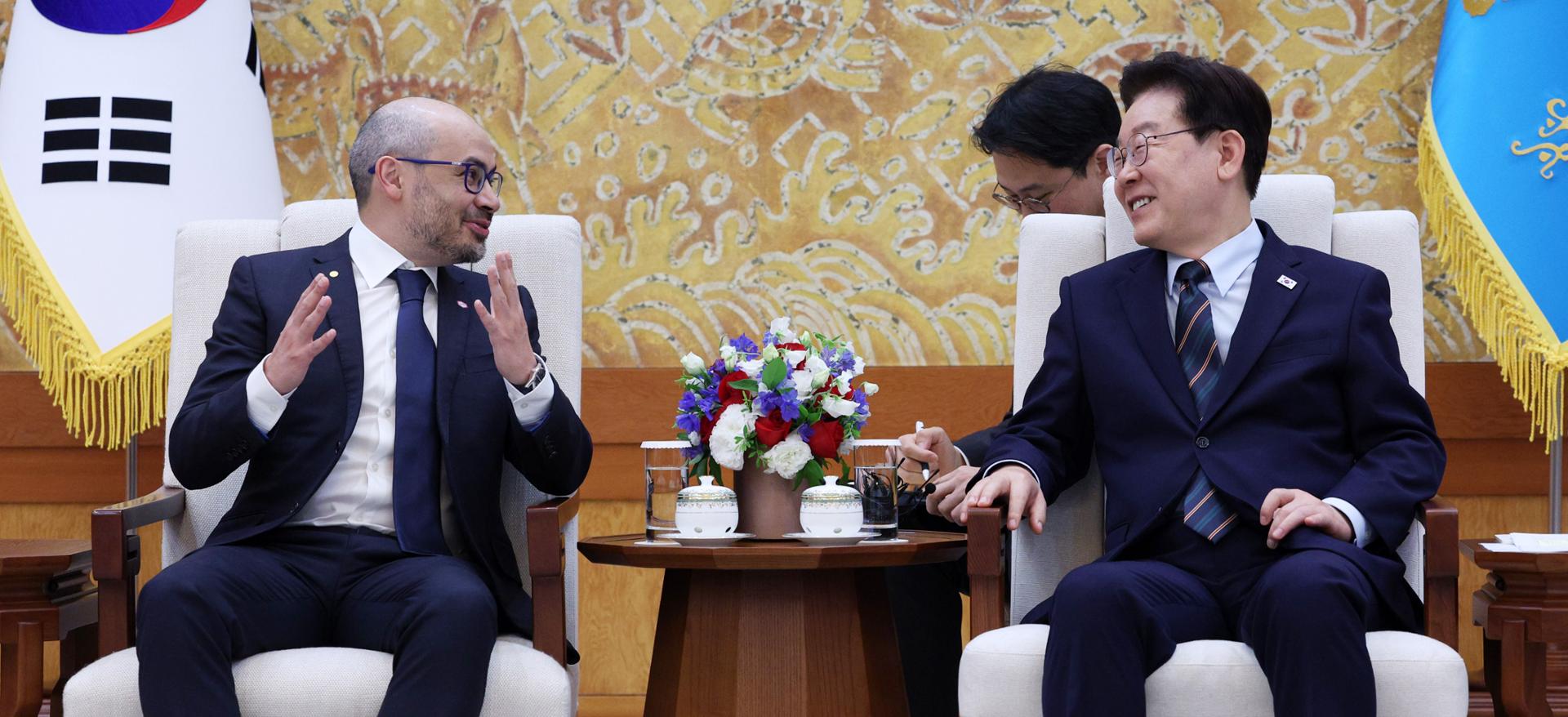

President Lee Jae-myung met with Demis Hassabis, co-founder and CEO of Google DeepMind, at the Blue House in Seoul on Monday. United
The South Korean government announced on Monday that it has partnered with Google DeepMind to expand global cooperation to develop the country’s artificial intelligence (AI) ecosystem and promote the responsible use of related technologies.
According to the Ministry of Science, Information and Communications, the cooperation will help advance South Korea’s “K-Moonshot” project, which brings together AI and scientific capabilities to tackle the nation’s major challenges.
Google DeepMind co-founder and CEO Demis Hassabis visited South Korea on Monday, meeting with President Lee Jae-myung at the Blue House and later that day meeting with Science Minister Bae Kyung-hoon at the Four Seasons Hotel in downtown Seoul, where they signed a memorandum of understanding (MOU).
The meeting took place as South Korea aims to become one of the world’s top three AI powers alongside the United States and China.
“This meeting is an extension of the government’s global AI cooperation efforts and an opportunity to further accelerate policy through collaboration with the world’s leading AI companies,” the presidential office said.
In 2016, Google DeepMind marked the beginning of what is now recognized as the modern era of AI. In this case, Go AI AlphaGo defeated world-class Korean master Lee Sedol 4-1 in the fifth match in Seoul. The game of Go is locally known as “baduk” and the signing ceremony was held at the same venue where the Lee vs. AlphaGo match was held in 2016.
The company then demonstrated the potential of AI applications in science and technology through AlphaFold. Hassabis will be co-recipient of the Nobel Prize in Chemistry in 2024 for his work with AlphaFold, which solved the long-standing problem of protein structure prediction.
DeepMind’s efforts align with the goals of the K-Moonshot project, which aims to use AI technology for the betterment of the country. The government aims to use the project to raise research productivity to the fifth highest level in the world by 2030, and to tackle 12 national missions using AI in areas such as advanced biotechnology, energy, space and semiconductors by 2035.
The memorandum outlined key areas of cooperation, including joint AI research in science and technology, AI skills development, and responsible use of AI.
“If AlphaGo ushered in the era of AI 10 years ago, we are now entering a phase where AI is solving complex scientific and technological challenges and making a tangible impact on people’s lives,” Bae said.
He said the MOU is “an important opportunity for both organizations to collaborate in accelerating AI-driven innovation in science and technology, centered on South Korea’s K Moonshot.”
The minister also expressed hope that the agreement will “facilitate the spread of safe and responsible AI research and best practices.”
“Since the historic AlphaGo match, South Korea has become a very special place for Google,” Hassabis said, according to the ministry.
He explained that Google is taking new steps to expand the frontiers of bioinnovation and weather forecasting, while also working as a partner to help build safeguards to ensure that AI is developed responsibly.
Hassabis was the latest in a line of prominent AI business leaders the president met with, including OpenAI’s Sam Altman, Nvidia’s Jensen Huang, SoftBank Group’s Masayoshi Son and BlackRock’s Larry Fink, as part of efforts to strengthen cooperation and attract investment.