

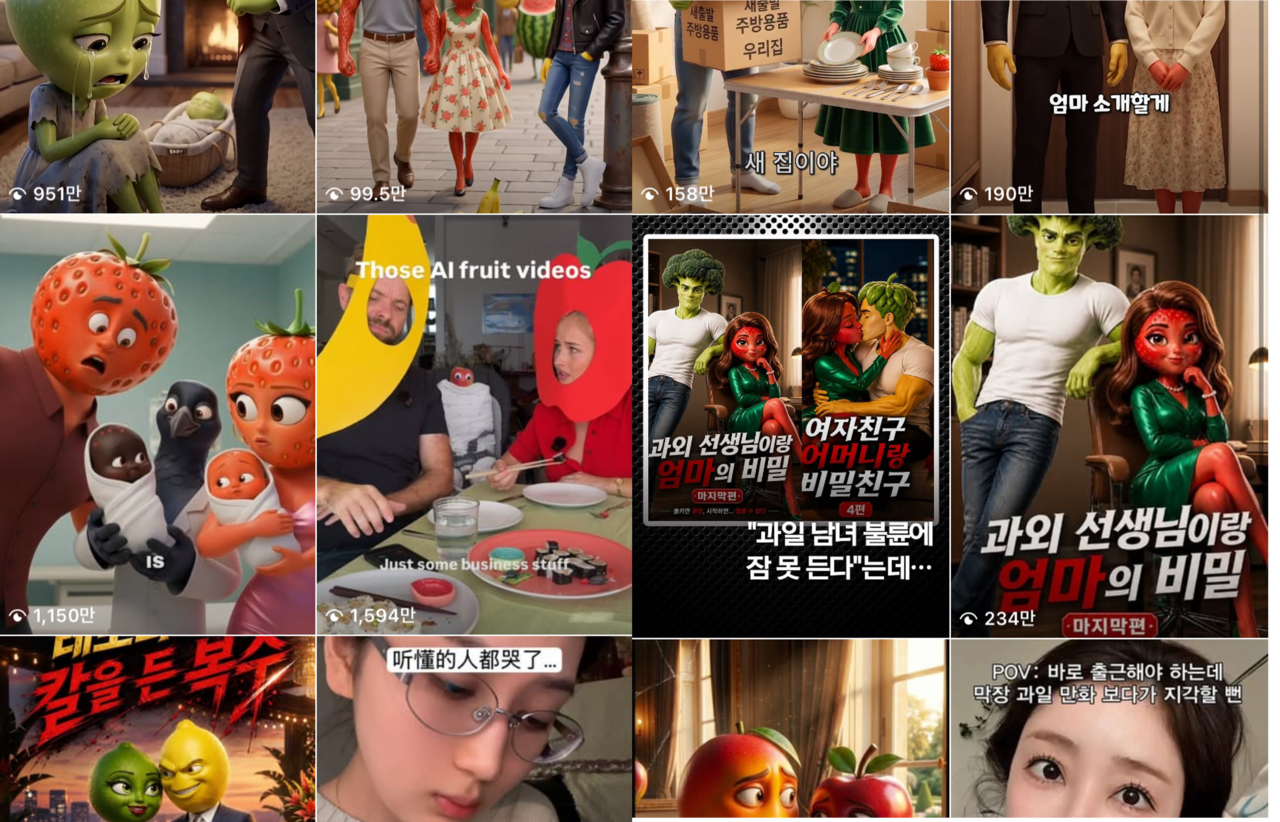
An artificial intelligence-generated video depicting an anthropomorphic fruit caught up in an affair or broken relationship has amassed millions of views on South Korean social media, turning the bizarre melodrama into one of the latest short-form trends.
But the trend is now facing increased scrutiny after a major fried chicken franchise removed the video and apologized after being accused of copying the format in its ads and borrowing from provocative content that is easily accessible to children.
Pelicana, a national chicken franchise, posted an apology on its Instagram account on Saturday after deleting an AI-generated short video depicting a human character with a fried chicken-shaped head engaged in an affair.
In the video, a husband, represented by plain fried chicken, realizes that his wife has been cheating on him with yangnyeom chicken (spicy fried chicken) after his newborn baby is shown covered in sauce. Her husband then falls in love with the brand’s mascot, a pelican, who appears as a doctor in the birth scene.
The company apologized, saying, “The video was posted without due consideration to the appropriateness of expression and social recognition during the production process.”

The ad parodies the recent wave of AI-generated videos in which human-like fruit characters have relationships with other fruits. Many of the works follow a similar plot line, in which the betrayed protagonist is left heartbroken when his partner’s infidelity is discovered after a baby resembling another fruit is born.
The trend first appeared on South Korean social media earlier this year through videos produced in foreign languages, but has recently spread further with Korean subtitles.
Its presence became especially evident in early May, when a search for “adultery fruit” in Korean on social media platforms turned up multiple videos with millions of views.
Many reaction videos and posts describe the provocative plots and images as funny or addictive. Some have expressed their displeasure with the content, as reflected in the criticism of Pelicana’s removed ad.
Some critics are concerned about the atmosphere of misogyny, noting that many of the videos depict female characters cheating on their husbands.
Experts have warned that the animated format makes content more accessible to children, potentially exposing them to sexually or morally confusing storylines. According to the Korean Teachers’ Union, nearly half of elementary school students use smart devices such as smartphones and tablets for more than two hours a day.
Lim Myung-ho, a psychology professor at Dankuk University, told local media that repeated exposure to sensational and unethical content from an early age can affect children’s cognitive and emotional development. He said that youth are formed not only by direct experiences, but also by indirect experiences.
“Parental intervention is needed to limit exposure to unethical social media content, not only between the ages of 6 and 12, when the frontal lobe is actively developing, but also after the age of 14, when the brain continues to develop,” he said.
forestjs@heraldcorp.com

