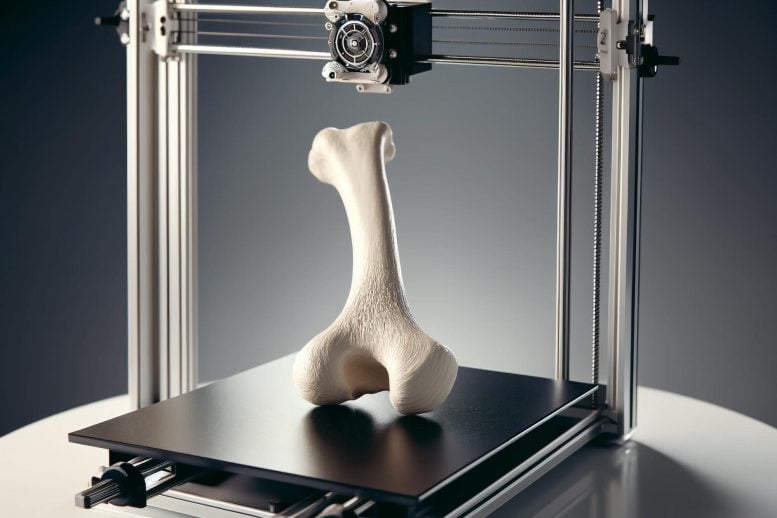
Powered by machine learning and 3D printing, a new synthetic material mimics human bone to improve fracture repair. (Artist's concept) Credit: SciTechDaily
Researchers have developed a synthetic bone-like material. Machine Learning 3D printing technology aims to improve orthopedic care: this new material has the potential to replace traditional surgery, reduce complications and improve healing.
Natural materials such as bone and bird feathers are highly effective at distributing physical stresses despite their irregular structures. However, the precise relationship between stress regulation and their structures has long eluded scientists. In a recent study, researchers used machine learning, optimization, 3D printing, and stress experiments to develop a material that replicates the function of human bone for orthopedic femur repair, revealing insights into this complex relationship.
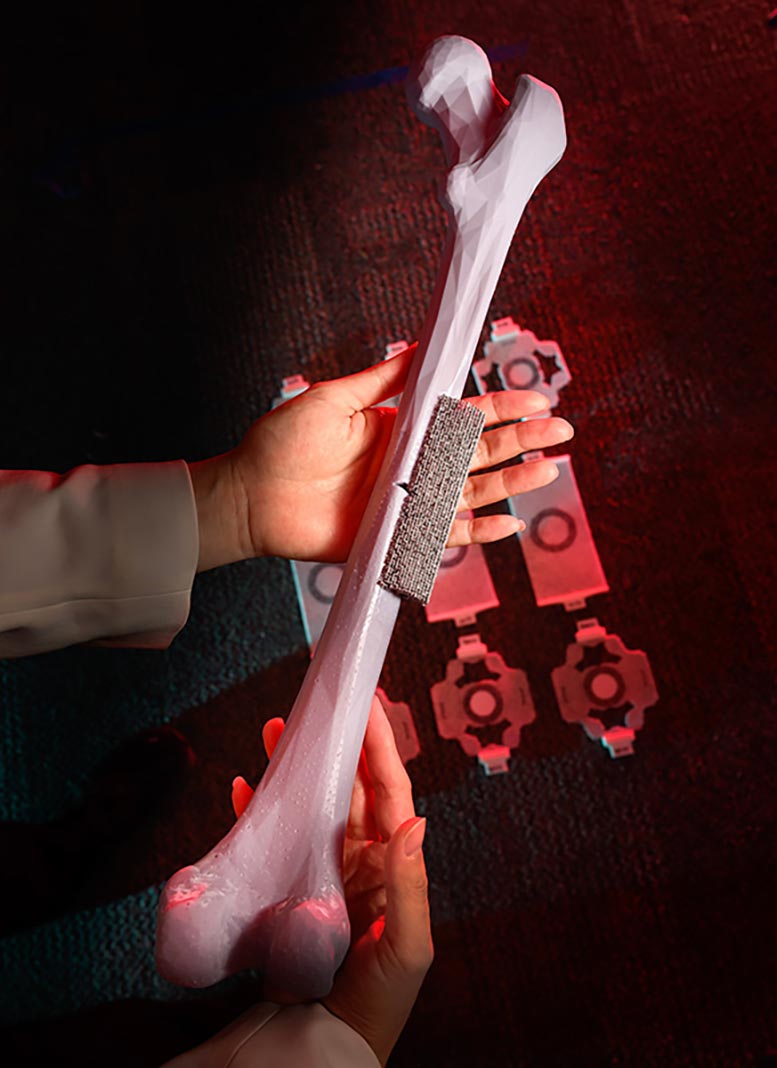
Researchers at the University of Illinois at Urbana-Champaign showed off a 3D-printed prototype of a new bioinspired resin, shown here attached to a synthetic model of a fractured human femur. Photo by Fred Zwicky.
Challenges in femoral fracture repair
Fractures of the femur (the long bone of the thigh) are a common injury in humans, and are more prevalent in the elderly. Broken ends cause stress concentrations at the tip of the crack, making the fracture more likely to be long. The traditional method of repairing femur fractures is usually surgery, where a metal plate is attached with screws around the fracture, but this can lead to loosening, chronic pain, and further injury.
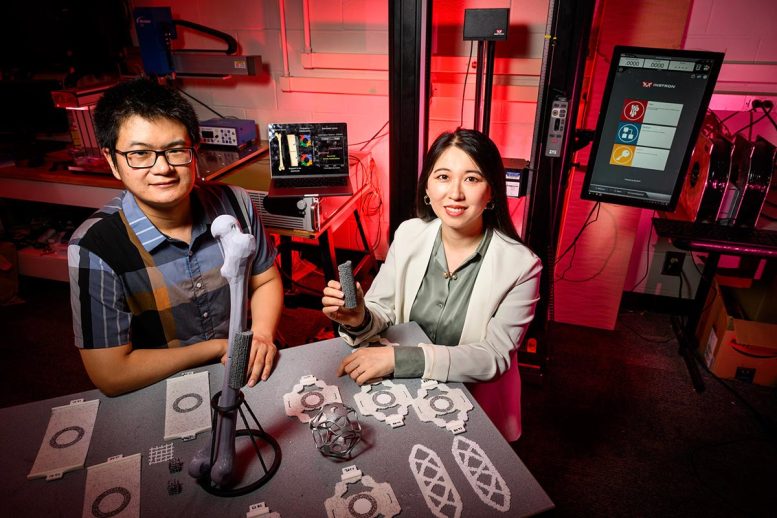
Graduate student Yingqi Jia (left) and Professor Shelly Zhang used machine learning and 3D printing to fabricate a new bio-inspired material that could improve upon traditional methods of treating bone fractures. Credit: Fred Zwicky
Innovative Approaches in Orthopedic Repair
The research was led by Shelley Zhang, professor of civil and environmental engineering at the University of Illinois at Urbana-Champaign, and graduate student Yingqi Jia and professor Ke Liu, both from Peking University. Nature Communicationsintroduces an innovative approach to orthopedic repair that uses a fully controllable computational framework to generate bone-mimicking materials.
“We started with a materials database and used a virtual growth stimulator and machine learning algorithms to generate virtual materials and learn the relationships between their structure and physical properties,” Zhang said. “What makes this work different from previous studies is that we went a step further by developing computational optimization algorithms to maximize both the structure and the stress distribution that we can control.”
In the lab, Zhang's team used 3D printing to create a life-size resin prototype of the new bio-inspired material, which they attached to a synthetic model of a fractured human femur.
Natural materials such as bone, bird feathers, and wood have an intelligent approach to physical stress distribution despite their irregular structures. A new study integrating machine learning, 3D printing, and stress experiments has allowed engineers to gain insight into these natural wonders by developing a material that replicates the function of human bone for orthopedic femur repair.
“The tangible model allowed us to perform real-world measurements, test its effectiveness, and confirm that it is possible to grow synthetic materials in a manner similar to how biological systems are constructed,” Zhang said. “We believe this research will help us build materials that promote bone repair by providing optimal support and protection from external forces.”
Zhang said the technique can be applied to any biological implant that requires stress engineering. “The method itself is very versatile and can be applied to virtually any kind of material, including metals, polymers, etc.,” Zhang said. “What's important is the shape, local structure, and the corresponding mechanical properties, which makes the applications almost limitless.”
Reference: “Bioinspired irregularly structured materials for tuned stress distribution for optimal tissue support,” Yingqi Jia, Ke Liu, Xiaojia Shelly Zhang, May 21, 2024, Nature Communications.
Publication date: 10.1038/s41467-024-47831-2
This research was supported by a David C. Crawford Faculty Scholar Award from the University of Illinois.