
Many of today’s most advanced defense systems, from hypersonic aircraft to nuclear submarines, rely on a special type of material known as a refractory alloy. This class refers to metals that do not melt or weaken even in extreme heat.
Alloys are materials made by combining two or more metallic elements that provide properties that a single metal alone cannot provide, such as increased strength or corrosion resistance. High melting point alloys are based on elements such as tungsten, niobium, and molybdenum, which have the highest melting points of metals.
Their atoms are held together by strong chemical bonds and arranged in a stable crystalline structure that is resistant to deformation even at extreme temperatures. While conventional alloys soften and slowly begin to deform under constant stress, refractory alloys maintain their strength, making them essential for parts exposed to extreme heat, stress, and radiation.
Most of the refractory alloys in use today were designed decades ago. They predate modern 3D printing of metal parts, also known as additive manufacturing, and artificial intelligence.
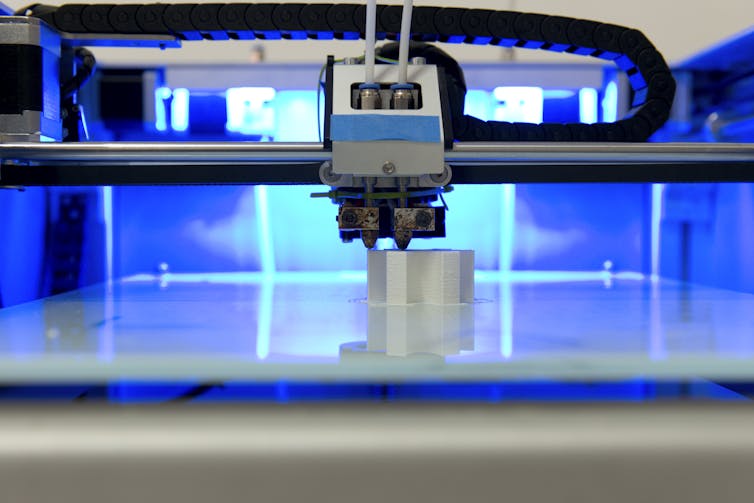
To perform metal 3D printing, a laser or electron beam melts successive thin layers of metal powder.
It builds 3D parts directly from computer models by adding material layer by layer, rather than using molds or removing material from solid blocks. 3D printing also enables shapes that are impossible with traditional manufacturing methods. However, many of today’s high melting point alloys are difficult or impossible to manufacture reliably using these techniques.
This discrepancy could delay the production of new parts in the country. To address these manufacturing and supply chain challenges, a team of materials researchers from Arizona State University and UNSW Sydney has formed a new international collaboration to redesign high-temperature alloys.
Old alloys in a new manufacturing world
Additive manufacturing enables defense and aerospace manufacturers to produce complex components locally, on demand, and with significantly less material waste. In principle, it is ideal for manufacturing replacement parts for aircraft, spacecraft, and naval systems.
In reality, many high-melting point alloys crack, warp, or develop internal defects when 3D printed. Their composition is optimized for casting or forging rather than the rapid melting and solidification associated with laser-based printing. In 3D printing, lasers melt and resolidify metal thousands of times in succession, creating steep temperature gradients and creating huge internal stresses. Some major refractory metals are brittle at room temperature and cannot absorb these stresses without cracking.
Brightstars/Photographers’ Choice RF (via Getty Images)
Redesigning these alloys using traditional trial-and-error methods would take decades.
Teach a computer to design new metals
Our alternative approach uses reinforcement learning, a form of artificial intelligence best known for training computers to master games like Go and Chess.
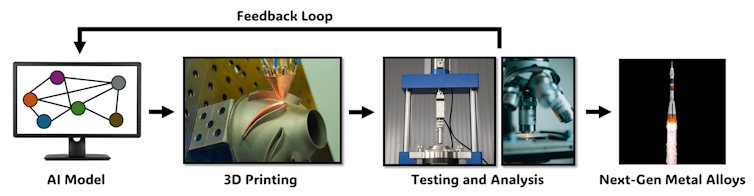
Designing new alloys is similar to mixing ingredients for a recipe, but at the atomic level. Rather than planning moves on a board, the AI system explores thousands of possible alloy recipes, including different combinations of chemical elements. Even small changes in ingredients can completely change the behavior of the final material.
AI virtually evaluates each candidate against multiple criteria, including strength at temperatures above 1,800 degrees Fahrenheit (1,000 degrees Celsius), resistance to damage caused by reaction with oxygen at high temperatures, weight, cost, and, importantly, whether it can be reliably 3D printed.
Vitor Rielli
Alloys that should perform well are rewarded, while those that fail are discarded. As the cycle repeats, the system learns which chemical combinations are most effective.
The most promising AI-designed alloys can then be manufactured and tested in the laboratory. Real-world performance is fed back into the model to steadily improve predictions.
Strategic benefits beyond the lab
The significance of our research extends beyond the laboratory.
For defense agencies, faster materials development means faster deployment of next-generation engines, hypersonic vehicles, and thermal protection systems. AI-designed alloys can optimize strength, heat resistance, and manufacturability. For example, NASA’s GRX-810 alloy, designed using computational methods and 3D printed, is 1,000 times more durable at high temperatures than traditional alloys.
While traditional refractory metal manufacturing wastes up to 95% of raw materials due to machining that removes unnecessary material to create precise shapes, 3D printing can bring that number closer to zero.
Our work is international cooperation. Arizona State University focuses on AI-powered computational design. The UNSW Sydney facility enables high-temperature testing by observing the microstructure of metals and performing additive manufacturing under realistic conditions.
Challenges continue
This approach is not without hurdles. One of the biggest is the lack of data. AI models learn from existing experimental results, but for high melting point alloys, that data is limited. Compared to more common materials such as steel and aluminum, far fewer alloys of this class have been systematically tested.
There are also practical constraints. Refractory metal powders suitable for 3D printing are expensive and difficult to obtain, making it difficult to scale up from small laboratory samples to full-size components. An alloy that works well as a thumbnail-sized test sample may behave very differently when printed as a large, complex part.
Finally, AI predictions always need to be verified experimentally, which is costly and time-consuming. This system does not eliminate the need for rigorous physical testing.
A new model for defense-focused research
Our collaboration is in its early stages. We are currently building an AI model and assembling an experimental database to use for training. The first alloy composition candidates will be selected for 3D printing and laboratory testing later this year. The results are fed back into the model.
We also work with defense research agencies to ensure our research is aligned with real-world needs and lay the foundation for larger programs.
In an era where technological advantage increasingly relies on speed and adaptability, rethinking how the metals behind defense systems are designed can improve the systems themselves.