

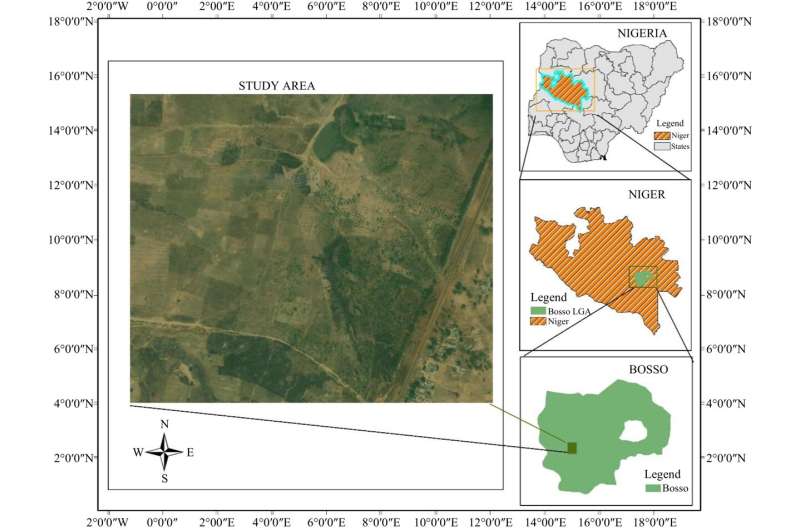
Study area, Garatu Mina, Niger State, Nigeria. Source: Technology in Agriculture (2024). DOI: 10.48130/tia-0024-0009
The research team investigated the effectiveness of AlexNet, a derivative of an advanced convolutional neural network (CNN), for automatic crop classification using high-resolution aerial imagery from UAVs, and the results demonstrated that AlexNet consistently outperforms traditional CNNs.
This study highlights the potential of integrating deep learning and UAV data to enhance precision agriculture, highlights the importance of early stopping techniques to prevent overfitting, and suggests further optimization for broader crop classification applications.
The world's population is projected to reach 9 billion by 2030, resulting in a significant increase in food demand. Currently, natural disasters and climate change are major threats to food security, and timely and accurate crop classification is necessary to maintain sufficient food production. Despite advances in remote sensing and machine learning for crop classification, challenges remain, such as reliance on expert knowledge and information loss.
Research paper published in Technology in Agriculture The study, which will begin on May 28, 2024, aims to evaluate the performance of AlexNet, a CNN-based model, in classifying crop types in small mixed farms.
In this study, we employed AlexNet and traditional CNN models to evaluate the crop classification efficiency using high-resolution UAV images. Both models were trained with hyperparameters such as 30-60 epochs, learning rate 0.0001, and batch size 32. AlexNet with a depth of 8 layers demonstrated superior performance, achieving a training accuracy of 99.25% and a validation accuracy of 71.81% in 50 epochs.
In contrast, the 5-layer CNN model reached the highest training accuracy of 62.83% and validation accuracy of 46.98% in 60 epochs. AlexNet's performance slightly degraded at 60 epochs due to overfitting, highlighting the need for an early stopping mechanism.
The results show that although both models improve with increasing epochs, AlexNet consistently outperforms traditional CNNs, especially in handling complex datasets and maintaining high accuracy levels.
This suggests that AlexNet is suitable for accurate and efficient crop classification in precision agriculture, although care should be taken during long-term training to mitigate overfitting.
“Given the observed overfitting, we strongly recommend implementing early stopping techniques as demonstrated for 50 epochs in this study, or optimizing the performance of AlexNet by modifying classification hyperparameters whenever overfitting is detected,” said Oluibukun Gbenga Ajayi, lead researcher on the study.
Future research will focus on extending AlexNet, optimizing preprocessing, and refining hyperparameters to further improve crop classification accuracy and support global food security efforts.
For more information:
Oluibukun Gbenga Ajayi et al., “Optimizing Crop Classification in Precision Agriculture Using AlexNet and High Resolution UAV Imagery” Technology in Agriculture (2024). DOI: 10.48130/tia-0024-0009
Courtesy of the Chinese Academy of Sciences
Quote: Advanced Deep Learning and UAV Imagery Boost Precision Agriculture for Future Food Security (July 17, 2024) Retrieved July 17, 2024 from https://phys.org/news/2024-07-advanced-deep-uav-imagery-boost.html
This document is subject to copyright. It may not be reproduced without written permission, except for fair dealing for the purposes of personal study or research. The content is provided for informational purposes only.


