Software for the past decade has been built to get attention. The next decade will be built on giving it back.
There’s a quiet energy among Silicon Valley’s top builders right now. A pull towards simple, almost analogue experiences. Still, these products are more capable than ever.
Look at ChatGPT. It is one of the fastest growing consumer products in history. Really, what? Blank field and cursor. The interface is almost non-existent. But the underlying power is one of the greatest advances in computing we’ve ever seen.
The deeper we understand AI, the more extreme this pattern becomes. AI agents make calls, schedule appointments, and negotiate, but we never see them move a cursor or fill out a form. Their power is completely invisible. Claude, Devin, Alice, etc. so much so that you have to give them personas to understand what they’re capable of.
Hardware is also trending in this direction. OpenAI is reportedly developing a pocket-sized, context-aware, and possibly screenless consumer device.
The philosophy of creating great products is changing. We’re not literally saying that the next wave of startups will be screenless (though it might be possible). In other words, we are moving towards products that have the “magic” of being able to set them up and use them out of the box. software got it. These tools are almost relaxing to use.
The most advanced AI companies at the app layer are demonstrating an important realization that next-generation products won’t win by attracting attention. They will win by removing their need for attention all together.
That’s a big change. It will change the way success is measured. It will change the way we work. It will surely change society. This article explains what this philosophy means and where it comes from. In my next post, I’ll dig deeper into the tactics of how to build within this new modality.

Technology tends to become invisible over time
Technology tends to become less visible over time.
In 2014, the Harvard University Innovation Lab created a beautiful illustration of this idea. The video opens at a 1980s office desk filled with computers, calendars, fax machines, and more. Over time, each element of the desk disappears and rejoins the desktop as an app.
We are already on this trajectory. Technology is becoming easier to use, and the level of friction we encounter today is incredibly low thanks to technology. (Economic areas where very low friction exists, the so-called “Lagging” industries are some of the best places to Build your startup with AI).
Invisibility begins with simplicity.
Simplicity x power is the secret to successful products. This was true even before the AI era. Google has broken the cluttered portal wars by building a very simple homepage on top of an innovative and very powerful search engine.
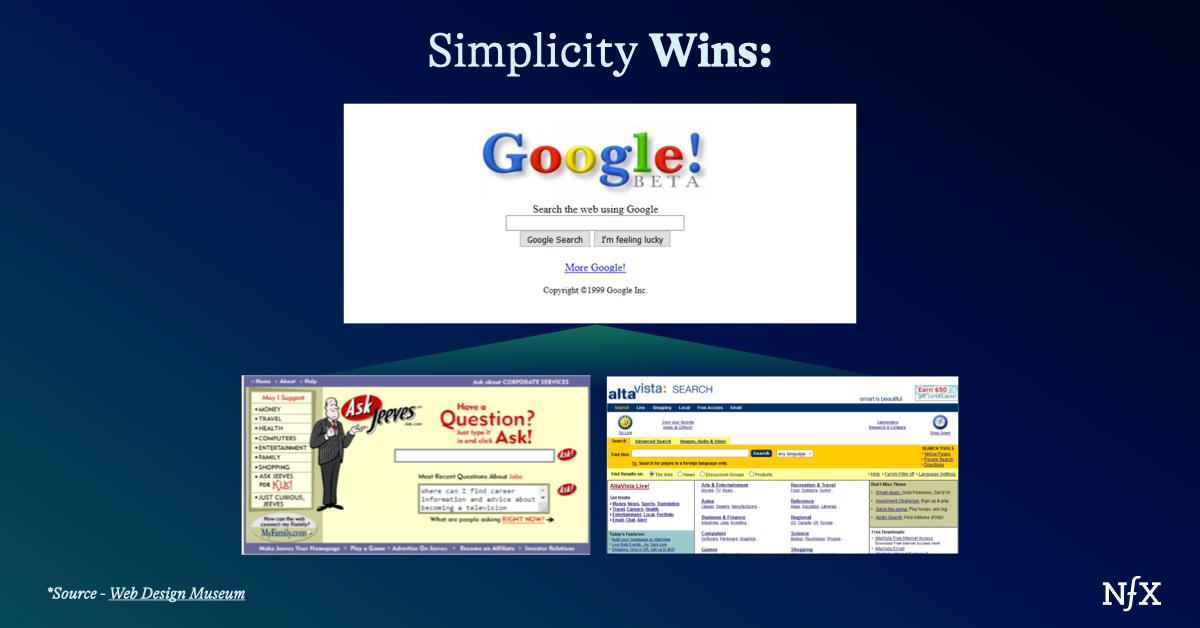
AI allows us to take this even further. It’s about thinking very fundamentally about how to design product experiences that are truly vanishingly simple.
why? Because AI is the first time that software can actually perform complex actions without human supervision.
Building invisible technology
So how can we use AI, or even software, to restore attention? The history of Silicon Valley actually gives us a roadmap.
In 1991, Mark Weiser, who would become known as the “Silicon Valley Philosopher,” wrote about the coming era:calming technology” His vision is of technology receding into the background of life rather than demanding the foreground.
Mr. Weiser outlined four principles:
- The purpose of computers is to help others
- The best computers are silent, invisible servants
- Computers are supposed to expand your unconscious mind
- Technology should create tranquility
He imagined that we were entering a “third wave” of computing. From mainframes to personal computing (where people and machines “look anxiously at each other across the desktop”) to ubiquitous computing, where technology disappears.
Steve Jobs visited Xerox PARC in 1979 and saw some of this vision. The iPhone was an attempt to free us from our desks. However, even Mr. Jobs could not completely escape the second wave. We simply replaced our desktop with another screen, now one that follows us wherever we go. Attention taxes remain high.
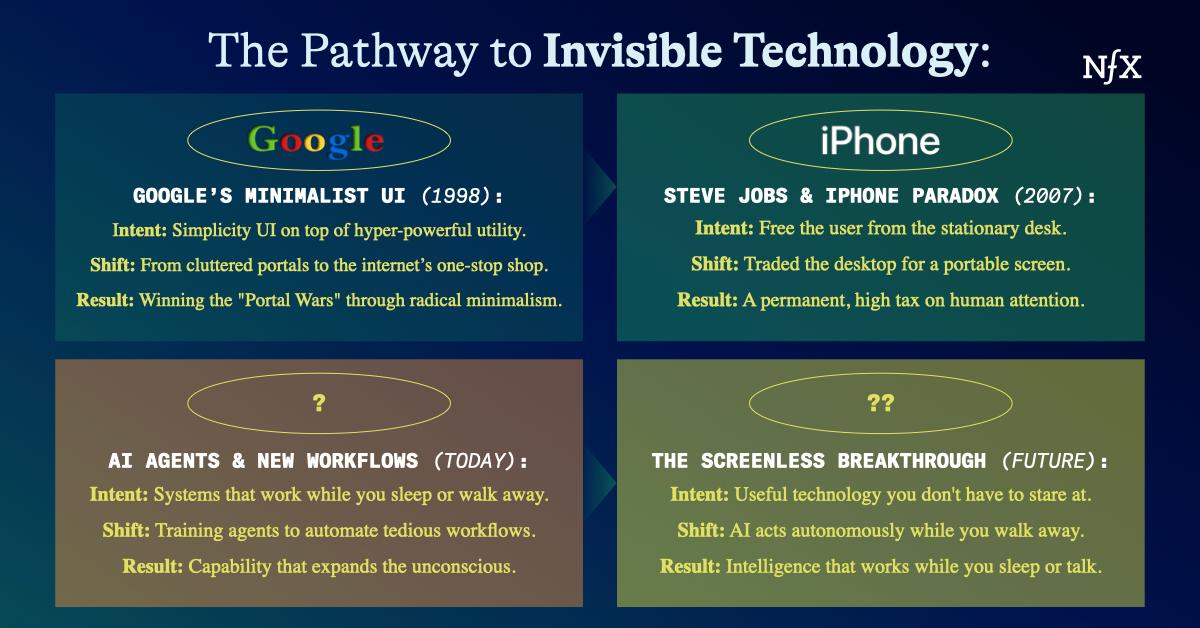
AI can take action, ultimately making Weiser’s vision a reality. while you leave. You can hear it in the background of the conversation. Information can be collected in real time. You can work even while you sleep. For the first time, we have technology that you can use without really having to look.
As the intelligence does its work, the interface will eventually become nothing, just blank fields and voice commands, and eventually there may be no interface at all.
An important caveat to consider with the rise of these technologies is privacy. The advantage of ambient computing is that it does not require continuous monitoring, but the trade-off is that users have limited opportunities to opt out. Many founders building in this space are well aware of this, and in most cases this may not be as big of an issue as it seems.
This is still early. Most founders aren’t building this way yet. But good people can feel it. They are designing capabilities that expand the unconscious rather than colonize it. It’s a philosophy, not a form factor.

Build products so good they disappear. They are so smart that you don’t need to monitor them. It’s so valuable that people choose it not because they can’t look away, but because they can finally look up.
Complexity migration
As products become simpler and less visible on the surface, the complexity of what they can do underneath increases.
The iPhone eliminated dozens of physical devices. Suddenly, our most basic needs could be met with a single device. What appeared? We started doing things that were much more complex than before. We broadcast ourselves to millions of people. We run our business with pocket money. Stream concerts from around the world and instantly send them to friends.
The pattern: When technology takes care of the invisible and simple things, there is an upward shift in human capabilities. We take on more complex ambitions. We spend our cognition on higher order problems.
AI will accelerate this pattern to never-before-seen extremes.
Imagine what would be possible if you no longer had to monitor technology.

A company you can build with a team of AI agents working around the clock, without your direct supervision. You decide the direction. they run. You review. they repeat it. The complexity of running a company remains, but the tedium of management disappears.
Time in the car during non-driving trips turns into hours of deep work, deep rest, or deep conversation as AI handles tasks that previously required hands and eyes.
Learning becomes even more complex when we have a system that tailors the perfect curriculum to precise knowledge gaps and delivers it at the most receptive moment. The complexity of mastering a discipline remains, but the inefficiency of random learning is eliminated.
This is not about removing friction to make humans lazy, as many fear with the rise of AI. Friction for the sake of friction doesn’t help anyone. It drains resources and provides little or no return on investment. But properly applied friction leads to progress and learning when tackling complex problems.
By removing friction, you can try more difficult things. Don’t struggle with boring things.
Gentle technology’s dream wasn’t about spending more time in front of a screen. It was about creating a system that expands your unconscious mind and allows you to continue whatever you’re doing before the phone goes off.
It becomes possible when a product stops attracting attention and starts expanding its functionality.
Products that are “like taking a walk in the forest”
Imagine Founders Day in 2028.
When she wakes up, the AI has already prioritized her nightly messages, flagging three that need her attention, drafting responses to 12 others, and scheduling two calls based on the availability she negotiated with the other party. She never opens her emails.
She has conversations about AI and product roadmaps during her commute. User feedback, competitor moves, and technical constraints have already been analyzed. Ask clarifying questions. By the time she arrives, a draft strategy document will be waiting. She spends 20 minutes refining key ideas. The AI spent 3 hours doing everything else.
She also regularly attends investor meetings. No laptop. There are no notes. The AI listens, remembers everything, and connects this conversation with relevant context from the other 40 conversations she’s had this month. Then update your CRM, send follow-ups, and adjust your fundraising strategy based on the signals you detect.
Technology is invisible. But her company is moving at a pace that was unimaginable even five years ago. With more mental space, she was able to make better decisions. She’ll be less stressed because she won’t be drowning in notifications. She participates more actively in every conversation because she’s not trying to remember everything.
The complexity of forming a company has not changed. In fact, it is increasing. She’s trying something even more ambitious than before. but, attention tax It has collapsed.
That is the world we are aiming for. There is more information and possibilities than ever before, and the psychological impact is becoming less and less. And even though technology is having an ever-greater impact within the company, our interactions with other colleagues, partners, and tools are all actually more human.
“A walk in the woods can give you more information than any computer system,” Weiser wrote. scientific american “But people find a walk among trees relaxing, but computers frustrating. If we had machines that fit into our environment, rather than humans forcing us into it, using a computer would be as refreshing as a walk in the woods.”
Technology is always moving in an invisible direction. AI completes the pattern. Make technology invisible empirically.
The power is there. His abilities are extraordinary. And for the right founder, everything is in place.