Misinformation about Japan’s growing anti-immigration stance is spreading across the region, with the latest example emerging in a South Korean post purporting to be an AI-generated video of Muslims praying on a crowded train in Japan. Experts said the supposed prayer scene was inconsistent with authentic Islamic prayer practices.
A Korean-language post shared on local online forum Bobe Dream on April 1 reads, “The latest sight of Muslims riding on Japan’s subway trains.”
The post includes a clip of a group of men, mostly wearing long tunics and skull caps, performing what appears to be a Muslim prayer on a moving subway train. They are tightly surrounded by passengers sitting on both sides of the vehicle.
The two men knelt on the floor, their heads bowed deeply on the small mats placed in front of them, their heads almost touching the knees of the passengers in front of them. Another person stands and bends forward at the waist, while the other person remains upright with his eyes closed.
Screenshot of incorrect post taken on April 16, 2026, with AI label and red X added by AFP
Anti-immigration sentiment is on the rise in Japan, with Prime Minister Sanae Takaichi coming to power pledging to tighten regulations on foreigners, while the far-right Japan First party, Sankokuminto, also made strides in recent elections (archive links here and here).
Misinformation surrounding Muslim-friendly policies has also flooded some Japanese local governments with complaints. For example, a tourism campaign to attract Muslim tourists to Aichi Prefecture was misrepresented as an immigration policy (archive link).
Japan’s Kitakyushu city also received complaints after inaccurate claims it was planning Muslim-friendly school lunches (archive link).
Posts of Muslims praying on subway cars in Japan have gone viral in South Korea, fueling anti-Muslim sentiment in some online spaces, particularly among conservative evangelical church groups.
In 2023, local residents staged months of protests against the construction of a mosque for Muslim students in Daegu, with some opponents calling the students “terrorists” and organizing a pork barbecue near the site (archive link).
The video was also shared in multiple languages including Chinese, Japanese, English, and Italian.
Comments indicate that some users believe the claim.
“Muslims never just come, they always take over!” said one.
“Go back to your country! This is Japan!!” another person wrote.
However, the video was generated by AI, and experts said the prayers shown in the video were inconsistent with actual Islamic customs.
visual discrepancy
An analysis of the clip found visual errors, including parts of the subway handle and overhead compartment disappearing and reappearing.
Screenshot of incorrect post with visual error highlighted by AFP
Passengers appear to merge with the seat rails, creating a distorted overlap, while other passengers appear to sit in areas where there would normally be no seat, such as directly in front of the door.
The images in the ads also look blurry and weird.
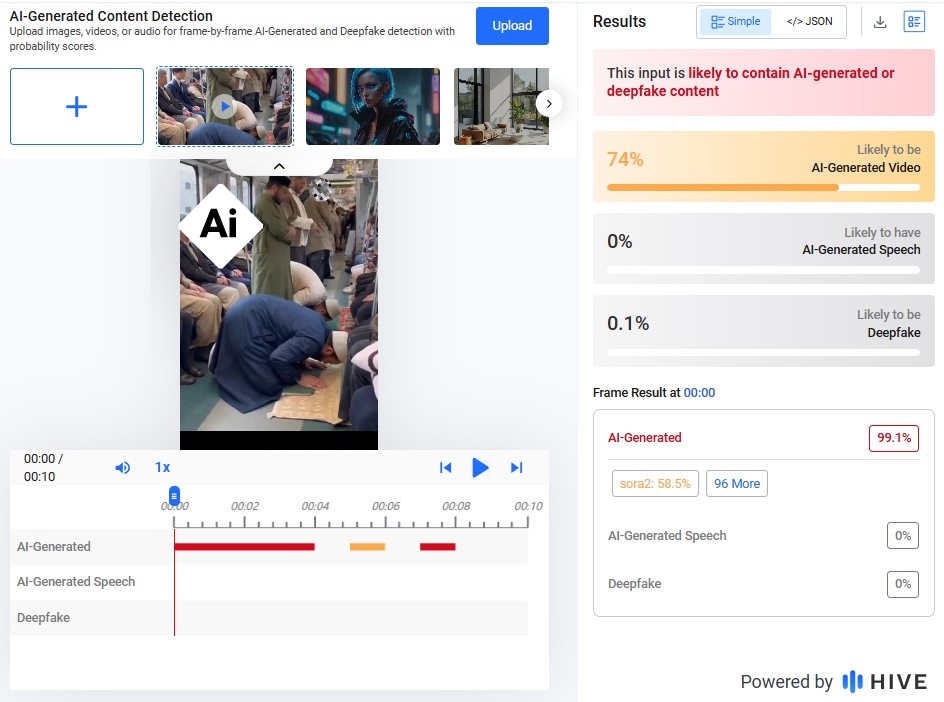
Analysis using the Hive Moderation AI detection tool found that this video “may contain AI-generated or deepfake content” (archive link).
Screenshot of Hive moderation analysis results
“That’s completely wrong.”
Experts said the video also incorrectly depicted how Muslims pray.
Kwon Seung-il, vice president of the Islamic League of Korea, told AFP on April 14 that “the way the people in the video pray and where they pray seem completely wrong.”
“This video appears to have been created by someone who doesn’t know much about how actual Muslims pray.”
He said that, unlike typical prayer movements, the two men in the video bowed their heads three times instead of twice, and did not lower their heads so much that their foreheads touched the ground when they prostrated themselves.
Kim Jong-myung, director of the Middle East Studies Institute at Seoul’s Myongji University, also said it was “totally unprecedented” for Muslim worshipers to prostrate to others, as depicted in the AI-generated video (archive links here and here).
He told AFP on April 13 that the gesture signifies submission to Allah alone and is generally forbidden in Islam.
Kim added that it is “extremely rare” for Muslims, who are required to pray in the direction of Mecca in Saudi Arabia, to pray while traveling on public transportation. A notable exception is on planes, where Muslim passengers are often given directions to Islam’s holy sites, he said.
AFP has previously debunked misinformation about Japan’s stance on immigration.