Traditional wet-lab scientists working on target discovery, drug identification, and drug optimization have the opportunity to catch up with their AI-enabled colleagues, but why and how? In this article (the third of a three-part series), Dr. Raminderpal Singh discusses the decisions that need to be made and the potential risks. The key is to start with a data strategy.

Early stage biotech companies are focused on surviving until wet lab and animal testing data is generated to make investors happy. Many biotech CEOs and CSOs are asking, often skeptically, whether computational (dry lab) methods can get the data they need faster and cheaper. Algorithms can replace some of the wet lab workflow and help reduce the number of experiments by qualifying and prioritizing experiments to be performed by contract research organizations (CROs).
Biotech teams do not always have bioinformaticians with experience in data processing, and while this experience is valuable and helps understand the work required and the nature of the data, it is also risky, as knowledge of AI techniques and availability of vendor tools are often limited. Additionally, biotech companies have relatively little funding available for computational tools, so investments are often aimed at short-term wins, such as Python scripts that ingest research datasets and output interesting correlations. Often a nice-looking graph plot is helpful, which indicates the need for a broader approach.
However, whatever approach is adopted, it may take a long time to reach the conclusion that the data is insufficient for even simple analysis. Initial investments should be focused on a data strategy, i.e., understanding and developing the quality and usefulness of wet lab (and/or animal) data.
See below for some recommended first steps:
- Assess data quality and usefulness and develop a data building and purchasing strategy. This will require some knowledge of AI/statistical methods as this will affect the usefulness calculation, but this knowledge can be obtained from an experienced advisor.
- Build a 6-12 month computational strategy that leverages current data and planned new data. Actively consider paying for datasets and tools, and also open source software if you have the software skills in-house. Each phase of your strategy should be targeted to help answer the key scientific questions investors expect.
The key is to take some risk as you take these steps – you're already taking some risk with your wet lab analysis – and use this opportunity to build relationships with data partners, tool vendors, and the life science data science community.
In addition to the above considerations, Large Language Models (LLMs) enable you to do a lot of things quickly, but their use in GenAI is nuanced and their value unpredictable. Also, LLM providers train their systems with your search terms and ultimately share your search terms with other users. We'll discuss practical ways to get around these constraints and use LLMs to create practical value in the next post in this series, published on Monday, June 24th.
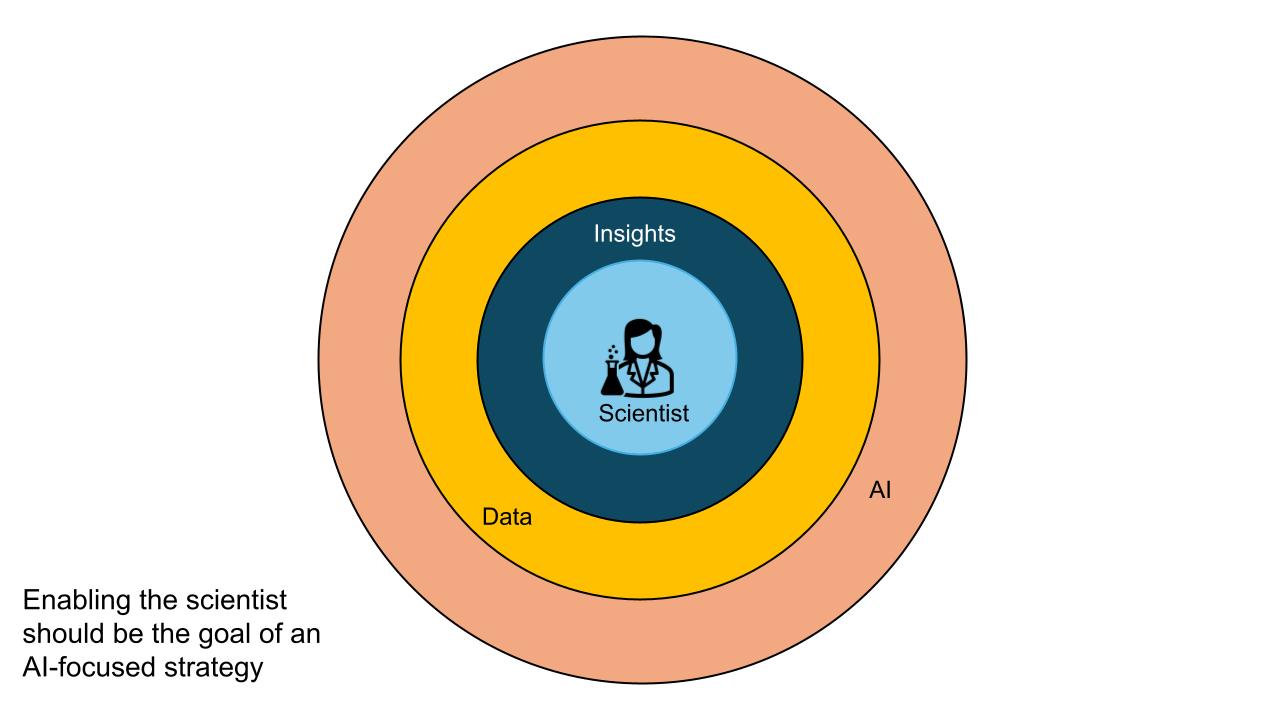
Finally, it is important to remember that despite all the AI and data available, scientists must remain at the center of the universe (see diagram below). The tools and data are only as good as the insights they produce. Creativity and invention come from scientists.
About the Author
Dr. Raminderpal Singh
 Dr. Raminderpal Singh is a recognized key opinion leader in the techbio industry. He has over 30 years of global experience leading and advising teams on building computational modeling systems that are cost-effective and have significant IP value. His passion is to help early to mid-stage life science companies achieve novel biological breakthroughs through the effective use of computational modeling.
Ramidar Pal currently leads the HitchhikersAI.org open source community to accelerate the adoption of AI technologies in early stage drug discovery, and is also the CEO and co-founder of Incubate Bio, which serves life science companies looking to accelerate research and reduce wet lab costs. Computer-based modeling.
Raminderpal has extensive experience building businesses both in Europe and the US. As a business executive at IBM Research in New York, Dr. Singh led the market launch of IBM Watson Genomics Analytics. He also served as Vice President and Head of the Microbiome Division at Eagle Genomics Ltd in Cambridge. Raminderpal received his PhD in Semiconductor Modelling in 1997. He has published several papers, two books and holds 12 patents. In 2003, he was named one of the 13 most influential people in the semiconductor industry by EE Times.
For more information, visit http://raminderpalsingh.com, http://hitchhikersAI.org and http://incubate.bio.