


Topological deep learning (TDL) surpasses traditional GNNs by modeling complex multi-way relationships, unlike GNNs that only capture pairwise interactions. This capability is essential for understanding complex systems such as social networks and protein interactions. Topological neural networks (TNNs), a subset of TDL, excel at handling high-dimensional relational data and have demonstrated excellent performance in a variety of machine learning tasks. Although TDL has progressed rapidly, reproducibility, standardization, and benchmarking remain challenges. Recent efforts, such as unified theories and software implementations, aim to address these issues and enhance TDL research and applications.
Researchers from multiple institutions, including La Sapienza University and University of California, Santa Barbara, have developed TopoBenchmarkX, a flexible, open-source library for benchmarking TDLs. TopoBenchmarkX organizes TDL workflows into modular components for data processing, model training, and evaluation, improving adaptability and ease of use. It converts graph data into higher-order topological formats, such as simplex and cell complexes, for enhanced data representation and analysis. The framework addresses challenges in TDL, including scarcity of topological data, cross-domain standardization, and diversity of TNN architectures, facilitating robust benchmarking and reproducibility in TDL research.
Several software packages support graph-based learning and geometric deep learning (GDL). NetworkX enables graph computation, while KarateClub provides unsupervised learning algorithms for graph data. PyG and DGL address both GDL and general graph learning. For higher-order domains, tools such as HyperNetX and XGI handle hypergraphs and simplicial complexes, while DHG provides deep learning for graphs and hypergraphs. The TopoX suite, which includes TopoNetX, TopoEmbedX, and TopoModelX, supports computation, embedding, and learning with TNNs across a range of topological structures. Unlike the Open Graph Benchmark (OGB), which focuses on graph-based learning, TopoBenchmarkX specifically benchmarks TNNs and generates higher-order datasets for TDL.
TopoBenchmarkX allows graphs to be extended into “featured topological domains” to structures such as cell complexes. Featured graphs map nodes and edges to feature vectors. Cell complexes extend this by mapping nodes, edges, and faces to feature vectors. Lifting transforms a graph into a higher-order domain and embeds its nodes and edges into more complex structures such as cell complexes or simplicial complexes. Machine learning models can either correct this process using predefined rules or be learnable and optimized. Different lifting methods include transforming a graph into a cell complex via cycles, into a simplicial complex via cliques or neighborhoods, and into a hypergraph using k-hop neighborhoods.
TopoBenchmarkX numerical experiments used 22 datasets to test 12 neural network models across graph, hypergraph, and topological domains in four tasks: node classification, node regression, graph classification, and graph regression. Higher-order neural networks outperformed graph neural networks in 16 of the 22 datasets, especially in node regression. Ablation studies demonstrated the importance of signal propagation strategies and showed different performance impacts based on model architecture. TopoBenchmarkX enables comprehensive model comparison, enhancing insights into topological deep learning.

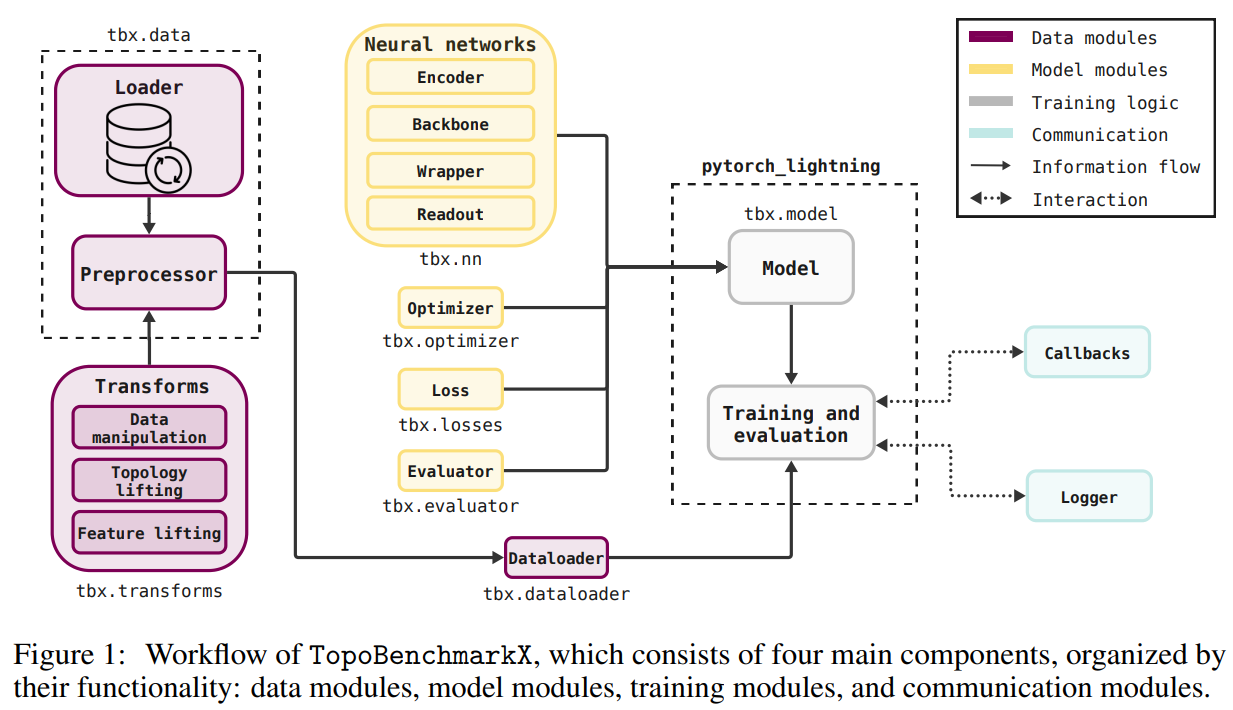
TopoBenchmarkX is an open-source benchmarking tool for TDL designed to streamline the research process by organizing TDL tasks into modular steps. It excels at converting graph data into richer topological representations, facilitating comprehensive model evaluation. While the framework shows promising results, it lacks features such as learnable lifting and built-in higher-dimensional datasets. Future work will integrate these features and improve performance metrics for evaluating models' expressiveness, explainability, and fairness. Researchers are encouraged to contribute these enhancements and extend the framework's capabilities.
Please check Papers and GitHub. All credit for this research goes to the researchers of this project. Also, don't forget to follow us. twitter.
participate Telegram Channel and LinkedIn GroupsUp.
If you like our work, you will love our Newsletter..
Please join us 44k+ ML Subreddit


Sana Hassan, a Consulting Intern at Marktechpost and a dual degree student at Indian Institute of Technology Madras, is passionate about applying technology and AI to address real-world challenges. With a keen interest in solving practical problems, she brings a fresh perspective to the intersection of AI and real-world solutions.


