

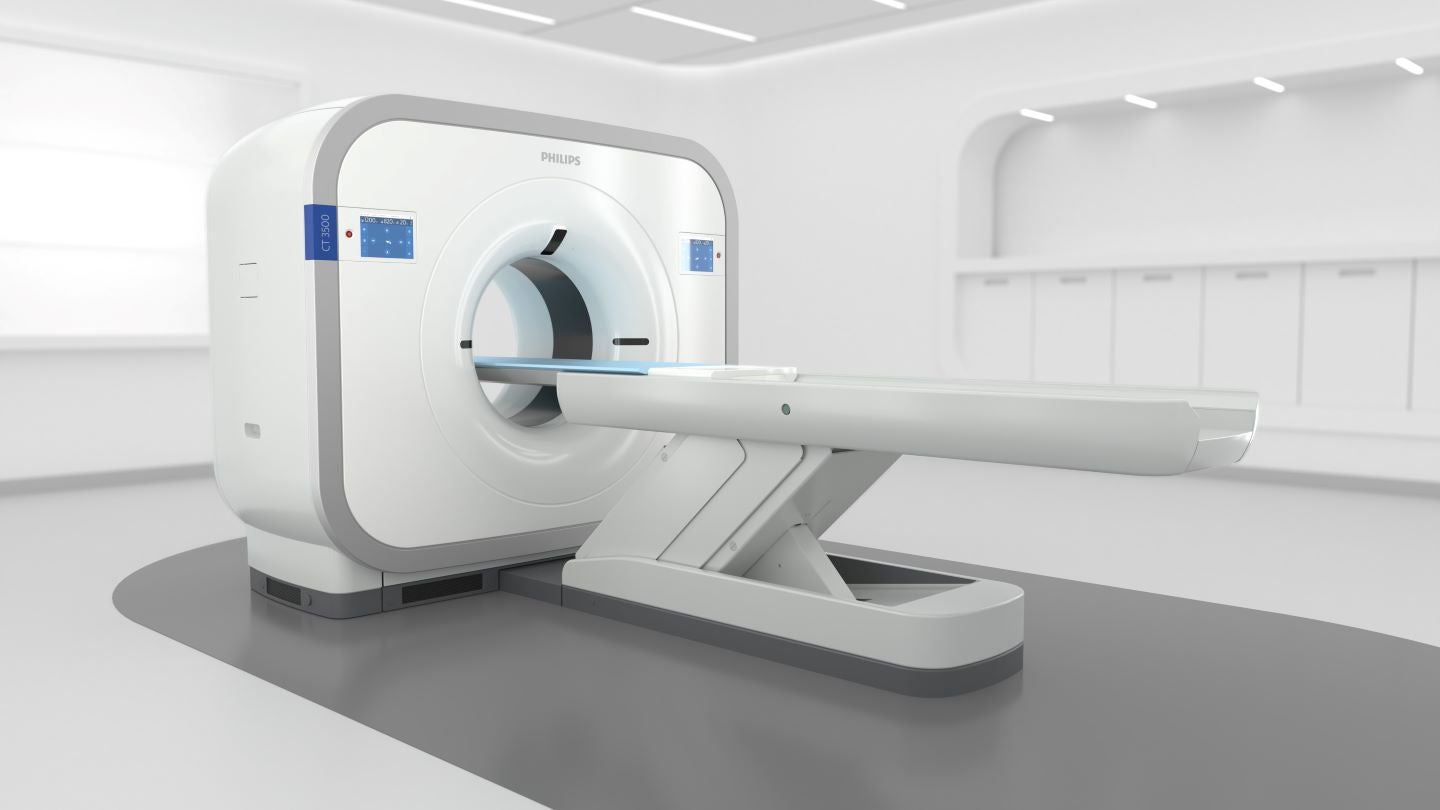
Royal Philips (Philips), a health technology company, has announced the Philips CT 3500, a new artificial intelligence (AI)-powered high-throughput computed tomography (CT) system.
The new system is designed to meet the requirements of routine radiology and high volume screening programs.
It offers a wide range of image reconstruction and workflow enhancements for consistent, fast and high-quality diagnostic images.
Based on Philips’ vMRC tubes, the CT 3500 incorporates both internal and external proactive monitoring sensors to track key performance indicators.
These advanced sensors allow Philips service engineers to intervene before disrupting CT operations.
Philips CT General Manager Frans Benker said: “Many radiology departments today scan hundreds of patients a day. We have designed the Philips CT 3500 to alleviate the pain of
“It allows radiologists to automate the most time-consuming steps so they can spend more time focusing on their patients.”
The CT 3500 uses the company’s AI-driven CT smart workflow to automate each step of the scanning process.
Precise Position, part of the company’s AI-enabled Precise Suite solution, uses cameras to automate patient positioning, resulting in 50% better positioning accuracy and up to 23% faster patient positioning time. I was.
Accurate AI-based image reconstruction ensures superior image quality for accurate diagnosis by radiologists.
This enables radiology departments to achieve significant improvements such as up to 80% lower radiation dose, 60% higher low contrast detection, and 85% lower noise.
Earlier this month, Philips also announced the Philips Image Guided Therapy Mobile C-arm System 1000 called Zenition 10.
The system uses the company’s flat panel detector technology to facilitate lower-cost treatments and improved patient outcomes.


