

As corporate legal departments deploy AI at scale, the next challenge is aligning the use of AI with the metrics and priorities that matter most to the business, a recent report reveals
Important points:
-
-
-
Corporate legal AI strategy must start with business goals, not just efficiency — While many corporate legal departments first deploy AI for internally focused use cases, the bigger opportunity is to align AI with broader business priorities, such as increasing revenue, mitigating risk, and improving operational performance.
-
GCs need to measure AI success by business impact — Metrics like time savings and tool usage are helpful, but more powerful AI metrics connect legal work to business outcomes. For example, in a contract review, success may be reflected in improved win rates, reduced revenue leakage, faster completion of deals, or risk avoidance.
-
A strong legal AI strategy must create multiple forms of business value at once — The most effective approaches are not focused on a single benefit, such as cost savings. Rather, we aim to improve service delivery, strengthen operations, support growth and reduce risk across the business.
-
-
Over the past few years, corporate legal departments have begun to rapidly adopt AI tools, often driven by company-wide AI initiatives. In fact, in the past year alone, sector-wide AI adoption has risen to nearly half (47%) of all sectors, according to those surveyed by the Thomson Reuters Research Institute (TRI).
However, it is not enough adopt technology. For AI to have real impact, it must be integrated strategically. However, GCs and other legal leaders are still in the early stages of adopting this strategic approach.
According to TRI research results 2026 Corporate Legal Department Current Status Reportmore GCs are focused on technology than ever before. When asked what their top strategic priority is for the year ahead, 28% said technology is their top priority, double the percentage who prioritized it just one year ago. And of the technology mentions, the majority specifically mentioned AI as their main area of focus.
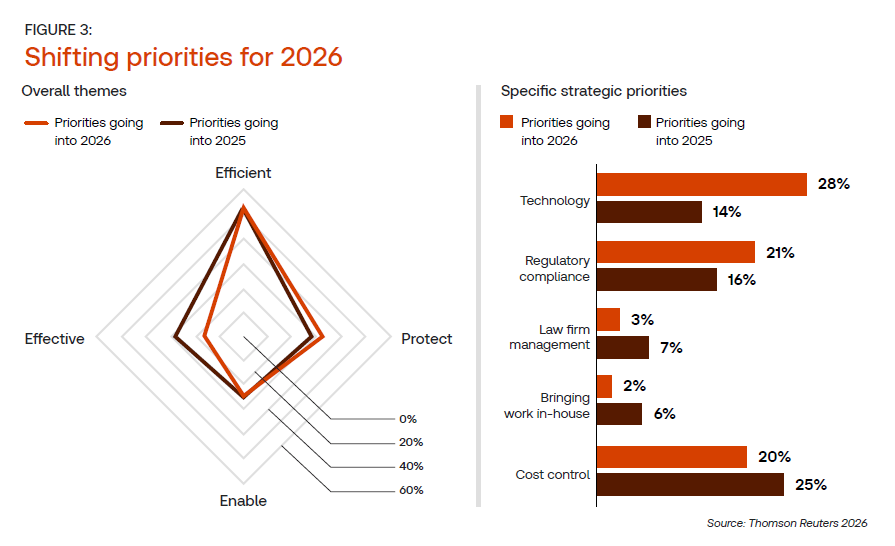
Historically, many legal departments have looked at AI from an internal efficiency perspective, leveraging it to perform tasks faster and cheaper. However, executives are increasingly looking to legal departments to provide more effective business counsel and connect legal analysis to business outcomes. And, not surprisingly, we expect AI to play a role in that change.
So how can GCs effectively make AI a priority, not just for the legal department but for the entire business? It starts with amplifying the potential impact of AI processes.
From unlocking capacity to deployment
The ChatGPT Generated AI (GenAI) tool has been publicly available for less than four years, so many corporate legal departments are still in the early stages of deploying this technology. As a result, most GenAI use cases still tend to focus on low-hanging fruit, such as document summarization and review, contract drafting and review, and research.
This can be understood from the perspective of individual use cases. The problem is that when these use cases are translated to the leadership level as overall strategic guidance, many GCs remain focused on how to maximize the benefits from that low hanging fruit. According to TRI research, less than 20% of corporate legal departments measure return on investment from AI at all. This means that many departments are using AI tools without any kind of guiding measurements of what success looks like. And even among departments that are measuring AI success, most of the metrics they use center around internal usage and the department’s cost savings from tools.
Certainly, these measurements are more useful than not tracking at all. They focus on what AI is unlock Look for ways to strengthen the capabilities of your legal department and help lawyers do their jobs more efficiently than before. In fact, the majority of legal departments investing in AI tools are currently at this stage.
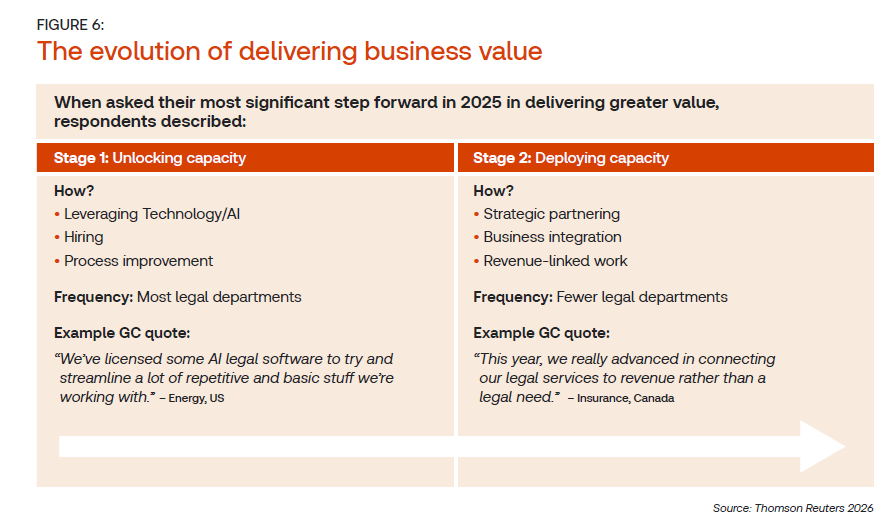
However, there are additional steps legal departments need to take to fully leverage the strategic value of AI. And it’s about connecting the use of AI to larger business goals. deploy Unlocked capacity. This requires thinking about AI not only in terms of how it impacts the legal department, but also in terms of how it impacts the people the legal department serves.
For example, consider a common AI use case such as contract review. Today, the most common metric for contract review technology is speed, such as how quickly legal departments can help a contract go from inception to signature. Indeed, maximizing its value can improve departmental efficiency. But executive partners don’t necessarily want efficient departments as the end goal; they want business success.
As a result, some leading GCs are looking to tie the use of AI directly to business goals and revenue. For contract reviews, this could mean demonstrating the impact on overall contract win rates and whether the use of AI has improved win rates. Or it could mean that revenue leakage prevention is more effective. And that can also mean risk aversion. Avoid risking a few dollars. These all demonstrate value and can be tied to other parts of your business.
Additionally, doing all of this requires close collaboration with other business functions in terms of sharing metrics and understanding what success across the organization means to all stakeholders. That said, GC has been telling TRI for years that breaking down silos is a top priority for legal departments. In this case, implementing AI is no exception.
Wide range of influence
Currently, corporate legal departments are most affected by AI in the areas of efficiency and time savings. More than three-quarters of GCs interviewed by TRI said that AI is currently benefiting their department’s efficiency and productivity, or that they expect the benefits to be seen within the next 12 months.
However, many more areas can be improved by connecting AI outcomes to business imperatives. This year Current status report of the Corporate Legal Department Additionally, TRI categorizes the role of the legal department into four main functions: of 4 rotating plates:
-
-
- provide effective Legal services and operational excellence
- offer efficient Legal price within budget
- enable business and strategic growth;
- protect Business Assets and Competitive Advantages.
-
The impact of AI on efficient legal value is clear. However, GCs are beginning to realize that they can actually affect all four of these plates.
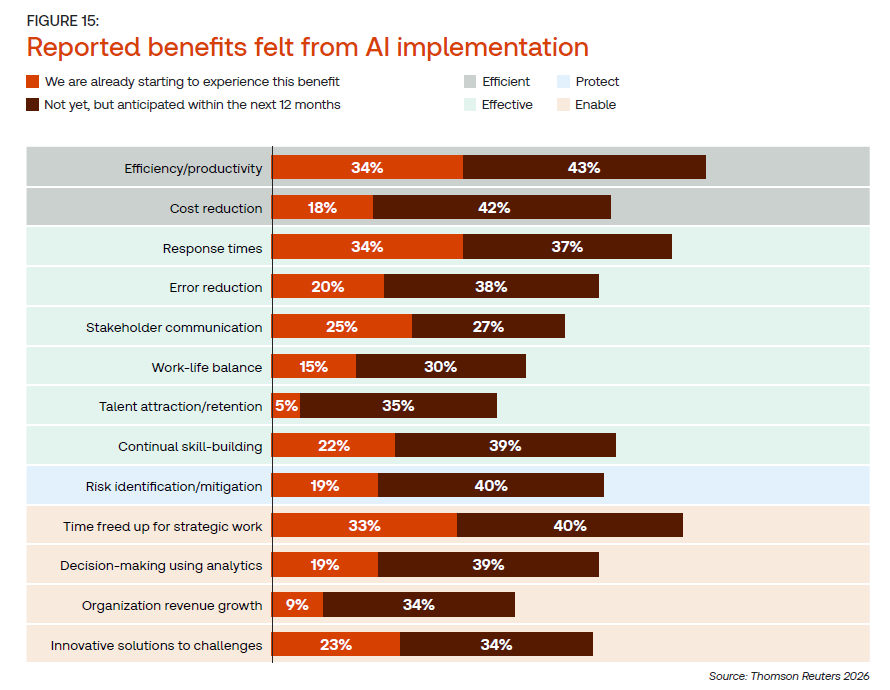
GCs looking to adopt AI as a strategic objective must recognize that their strategy must encompass more than just internal efficiency. Not all of these benefits apply to every department, but every department should consider one or more of these areas. An effective AI strategy must account for multiple benefits, so multiple business factors must be considered when evaluating the success of a department’s AI strategy.
Entering an AI strategy is a laudable goal for today’s GCs, but it’s also no easy task. When thinking about how AI will impact the department, leaders must take the next step to not only deploy capabilities but also unlock capabilities, helping lawyers not only work more efficiently but also have a greater impact across the business.

