
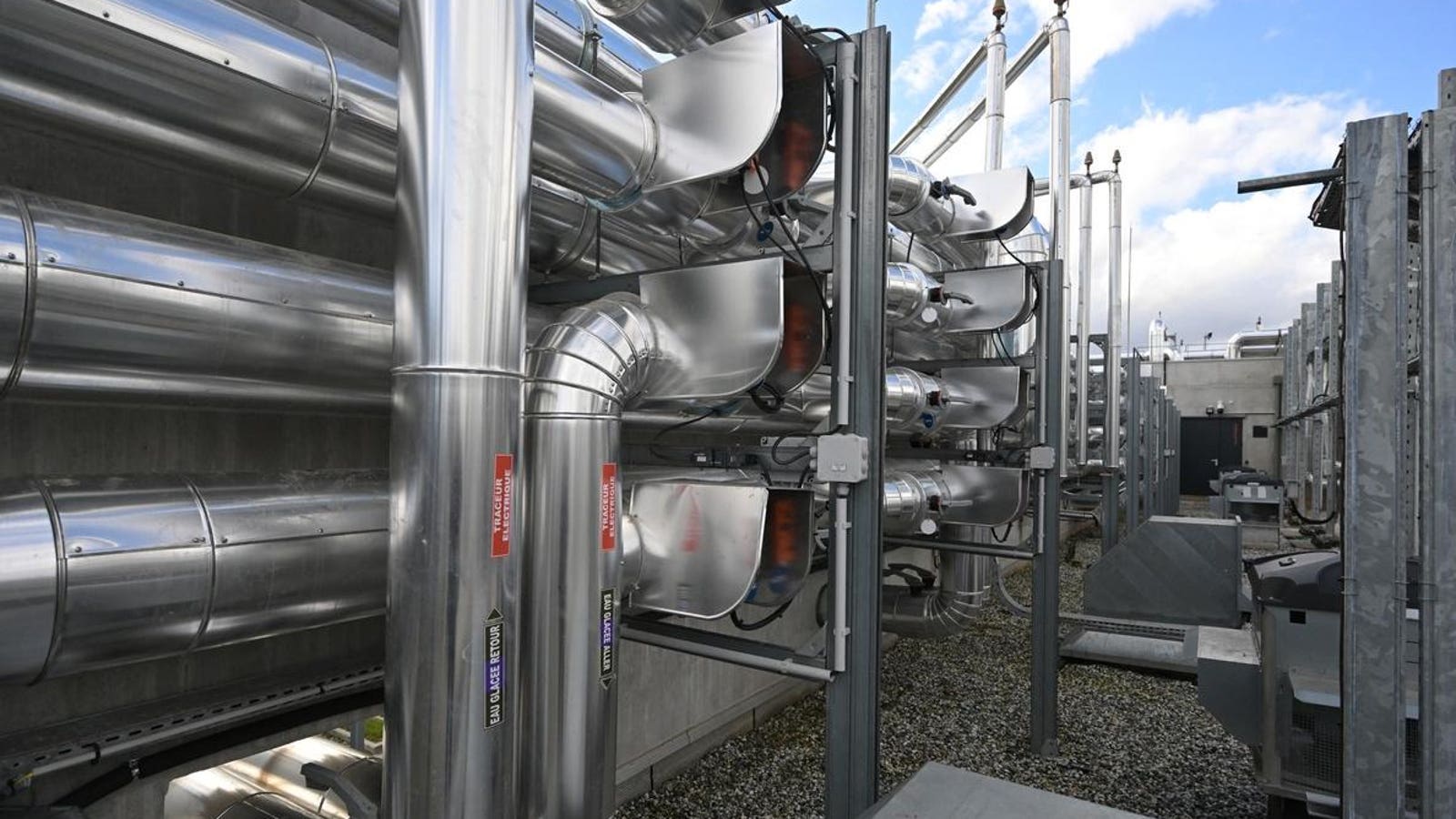

Chilled water pipes forming part of the cooling system of a data center in Noyals-sur-Vilaine, France, October 31, 2025. Cooling design helps determine your facility’s peak water and power requirements. (Photo by Damian Meyer/AFP via Getty Images)
AFP (via Getty Images)
How much water does AI use? Annual totals miss out on peak-day demand that forces towns to build pipes, pumps, and processing capacity.
AI’s next water bill may arrive before your new data center processes your first ChatGPT prompt. A study by the University of California, Riverside, conducted in conjunction with the California Institute of Technology, estimates that depending on the pace of data center growth, U.S. community water systems could require between $10 billion and $58 billion in new infrastructure by 2030, assuming new efficiencies do not reduce demand. Most of the discussions ask how much water is used in one AI query and compare the answer to a teaspoon or a bottle. Cities don’t design water systems based on average queries. They make for the hottest days. That peak, and who pays to provide it, are commercial questions hiding behind the virus numbers.
Per-prompt discussion hides pipes
Bottle comparisons have real sources. In 2024, The Washington Post collaborated with researchers at the University of California, Riverside to estimate the resources required for GPT-4 to generate a 100-word email in an average data center in the United States. Their model produced an estimated water volume of 519 milliliters, including both cooling water and water from power generation.
The researchers behind that number have since revised it. Xiaolei Ren of the University of California, Riverside, who co-authored the 2024 estimates with the Post, puts the number closer to 15 milliliters for the GPT-4 prompt, including about 5 milliliters for on-site cooling. He claims the original numbers are outdated for today’s system.
Sam Altman writes that the average ChatGPT query uses about 0.000085 gallons, or about 0.32 milliliters. He did not release enough details to reconcile the numbers with the Post’s estimates. Other researchers have found a wide spread across models and workloads. The 2025 benchmark study “How Hungry is AI?” estimated that efficient models used less than 2 milliliters over the entire test period, but some inference models exceeded 150 milliliters per query.
These numbers do not describe the same tasks or draw the same accounting boundaries. These vary by model, output length, hardware, cooling system, power source, and location. This spread explains why the national average tells local utilities little about the capacity needed for a particular project.
How much water does AI use at peak times?
Annual totals show scale while hiding engineering constraints. A 2024 Berkeley Lab report estimates that all data centers in the U.S., not just AI facilities, will directly consume approximately 17.4 billion gallons of water in 2023. We predict that direct consumption from hyperscale data centers could reach 16 billion to 33 billion gallons per year by 2028.
In some towns, it has not yet been possible to determine the size of the pipes from the national annual total. A team from the University of California, Riverside and the California Institute of Technology found that during hot months, the daily demand for evaporative cooling can increase by six to 10 times the annual average. Depending on the facility being planned, the multiple may exceed 30. Large projects can draw more than 1 million gallons of water on a hot day, with some facilities under construction receiving allocations of up to 8 million gallons per day.
Researchers estimate that without new efficiencies, U.S. water systems could require an additional 697 million to 1.45 billion gallons per day of peak capacity by 2030. That’s about the same amount as New York City’s daily supply. Much of that capacity remains unused except during the hottest months. Utilities still need to raise and maintain funding.
Annual averages may seem manageable, even if a few hot days require large infrastructure investments. The pipes, pumps, and processing capacity built on these mountaintops must be funded and maintained for decades.
Cooling shifts costs between water and power
Banning water cooling would shift some of the burden onto the power grid. Evaporative systems remove heat efficiently but consume water. Dry-cooled chillers and air-cooled chillers reduce direct water usage, but generally consume more electricity. Circle of Blue also points out that indirect water use will vary depending on the local electricity mix, as some forms of electricity generation consume much more water than others.
The industry can significantly reduce direct water consumption by moving to waterless closed-loop cooling. However, “closed loop” alone will not solve the problem. Water may be cycled repeatedly within a data center, but the facility requires a definitive method to eliminate heat. The system may use air, evaporation, or both.
These choices are made well before the server arrives. Site selection sets available water sources and climate. Electricity agreements affect indirect water use. Cooling design determines the trade between water consumption and power demand. Procurement and development agreements are more important than instant consumer reviews because changing these decisions after construction is costly.
Incorporate peak water conditions into transactions
Business owners and local government officials must request four numbers before approving large data center projects. First, we obtain the annual average as well as the daily peak water demand under the hottest expected conditions. Next, identify water sources during drought restrictions and separate water related to direct project consumption and power supply. Finally, we quantify developers’ contractual contributions to new processing, storage, and pipeline capacity.
The last number is important. Researchers from the University of California, Riverside and the California Institute of Technology recommend that developers help fund verifiable water system improvements so that the entire cost of expansion is not passed on to local ratepayers. Water utilities must also consider large user charges or capacity charges that allocate more dedicated infrastructure costs to demand-generating customers. Peak reporting and mandatory funding conditions are included in the contract and will not be included in the sustainability report issued after the site launches.
The common question of how much water does AI use still needs an answer. You need a suitable unit. You can compare models in milliliters per prompt, but you can’t tell a mayor whether a treatment facility will be able to handle the next heat wave, or tell an executive how much a treatment facility’s services will cost. Start with daily peak demand, water sources, and infrastructure agreements. These numbers reveal whether your data center is a manageable customer or a decades-long liability.


