image:
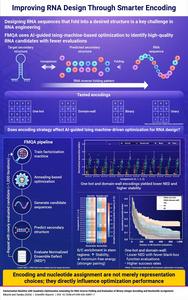
Artificial intelligence-based RNA design performance varies significantly depending on the sequence encoding strategy.
view more
Credit: Dr. Shuta Kikuchi, Keio University
RNA has emerged as one of the most promising molecules in modern medicine, enabling advances from mRNA vaccines and gene therapy to genome editing and synthetic biology. However, designing RNA molecules that reliably fold into desired secondary structures remains a major challenge. Even for relatively short sequences, the number of possible nucleotide combinations increases exponentially, making it difficult to identify the best candidate. As a result, traditional computational methods often require extensive candidate evaluation, creating a significant bottleneck when experimental validation is time-consuming and costly.
To address this challenge, researchers led by Specially Appointed Lecturer Shuta Kikuchi of the Keio University Graduate School of Science and Engineering and Professor Hide Tanaka of the Department of Applied Physics and Physical Informatics developed a new RNA inversion framework based on a factorization machine with quadratic optimization annealing (FMQA). This machine learning and Ising machine-driven black box optimization approach is designed to identify high-quality RNA sequence candidates with relatively few evaluations.
“We investigated a novel application of FMQA in biomolecular design, where the potential of FMQA is relatively unexplored. Because RNA, DNA, and protein sequences are categorical in nature, it is unclear how converting them to a binary representation affects optimization performance. In this study, we investigated RNA inversion and the impact of different encoding and assignment choices within FMQA.”” says Dr. Kikuchi. scientific report May 3, 2026.
The researchers formulated RNA inversion as an optimization problem aimed at identifying sequences that are most likely to fold into a predefined target structure. FMQA served as the core optimization engine, and its performance was evaluated across four binary encoding methods: one-hot, domain-wall, binary, and uninary, along with all possible nucleotide-to-integer assignments of adenine (A), uracil (U), guanine (G), and cytosine (C). The quality of RNA designs was assessed using normalized ensemble defects (NED), which measures the match between predicted and target structures. FMQA was benchmarked against random search, genetic algorithms, and Bayesian optimization.
The results show that encoding strategies play a crucial role in artificial intelligence (AI) and Ising machine-driven RNA design. One-hot encoding and domain-wall encoding consistently performed better than binary and unary representations, producing sequences with lower NED values and higher success rates. Importantly, domain wall encoding introduced a search bias towards specific integer states. When guanine (G) and cytosine (C) were assigned to these favorable states, GC base pairs accumulated more frequently in the stem region, resulting in improved thermodynamic stability and improved design performance. FMQA also identified high-quality RNA designs with fewer functional evaluations than competing methods across multiple benchmarks, demonstrating high efficiency in search-constrained settings.
This discovery has broader implications for computational biology and optimization science beyond RNA inversion. They demonstrated that annealing-based optimization frameworks such as FMQA can be effectively extended to life science problems, strengthening the bridge between quantum-inspired computing and biomolecular engineering. More importantly, this study highlights that data encoding is not just a preprocessing step, but a design variable that can fundamentally shape optimization results. These insights may guide future applications of FMQA in biomolecular design, materials discovery, and polymer engineering.
In the future, this approach could accelerate the design of functional biomolecules, especially RNA systems that need to reliably adopt a specific structure for therapeutic or diagnostic applications. “Potential applications include biosensors, genome editing tools, aptamers, ribozymes, riboswitches, etc. ” Dr. Kikuchi’s memo. “Since DNA, RNA, and proteins are all represented by categorical biological sequences, this approach could also be extended to a broader range of biomolecular design.“Furthermore, because FMQA is a flexible black-box optimization framework, future implementations can incorporate experimentally measured properties such as molecular stability, binding affinity, and gene expression control, which could help bridge computational design and laboratory validation.”Insights from this study are not limited to RNA” added Professor Tanaka.They are versatile enough to be applied to discrete design problems, such as materials and molecular design, where each evaluation is costly.” In the long term, such evaluation-efficient optimization strategies could help reduce experimental burden and accelerate discoveries across biotechnology and medicine.
“FMQA formulates the learned surrogate model as a quadratic optimization problem, so it can be implemented with a quantum annealing machine.” says Dr. Kikuchi.This perspective points to exciting future directions for advancing “quantum for biology” by exploring how next-generation quantum and quantum-inspired computing technologies can support the design of biomolecules.”
In conclusion, this study establishes FMQA as a powerful and evaluation-efficient framework for RNA reverse folding. It also highlights important but often overlooked insights. In other words, the way biological sequences are encoded can be as influential as the optimization algorithm itself. Taken together, these discoveries open new directions for more efficient, scalable, and effective approaches to biomolecule design.
reference
Original paper title: Factorization Machine with Quadratic Optimization Annealing for RNA Inverse Folding and Evaluation of Binary Integer Encoding and Nucleotide Allocation
journal: scientific report
DOI: https://doi.org/10.1038/s41598-026-50891-7
About Keio University Global Research Institute (KGRI)
The Keio University Global Research Institute (KGRI) was established in November 2016 as a university-wide platform connecting undergraduate and graduate schools. We promote interdisciplinary and international collaborative research that transcends academic and geographical boundaries, and disseminate research results domestically and internationally.
Keio University has set the vision of becoming a “research university that creates the common sense of the future” in 2024, and has launched the “Japan’s Top Research Universities Promotion Project (J-PEAKS)” with funding from the Japan Society for the Promotion of Science (JSPS). Through this initiative, KGRI will strengthen its research infrastructure to strengthen interdisciplinary collaboration, promote the social implementation of research, and foster a research ecosystem that enables collaboration within the university and with leading institutions at home and abroad.
Website: https://www.keio.ac.jp/ja/org/kgri/
About Dr. Shuta Kikuchi of Keio University
Dr. Shuta Kikuchi is a specially appointed lecturer at the Keio University Graduate School of Science and Engineering. His research focuses on the application of optimization and computational methods to biological systems, including RNA design and reverse folding problems. His research explores the use of factorization machines with quadratic optimization annealing (FMQA), quantum annealing, and Ising machine-based approaches to address complex optimization challenges in life sciences and biomolecular design.
https://shutakikuchi.github.io/
About Dr. Osamu Tanaka of Keio University
Professor Osamu Tanaka is a professor in the Department of Applied Physics and Physical Information Science, Faculty of Science and Engineering, Keio University. He is also Director of the Keio University Sustainable Quantum Artificial Intelligence Center (KSQAIC) and Core Director of the Keio University Human Biology, Microbiome, and Quantum Research Center (Bio2Q). His research interests include quantum annealing, Ising machines, quantum computing, statistical mechanics, and materials science.
https://shutanaka.appi.keio.ac.jp/
Funding information
This research was supported by the Japan Society for the Promotion of Science (JSPS) KAKENHI (grant number: JP23H05447), the Council for Science, Technology and Innovation (CSTI) Strategic Innovation Creation Program (SIP) “Promoting the Application of Advanced Quantum Technology Platforms to Social Issues” (funding agency: QST), and the Japan Science and Technology Agency (JST). (Grant number: JPMJPF2221).
journal
scientific report
Research method
Computational simulation/modeling
Research theme
not applicable
Article title
Factorization Machine with Quadratic Optimization Annealing for RNA Inverse Folding and Evaluation of Binary Integer Encoding and Nucleotide Allocation
Article publication date
May 3, 2026
Conflict of interest statement
The authors declare no competing interests.