- New tools help experts diagnose early and predict disease spread
Rahaf Jambi
RIYADH: At the LEAP25 conference in Riyadh, Saudi Arabia’s Ministry of Environment, Water and Agriculture announced major initiatives aimed at transforming animal healthcare through artificial intelligence.
The ministry launched the Artificial Intelligence Animal Health Platform, a system designed to monitor animal diseases, analyze veterinary data and predict outbreaks with incredible accuracy.
The launch was announced by Mansour bin Hilal Al-Mushaiti, Deputy Minister of Environment, Water and Agriculture, at an event hosted by the Ministry of Communications and Information Technology, the Saudi Cybersecurity, Programming and Drone Federation, Tahaluf and the Event Investment Fund in February.
The platform forms part of Saudi Arabia’s broader push to integrate advanced technologies into agriculture and livestock management, while advancing sustainability and food security goals. By collecting and analyzing real-time veterinary data, authorities aim to reduce disease outbreaks, strengthen prevention strategies, and support veterinarians across the country.
The platform will use AI to analyze veterinary records, monitor infections and deaths, and predict the spread of diseases based on geographic and temporal data, the ministry said. The system is integrated with the “An’am” database and uses ETL technology to process field information collected from veterinary hospitals.

“The platform is designed to monitor 151 animal diseases and contaminants, with a strategic focus on the top 10 major health threats, including foot-and-mouth disease, brucellosis, and small ruminants. region and governorate, providing accurate forecasts on the spread of the disease and high-risk areas,” said Abdulhamid bin Abdullah, Deputy Minister of Information Technology and Digital Transformation. Al Alawi told Arab News.
Initial testing of the AI model showed excellent performance. According to data from the ministry, the accuracy of predicting infections reached 99.5% and the accuracy of predicting deaths reached 99.1%. Predictions of veterinary field visits recorded an accuracy of 93 to 94 percent.
Officials say these features will allow veterinarians to make faster and more informed decisions, moving animal care from reactive to preventive care.
“The platform will act as a digital compass by providing an early warning system to identify high-risk areas, enabling veterinarians to make more effective and accurate decisions. It will also contribute to filling the expertise gap in emerging regions with low levels of veterinary activity,” Al-Alawi said.
Looking ahead, the ministry plans to expand the platform’s capabilities to predict emerging and cross-border diseases before they reach the Kingdom. Future updates are expected to incorporate import and livestock shipment data to enhance preparedness and reduce risks associated with global disease spread.
Data security is also a priority. Officials describe the system as a “digital fortress,” with all data hosted on ministry servers within Saudi Arabia and protected by advanced encryption and data sovereignty standards.
In addition to improving animal health outcomes, the platform is expected to reduce vaccine waste, minimize livestock losses, ease the financial burden on breeders, and contribute to broader food security and agricultural sustainability goals.
The ministry also plans to work with private companies and international organizations to enhance AI models and improve data quality. Future updates will introduce additional tools for veterinarians and farmers to improve efficiency and reduce response times in the field.
While the government is implementing AI at the national level, a veterinary hospital in Riyadh is already applying the technology to everyday pet care. Arab News visited Fluff and Woof Veterinary Clinic to observe how these tools are used in practice.
“AI is transforming veterinary medicine from reactive to predictive and data-driven care, supporting early diagnosis, continuous monitoring, and rapid clinical decisions,” Dr. Ahmed Mandour, cardiology consultant at the clinic, told Arab News.

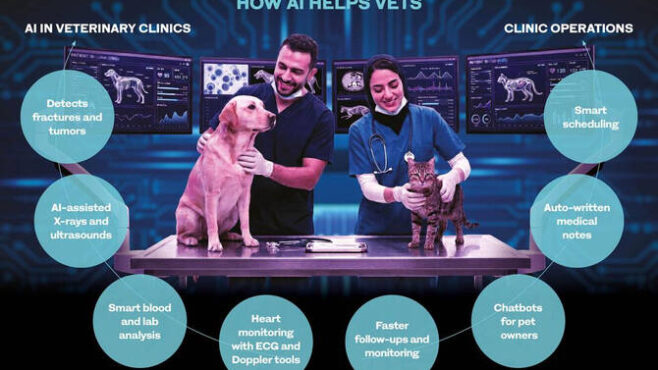
In clinics, AI tools are now widely used in diagnostic services, especially in the fields of diagnostic imaging and cardiology. AI-assisted radiology systems use X-rays, CT scans, and ultrasound to help detect fractures, tumors, and heart enlargement. Smart image analysis is also applied in clinical testing to interpret blood smears, cytology, and fecal samples.
Cardiology has emerged as one of the areas where AI adoption is most advanced. Modern echocardiography machines, Doppler ultrasound machines, and monitoring systems integrate AI-powered analytics to better detect heart conditions.
“We have AI-supported echocardiography/ultrasound equipment, ECG and blood pressure monitors,” he said.
Mandour noted that pet owners also now have access to AI-powered monitoring tools to track heart health and support ongoing treatment plans outside of the clinic.
In addition to diagnosis, AI has significantly streamlined administrative processes in veterinary clinics. Smart systems can help schedule appointments, triage cases, communicate with clients via chatbots, and create automated medical notes.

“In Riyadh, AI will help clinics deal with a high volume of cases while maintaining high diagnostic accuracy and customer satisfaction,” Mandour told Arab News.
“AI reduces administrative burden, allowing veterinarians to focus more on patient care. Our clinic is also supported by purpose-built smart software to enhance daily operations, including every step of the pet’s journey, from booking to follow-up,” he said.
While AI is increasingly being incorporated into veterinary medicine, experts stress that it is not meant to replace veterinarians, but to support them. There continues to be a focus on combining human expertise with faster data analysis, earlier diagnosis, and increased efficiency.
As Saudi Arabia continues to invest in an AI-driven health system, both public and private clinics appear to be converging toward the same future: one in which technology will play an expanded role in protecting animal health and improving the care of pets and livestock.