Enterprise marketing teams have spent years investing in social listening tools built for a text-first internet, even as the platforms their customers actually use have moved almost entirely to video. The gap that creates is structural: roughly 80% of brand mentions on TikTok and Instagram happen without a tag, a hashtag, or a caption – meaning the vast majority of organic consumer conversation about a product is invisible to the tools brands rely on to track it. Plot was built to close that gap, using multimodal AI to analyze the audio, visuals, and on-screen text inside social video simultaneously, surfacing brand mentions whether or not a creator ever tags the brand. The platform gives enterprise marketing teams the ability to track earned media, source and vet creators, and run consumer research in minutes rather than weeks and early results show brands discovering 2 to 8 times more content featuring their products than they captured before. In 18 months since launch, Plot has grown ARR 3.8x year-over-year with a 132% net revenue retention rate, attracting enterprise customers including Visa, Mastercard, PepsiCo, Fenty Beauty, Benefit Cosmetics, and CAVA almost entirely through inbound demand.
AlleyWatch sat down with Plot Co-founder and CEO Megan Duong to learn more about the business, its future plans, recent funding round, and much, much more…
Who were your investors and how much did you raise?
We raised $10M in a seed round co-led by XYZ Venture Capital and Mischief Ventures, with participation from Seven Seven Six, Alexis Ohanian’s fund, and Acme Capital. This brings our total raised to $14M. What made this round special to me is the caliber of operators and marketers around the table. Camille Ricketts, who co-led from XYZ, was previously Head of Marketing at Notion and First Round Capital. She told us this was her first investment at XYZ. She wasn’t just writing a check, she felt the pain we’re solving firsthand. Dustin Moring at Mischief Ventures brings a rare combination of product instinct (Cash App, Square) and operator experience. The Mischief team includes founders and operators who have built some of the defining companies of the last decade, and that’s exactly the kind of backing we wanted.
Tell us about the product or service that Plot offers.
Plot is a social video intelligence platform for enterprise brands. In plain terms: we analyze social video data so brands can see and understand what’s actually happening in video without any tagging required.
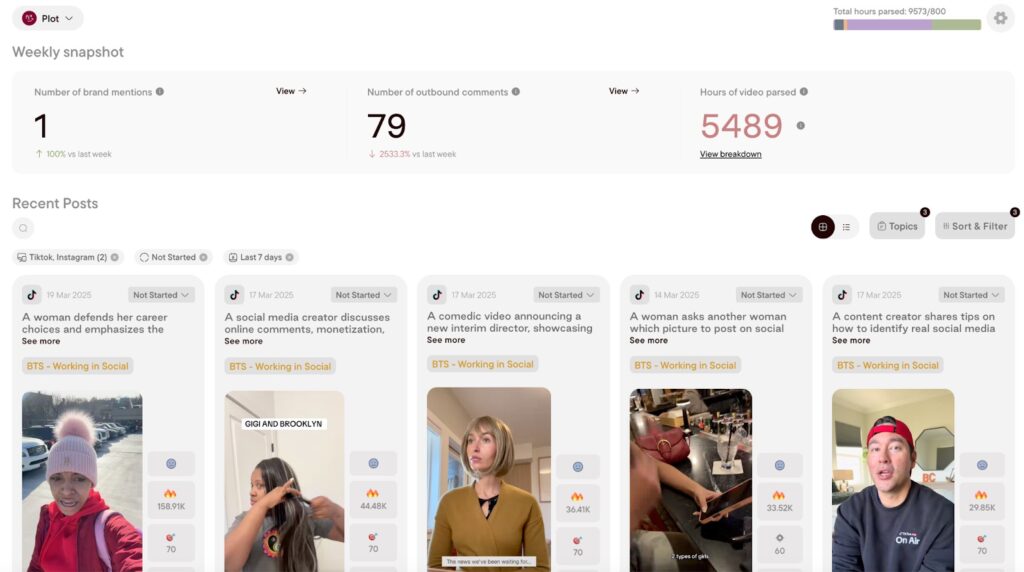
Here’s the problem we’re solving. Roughly 80% of brand mentions in social video are untagged. Someone shows your product, speaks your brand name, holds your packaging and none of it gets picked up by traditional social listening tools because those tools were built for text, hashtags, and captions. Plot was built to see inside video. We use multimodal AI to analyze audio, visuals, and on-screen text simultaneously, so if a creator is making dinner and your product is sitting on their counter, we catch it, even if they never mention you by name.
From there, brands use Plot for four core things: tracking earned media (tagged and untagged), sourcing and vetting creators for campaigns, running consumer research in minutes instead of weeks, and measuring the impact of their community engagement efforts. On average, brands discover 2–8x more content featuring their products than they were capturing before.
Toto Haba, SVP, Global Marketing and Communications at Benefit Cosmetics, put it well: “Since using Plot, I’ve been seeing a 30 percent to 50 percent lift in user-generated content that features our products but does not tag us. This is a big deal because brands like us rely on engaging with our advocates directly. I’m buzzing with the possibilities for engaging in conversations that are ‘hidden’ to us today. Things like ‘benefit brow services experiences’ aren’t something that gets tagged. Plot lets you break out of your For You Page (FYP).” That’s the unlock, not just seeing more data, but acting on it before the moment passes.
What inspired the start of Plot? My entire career has been in social media and branding. I’m what I call a first-generation social media marketer. I came up learning how to write great copy, built the social team at Apple, and understood the text-based world deeply.
When I left Apple in 2020 and started a social media agency, two things happened simultaneously: the pandemic hit, and TikTok took over. Overnight, everything I knew about content shifted from text-first to video-first. I was creating video content for brands and trying to pull insights from it and I quickly realized no tools existed to make sense of what was happening inside video at scale.
I was watching creators talk about products, hold them up, mention them in passing, and brands had no idea. The data was right there, but invisible. I saw a massive untapped market, met my co-founder and CTO Ethan, who led product engineering at Formation Bio from Series A to C, previously at Microsoft, through a YC co-founder matching program, and we started building Plot in 2022. The technical timing was also right. Multimodal AI had finally matured to the point where analyzing video at scale was both possible and affordable. Eighteen months ago this was technically out of reach for most startups. Today it’s in production for Fortune 500 brands.
How is Plot different?
The differentiation starts with what we can actually see. Sprinklr and Brandwatch were designed for a text-first era. They require tagging, hashtags, or captions to surface a mention, and were really built around customer service use cases. Plot analyzes the full context of video: visuals, audio, objects, actions, on-screen text. We built a rich video intelligence layer and leverage that data to supercharge agentic workflows across community, influencer, and research. If someone holds up a Goldfish cracker while making dinner and talks for two minutes without ever mentioning the brand, we find it. No other tool in the market does that today.
Plot’s video intelligence layer lets you see real signals, and our agents let you act on them. Creator Sourcing lets marketing teams find creators with a prompt: “Find me 100 skateboarders in Brooklyn who’ve used our product in the last three months.” We surface real matches from video data, not bio keywords. Deep Research compresses weeks of consumer research into minutes. And our community tools help brands identify and engage their superfans at scale. People who love the product but have never been tagged, never been reached.
It’s also worth noting: for brands that already have Sprinklr or Meltwater for text coverage, Plot is additive. We’re not asking anyone to rip and replace. We fill the video gap those tools literally cannot see.
What market does Plot target and how big is it?
We serve enterprise consumer brands with a strong presence on TikTok and Instagram. Our core buyers sit in social media, community, consumer insights, and influencer marketing. Our customer base spans beauty, CPG, food and beverage, fashion, financial services, sports, and entertainment, and includes brands like Visa, Mastercard, PepsiCo, Fenty Beauty, Benefit Cosmetics, CAVA, Canva, Lululemon, and Warby Parker.
What’s surprised us is how many “non-obvious” verticals need this. We’re working with insurance companies, fintech brands, and even QSR chains because any brand trying to reach a younger generation is trying to understand what’s happening in video. That expands the market considerably.
In terms of size: social intelligence and market research services represent a $100B market, and influencer platforms and services are another $35B on top of that. As we build deeper intelligence on both brands and creators, we’re positioned to expand across both. The total addressable market we’re going after is $135B and we’re starting with the intelligence layer that makes the whole thing work.
What’s your business model?
SaaS. Enterprise brands pay annual subscriptions to access the Plot platform, and contracts expand as teams find more use cases: social, community, insights, influencer, research. Our 132% net revenue retention rate tells that story: customers stay and grow.
Historically, most of our growth has been almost entirely inbound. We haven’t had an outbound sales team. Brands find us because they’re hitting the wall of what legacy tools can do, and someone on the team hears about Plot through a customer, a conference, or a press story and comes to us. We think that will continue, and the funding is helping us build the team and product to support that demand at scale.
For example, when Benefit Cosmetics’ SVP of Global Marketing saw her own data for the first time featuring Benefit products that had never been tagged, entire categories of UGC her team didn’t know existed, she said, “Plot lets you break out of your For You Page.” That moment of recognition started repeating across customer after customer, and within months Fortune 500 brands like Visa and Mastercard were finding us through word of mouth — brand teams telling other brand teams, “you have to see this.”
How are you preparing for a potential economic slowdown?
We’re actually in a position where an economic slowdown tends to accelerate demand for what we build. When budgets tighten, brands need to prove the ROI of every dollar, which means they need better data. They need to know which creators are actually driving results, which campaigns are cutting through, and where authentic brand love lives. Plot answers all of those questions.
We’re also seeing brands shift away from expensive paid influencer deals toward community-led growth, engaging superfans who already love the product. That’s a meaningfully cheaper strategy, and it’s one Plot enables. When a brand realizes they can find and engage 10,000 authentic advocates who’ve never been tagged, at a fraction of the cost of one mega-influencer deal, that’s a budget conversation that writes itself.
And then there’s the agentic piece: the work that used to require a team of analysts, coordinators, and agency hours — sourcing creators, running research, tracking campaigns — Plot’s agents handle automatically. That’s real headcount and agency spend that brands can reallocate. In a tighter environment, that value proposition becomes more compelling, not less.
We’re a 12-person team in New York and deliberately lean. The business has scaled 3.8x year-over-year almost entirely on inbound demand. That foundation holds up well in uncertain environments.
What was the funding process like?
Honestly, we were selective about who we wanted in the room. The investors who understand this market deeply are operators and marketers who’ve felt the problem firsthand. That was the filter.
Camille Ricketts at XYZ had lived this as Head of Marketing at Notion. She understood immediately why brands were flying blind in video. Dustin Moring at Mischief has a deep read on where media and the creator economy are going. The Mischief team is built around product operators who have founded and scaled defining companies, including Zach Perret, the co-founder and CEO of Plaid. That perspective on what it takes to build foundational infrastructure was exactly what we wanted. And Alexis Ohanian — Co-founder and Executive Chair of Reddit and Founder of Seven Seven Six — has spent his career at the intersection of community and the internet. Everyone around the table came with genuine conviction about the category, not just the company.
What are the biggest challenges that you faced while raising capital?
The biggest challenge was helping investors understand that this is a new category, not just a feature on top of existing social listening. Social listening is a well-known space, and there’s a temptation to pattern-match us to existing tools. We’re not that. We built the video intelligence layer. Once you own the layer, we enable agents to act on it and supercharge challenging marketing roles.
The education piece was real. We had to show, not just tell — demo the product, walk through how it finds untagged content, show what it unlocks that nothing else in the market can. Once investors saw it, the reaction was consistent: “Why doesn’t this exist already?” Getting there in a 30-minute pitch required building a clear through-line from the technical infrastructure to the business outcomes brands care about.
What factors about your business led your investors to write the check?
Three things. First, the problem is undeniable. Video is now 76% of all mobile data traffic and the IAB estimates U.S. companies are spending about $43.9 billion on influencer and creator marketing in 2025. This category is expanding rapidly, growing four times as fast as the overall traditional media advertising industry. Consumer conversation has moved entirely to video, and marketing measurement tools haven’t. That gap is massive and structural.
Second, the traction and the speed of it. 3.8x ARR growth year-over-year, 132% NRR, enterprise logos like Visa, Mastercard, and PepsiCo, and we had locked in all of these top-tier enterprise brands within our first year of being live, almost entirely inbound. That’s unheard of. GTM is my background; I spent a decade in social and brand marketing before starting Plot. Having a technical co-founder in Ethan and a GTM-focused founder in me meant we could build the product and sell it at the same time. A lot of great products stall because the team can’t go to market. That wasn’t our problem.
Third, timing. Eighteen months ago, analyzing social video at this scale and price point wasn’t technically feasible. Multimodal AI crossed a threshold that made it possible. We were positioned at exactly the right moment to build this, and we moved fast. The customer roster we’ve built in 18 months proved the market was waiting.
What are the milestones you plan to achieve in the next six months?
Building the agentic layer to action against these rich video signals we built.
We shipped AI Creator Sourcing. This is one I’m really excited about. Marketing teams can describe exactly the creator they want to find and let Plot surface real matches from video data. Not bio keywords. Actual video evidence of who they are, what they use, what they talk about. If you’re looking for curly hair creators, our AI looks at millions of videos to find the best fit creator by analyzing their videos.
Deep Research follows closely behind. We’re compressing what used to take consumer insights teams weeks, pulling themes, understanding sentiment, answering strategic questions, into something that takes minutes inside the platform.
We’re also expanding our data sources, including Reddit, which gives brands an even richer picture of where consumer conversation is happening. And we’ll continue to scale the enterprise customer base and expand inside the accounts we already have. The 132% NRR tells us there’s a lot of room to grow within existing customers as more teams inside the same company discover the platform.
What advice can you offer companies in New York that do not have a fresh injection of capital in the bank?
Stay close to your customers and get clear on your GTM strategy. Our entire growth has been inbound, driven by customers who had a real problem and found that Plot solved it. That only happens when you’re solving something that actually matters. Not something you think should matter, but something people are actively struggling with. You can have a great product, but if you don’t know how to sell to your target market that’s the biggest hurdle.
And in New York especially: use the network. This city has an incredible density of marketers, operators, and founders. Every customer we’ve landed has come with some kind of warm introduction or word-of-mouth connection. Relationships compound here.
Where do you see the company going now over the near term?
We think of Plot as the social data layer for the next generation of marketing AI. The near-term is about shipping the full agentic OS on top of our video intelligence infrastructure, specialized agents for every marketing function, each powered by the same underlying data layer.
We have four agents in motion: the Community Agent, which identifies and activates superfans to drive repeat revenue and reduce CAC; the Campaign Agent, which gives teams instant campaign insights so they can reallocate budget to what’s actually working; the Research Agent, which surfaces product opportunities and whitespace from real consumer signals; and the Influencer Agent, which automates creator sourcing, vetting, and communicating at scale.
Today, marketing teams are limited by human capacity, how many videos someone can watch, how many creators someone can vet, how many comments someone can leave. The near-term is about removing that ceiling. We’re building so that the work that used to require a team of analysts happens automatically, in real time, every day. That’s what we mean when we say agentic OS for video intelligence.
What’s your favorite spring destination in and around the city?
Central Park is my favorite during the spring in NYC. It’s a great change of pace from downtown where I live in SoHo.
You are seconds away from signing up for the hottest list in NYC Tech!
Sign up today