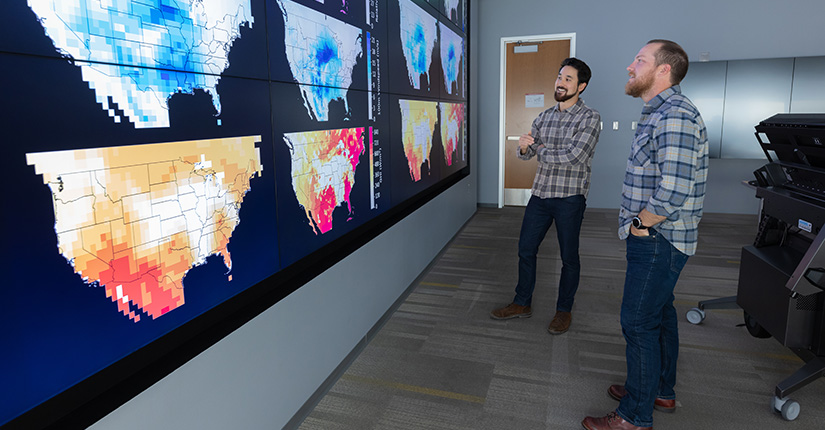
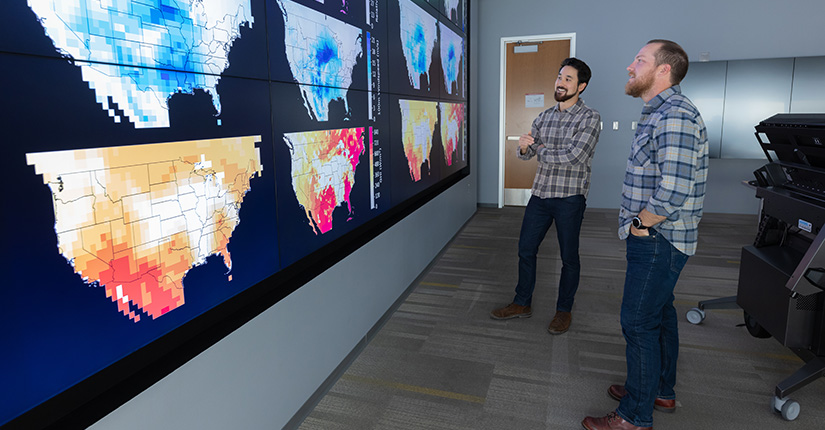
Sup3rCC is changing the way integrated energy system planning is done. Photo credit: Joe DelNero, NREL
As countries around the world transition to wind and solar power and electrify their energy end-uses, societies are becoming more intertwined with weather conditions. Meanwhile, the climate is changing rapidly, with extreme weather events becoming the “new normal.”
Energy system planners and operators need detailed, forward-looking, high-resolution data to understand how climate change will affect wind and solar generation, electricity demand, and other weather-dependent energy variables. Available data indicate that energy demand is likely to increase due to climate change, but there are few high-resolution resources to quantify these impacts.
“We envision a future where all or nearly all of our electricity needs are met by renewable energy sources,” said Grant Buster, a data scientist at the U.S. Department of Energy’s National Renewable Energy Laboratory (NREL). “We need to understand how renewable resources such as wind and solar may be affected by climate change and how those resources can meet our energy needs in the future.”
That’s why NREL’s Grant Buster, Brandon Benton, Andrew Grose, and Ryan King developed Super Resolution for Renewable Energy Resource Data with Climate Change Impacts, or Sup3rCC (affectionately pronounced “Super CC”).
natural energy Magazine article.
Sup3rCC is an open-source model that uses generative machine learning to generate state-of-the-art downscaled future climate data sets that are freely available to the public. Understanding the impact of climate change on regional wind and solar resources and energy demand requires downscaled climate data. There are many existing downscaling methods, but they all involve tradeoffs in resolution, computational cost, and physical constraints in space and time. Sup3rCC represents a new field of generative machine learning methods that can generate physically realistic high-resolution data 40 times faster than traditional dynamic downscaling methods.
“Sup3rCC will change the way we study and plan for future energy systems,” said Dan Bilello, director of NREL’s Center for Strategic Energy Analysis. “This tool produces fundamental climate data that can be incorporated into energy system models, providing much-needed insight for decision makers responsible for keeping the lights on.”
Overcoming the energy and climate disconnect
Energy systems research and climate research have traditionally been siled for several reasons. The resolution of traditional global climate models is too coarse in both time and space for most energy system models, and increasing resolution is computationally expensive. Additionally, global climate models do not always produce or conserve the output needed to model renewable energy generation. Additionally, existing publicly available global climate model datasets are typically not connected to the data pipelines and software used in energy systems research.
Because of these persistent challenges, most energy system planners have relied on historical high-resolution wind, solar, and temperature data to model generation and demand. But when planning for reliable energy systems, ignoring future climate conditions can be dangerous, as highlighted by recent weather-related power outages in California and Texas.
At NREL, we have a growing community of modelers and analysts working to overcome the energy and climate disconnect.
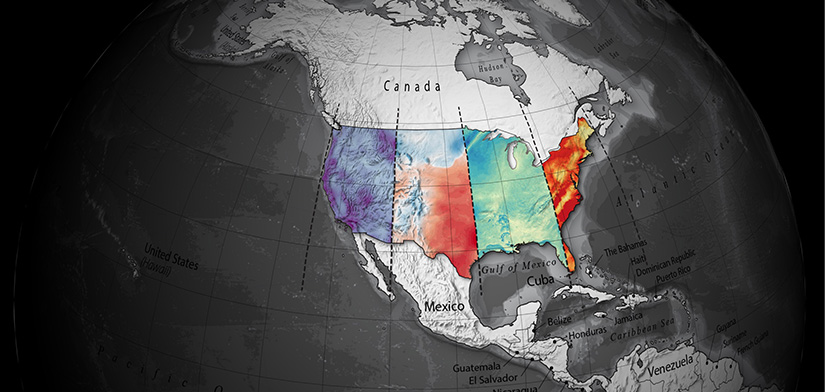
Climate and energy are increasingly intertwined. Now we have the tools to study both of them. Photo courtesy of NREL, Billy Roberts.
“Climate science is a complex field with huge amounts of data and large uncertainties, and there aren’t many resources for how that information can or should be applied to other areas of research,” Buster said. “At NREL, we aim to bring together the energy and climate modeling communities to effectively and appropriately use climate information to guide the design and operation of energy systems.”
Sup3rCC was created through a partnership of energy analysts and computational scientists at NREL to better incorporate multi-decade climate change and weather variability into energy system modeling. “This study bridges the gap between the energy system and climate research communities and significantly advances the developing field of energy-climate research,” said Bilello.
Harness the power of artificial intelligence
Sup3rCC overcomes the computational challenges of traditional dynamic downscaling techniques by leveraging recent advances in generative machine learning techniques called Generative Adversarial Networks (GANS).
“Generative machine learning is the foundational technology at the heart of our super-resolution approach,” said Ryan King, a computational researcher at NREL and co-inventor of Sup3rCC. “It’s impossible to do these analyzes without machine learning.”
Sup3rCC learns the physical features of nature and the atmosphere by studying NREL’s historical high-resolution datasets, including the National Solar Radiation Database and the Wind Integration National Dataset Toolkit. The model then injects the small-scale, physically realistic information learned from the dataset into the coarse-grained future output from the global climate model. As a result, Sup3rCC produces highly detailed temperature, humidity, wind speed, and solar radiation data based on the latest future climate projections. The output of Sup3rCC can be used to investigate future renewable energy generation, changes in energy demand, and impacts on power system operations. The initial Sup3rCC data set includes data for the contiguous United States from 2015 to 2059, with additional data sets expected to be released in the coming years.
Video: Heat Map of the United States.
Future wind, solar, and temperature data output from traditional global climate models (left) and output from Sup3rCC (right) show a striking contrast in resolution.
Graphics: Grant Buster, NREL
“Our super-resolution study is unique in that it simultaneously enhances spatial and temporal resolution, injecting much more information than previously possible,” King said. “Sup3rCC preserves the large-scale trajectories of climate simulations while giving them realistic small-scale capabilities essential for accurate assessment and load forecasting of renewable energy resources.”
Sup3rCC improves the spatial resolution of global climate models by a factor of 25 in each horizontal direction and the temporal resolution by a factor of 24. This means that the total amount of data increases by a factor of 15,000. The model can perform this process 40 times faster than traditional dynamic downscaling models, allowing energy system planners and operators to tackle large-scale planning directly.
This will allow NREL and other researchers to study future weather phenomena such as heat waves and the interaction of the power grid and renewable energy generation.
“Our approach significantly reduces the computational cost of producing high spatial and temporal resolution data by several orders of magnitude,” said King. “This allows us to take into account changes in renewable resources and electricity demand in future climate scenarios over several decades, which is critical for planning future energy systems.”
Superdata supports bigger and better research
The Sup3rCC data set joins NREL’s family of high-resolution data that has enabled a significant increase in large-scale renewable energy research. Output from Sup3rCC is compatible with NREL’s renewable energy potential (reV) models for studying wind and solar power generation and is interoperable with the entire suite of NREL modeling tools. Users can access Sup3rCC data on Amazon Web Services and run reV in the cloud from their desktops to see how wind and solar power, capacity, and system costs change under different climate scenarios.
The success of Sup3rCC and many other high-impact data-driven NREL projects was made possible by collaboration between two different centers that combined NREL’s key strengths in analysis and computing.
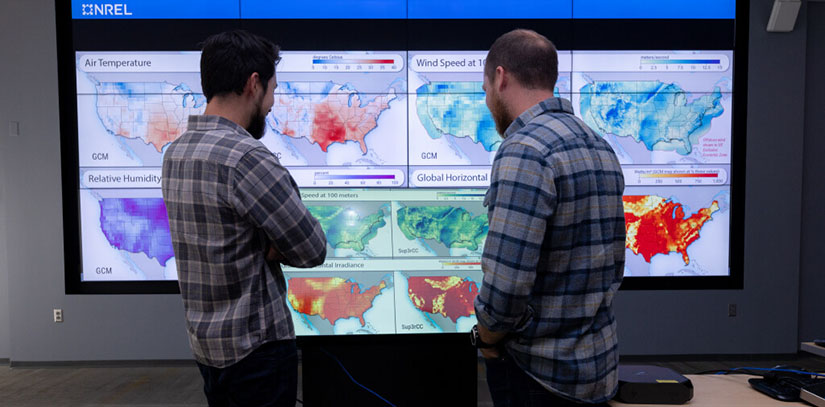
Sup3rCC was developed through an innovative collaboration. Photo credit: Joe DelNero, NREL
NREL’s Center for Strategic Energy Analysis is at the forefront of developing the data architectures and software solutions needed to power the Institute’s most high-profile data-intensive research, including the Los Angeles 100% Renewable Energy Study, the Puerto Rico Grid Resilience and Transition to 100% Renewable Energy Study, and the National Transmission Planning Study. Advanced data solutions make energy data more accessible, usable, and actionable for NREL researchers and engineers and beyond.
These advanced data solutions would not be possible without NREL’s Center for Computational Science, which uses computational techniques to develop groundbreaking interdisciplinary data acquisition and analysis. For example, in the LA100 study, a multidisciplinary team of dozens of NREL experts used NREL’s supercomputers to run more than 100 million simulations at ultra-high spatial and temporal resolution to evaluate various future scenarios for how LADWP’s power system might evolve to a 100% renewable future. This meaningful collaboration between analytics and computational science is advancing NREL research in energy efficiency, sustainable transportation, energy system optimization, and more.
“By collaborating with other centers and groups across the lab, we can improve NREL’s overall data capabilities,” Bilello said. “Through our collaboration, we are building a framework that will prepare us to tackle new and innovative data-focused research questions.”
Learn more about Sup3rCC
To learn more about Sup3rCC, visit the Sup3rCC open source code and data set, natural energy Articles about model and data releases.
Learn more about NREL’s energy analysis research or contact Grant Buster. [email protected].