
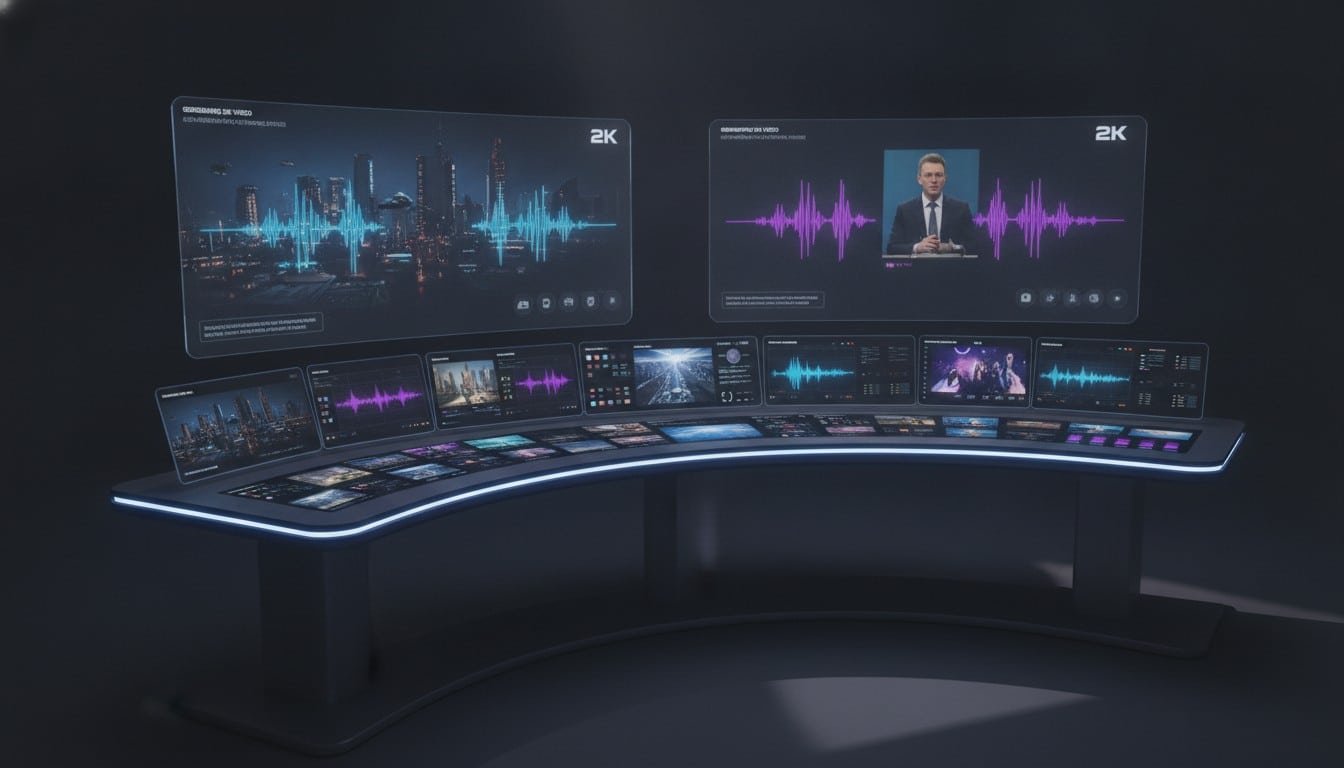
On July 31, 2026, Chinese AI company MiniMax released H3, a general-purpose multimodal video generation model that immediately climbed to the top of independent leaderboards. Within days, it became the first open-weight model to rank among the top three on the Artificial Analysis Video Arena, competing head-to-head with closed-source giants from Google and ByteDance. For creators, developers, and businesses exploring AI-generated video, MiniMax H3 represents a significant shift: frontier-quality video generation with native stereo audio, available through both a hosted API and downloadable model weights.
This guide covers everything you need to know about MiniMax H3, from its technical architecture and generation capabilities to pricing, licensing restrictions, and practical local deployment.
What Is MiniMax H3?
MiniMax H3 is an omni-modal generative model that accepts text, images, video, and audio as unified input context and produces video with synchronized stereo sound. Unlike earlier video generators that bolted audio on as a separate post-processing step, H3 generates picture and sound together in a single pass, at up to 2K resolution and 15 seconds in duration.
Key Features at a Glance
- Omni-modal input: Accepts text, images, video, and audio as unified context in a single prompt.
- Native stereo audio: Generates synchronized 32 kHz dialogue, ambient sound, and effects alongside video, not as a separate step.
- Up to 2K resolution: Outputs video at 2K through the hosted API, with 768p available through open weights.
- 4 to 15 second clips: Flexible duration at 24 FPS with aspect ratios from 21:9 to 9:16.
- 11 supported languages: Stable generation across English, Chinese, Japanese, Korean, French, German, Spanish, Portuguese, Russian, Arabic, and Italian.
- Open weights available: Downloadable model weights on Hugging Face, though with geographic and licensing restrictions.
The model is the third generation of MiniMax’s Hailuo video line, also marketed as Hailuo 3.0.
Who Is Behind MiniMax?
MiniMax is a Shanghai-based AI company founded in 2021, as detailed in its official H3 announcement. The company is also known for its MiniMax Music 3 AI music generation model. The company has raised funding from major investors, including Tencent and Alibaba, and it operates the Hailuo AI consumer platform alongside its enterprise API. MiniMax went public on the Hong Kong Stock Exchange under ticker 0100.HK, as Reuters reported at the time of H3’s launch. The company positions H3 as a tool for commercial content creation across advertising, e-commerce, product design, and gaming.
Technical Architecture: How H3 Works Under the Hood
H3’s architecture centers on the H3-Omni Transformer, a dense, single-stream model with 33 billion parameters spread across 50 layers. It uses a hidden size of 5,376 and 56 attention heads, with 3D multimodal Rotary Position Embeddings (RoPE) spanning temporal, height, and width dimensions.

The full inference stack is considerably larger than the core transformer alone. It includes a Qwen3-VL-32B text encoder, the H3-VAE for video encoding and decoding, and the Context-IR system for interpreting multimodal inputs. Together, these components total approximately 69.2 billion parameters.
Key Technical Components
- Contextual Omni Representation: Fuses text, image, video, and audio inputs into a single unified context representation, eliminating the need for separate expert models for each modality.
- H3-VAE: A high-compression video autoencoder that delivers a 4x gain in effective sequence length, enabling longer and higher-resolution generation without proportional increases in compute.
- H3-Omni Transformer: The core 33B-parameter model that processes the unified context and generates video frames with synchronized audio at 24 FPS and 32 kHz stereo.
- In-Context Regeneration: Instead of using a traditional super-resolution module that often blurs fine details, H3 regenerates its own low-resolution output in-context to produce sharp 2K video with accurate text rendering.
MiniMax reports that separating understanding and generation workloads during training lifted throughput by nearly 30%, and that data distillation compresses approximately 100,000 tokens of source inference material down to an average of 4,000 tokens for training.
Capabilities and Generation Modes
H3 supports three primary generation modes, each designed for different creative workflows.
- Text-to-Video: Generate video from a text prompt with synchronized audio.
- Image-to-Video: Animate a first frame, last frame, or bridge between two frames.
- Omni-Reference: Use up to 12 mixed reference files (images, video, audio) to guide generation.
Text-to-Video
The simplest mode: provide a text prompt and H3 generates a video clip with synchronized audio. Output ranges from 4 to 15 seconds at 24 FPS, with aspect ratios spanning from 21:9 to 9:16. The default resolution on the hosted API is 2K; the open-weight base model outputs at 768p.
Image-to-Video (First-and-Last-Frame)
The H3-Base-FL2VA variant supports zero, one, or two input images. With no image input, it operates as text-to-video. With one image, it generates video from a specified first frame or last frame. With two images, it interpolates motion between a defined starting and ending point, giving creators precise control over scene composition.
Omni-Reference Mode
The H3-Base-Ref2VA variant accepts up to 12 mixed reference files in a single generation: up to 9 images, 3 video clips (2 to 15 seconds each), and 3 audio clips. This mode enables motion transfer from reference videos, style guidance from images, and voice or sound direction from audio clips, all described and controlled through natural language prompts of up to 7,000 characters.
Director Mode and Advanced Controls
H3’s director capabilities allow users to specify camera movements, scene transitions, and character actions through natural language instructions. The model handles complex multi-modal references, meaning you can supply a product photo, a motion reference clip, and a voice recording, then describe the desired output in a single prompt. This unified approach replaces the fragmented pipelines that previously required separate models for text-to-video, image-to-video, voice synthesis, and sound effects.
MiniMax H3 vs. the Competition: Benchmark Comparison
Independent benchmarking from Artificial Analysis, which aggregates hundreds of thousands of blind human preference votes, provides the clearest picture of where H3 stands against competing models as of August 2026.

| Leaderboard | MiniMax H3 | Wan 3.0 | Gemini Omni Flash | Seedance 2.0 | Veo 3.1 | Kling 3.0 |
|---|---|---|---|---|---|---|
| Text-to-Video (with audio) | 1,228 (#3) | 1,244 (#1) | 1,245 (#1-2) | 1,221 (#4) | 1,089 (#13) | 1,106 (#9) |
| Image-to-Video (with audio) | 1,184 (#2) | N/A | 1,182 (#3) | 1,191 (#1) | 1,084 (#10) | 1,072 (#13) |
| Video Editing (with audio) | 1,130 (#2) | 1,192 (#1) | 1,122 (#3) | N/A | N/A | 1,000 (#8) |
| Open Weights T2V (no audio) | 1,303 (#1) | N/A | N/A | N/A | N/A | N/A |
H3 holds the top position among all open-weight models for text-to-video generation without audio, with an Elo score of 1,303. In the audio-enabled categories, it consistently ranks in the top three, competing closely with Alibaba’s Wan 3.0 and Google’s Gemini Omni Flash while significantly outperforming Google’s Veo 3.1 and Kuaishou’s Kling 3.0.
On the academic VBench-2.0 benchmark, MiniMax reports that H3 scored 84.7% overall, with particular strength in temporal consistency and physical plausibility.
Pricing: How Much Does MiniMax H3 Cost?
One of H3’s strongest selling points is its pricing. MiniMax has positioned the model as a cost leader, particularly at higher resolutions.
| Model | Resolution | Price per Minute | Price per Second |
|---|---|---|---|
| MiniMax H3 | 2K | $7.80 | $0.13 |
| MiniMax H3 | 768p | $4.80 | $0.08 |
| Gemini Omni Flash | 1080p | $6.00 | $0.10 |
| Veo 3.1 Fast | 1080p | $9.00 | $0.15 |
| Kling 3.0 (Pro) | 1080p | $20.16 | $0.34 |
| Seedance 2.0 | 1080p | $22.45 | $0.37 |
| Veo 3.1 | 1080p | $24.00 | $0.40 |
At 2K resolution, H3 costs less than one-third of what Veo 3.1 charges for 1080p. At 768p, it undercuts every major competitor except Gemini Omni Flash. A full 15-second 2K generation costs approximately $1.95, compared to $6.00 for the same duration on Veo 3.1 at lower resolution.
For the In-Context Regeneration pipeline (upscaling from 768p to 2K), MiniMax charges an additional $0.05 per output second. Context-IR token processing costs $0.90 per million input tokens and $3.60 per million output tokens.
Open Weights, Licensing, and Regional Restrictions
MiniMax published H3’s model weights on Hugging Face on August 3, 2026, under the MiniMax H3 Community License Agreement. However, the license carries restrictions that set it apart from truly open-source releases like Meta’s Llama or DeepSeek’s models, or even other open-weight video models like Lightricks’ LTX-2.5.
Geographic Exclusions
The most significant restriction: the Community License explicitly excludes the United States, the European Union, the United Kingdom, and South Korea from its definition of “Applicable Territory.” Under Sections I.3, I.5, and V.4 of the license, users in these regions are not authorized to use, run, modify, distribute, or even deploy the outputs of locally-run H3 weights.
This means a developer in Germany, a studio in California, or a company in London cannot legally download and self-host H3 under the default community license. MiniMax cites “a more complex and rapidly evolving regulatory environment” for generative video models as the reason for these exclusions.
The hosted API remains globally available in all regions, including excluded territories. API access operates under a separate legal relationship where the user is a customer of a hosted service rather than a licensee of the underlying weights.
Revenue Cap and Commercial Use
Organizations with annual revenue under $20 million can use H3 commercially under the Community License at no cost. Companies exceeding that threshold need prior written authorization from MiniMax. The license also prohibits using H3 outputs to train or distill other AI models.
Applying for a Separate License
Users in excluded territories can contact MiniMax to negotiate a separate license agreement. MiniMax has stated it will consider individual authorization for applicants who commit to content compliance mechanisms meeting their region’s legal requirements. However, there is no public self-serve process for this; it requires direct engagement with MiniMax’s licensing team.
What “Open Weights” Actually Means for H3
It is important to understand what the open-weight release includes and what it does not. The downloadable weights provide the H3-Base model, which generates video at 768p resolution. The 2K upscaling module (H3-Regenerate-2K) and the Context-IR multimodal prompt processing system were not included in the weight release. These components remain hosted-API-only, meaning the full 2K experience is not reproducible locally.
The weight files themselves are substantial: approximately 134 GiB per task partition (FL2VA or Ref2VA) in BF16/FP32 precision, with the full repository approaching 330 GiB on disk.
Running MiniMax H3 Locally: Hardware and Setup
For users outside the excluded territories who want to self-host H3, the hardware requirements are significant but not insurmountable for well-equipped studios and research labs.

Storage Requirements
A single task partition (either FL2VA for text/image-to-video or Ref2VA for omni-reference mode) requires approximately 134 GiB. Running both partitions demands roughly 196 GiB deduplicated, or up to 330 GiB for a full repository checkout. Plan for NVMe SSD storage accordingly.
GPU and Memory Requirements
| Hardware Setup | Precision | Peak VRAM per GPU | Latency (5s clip) |
|---|---|---|---|
| NVIDIA B300 (8-GPU) | BF16 | 52-84 GB | ~19 seconds |
| NVIDIA H100 (4-GPU, TP2) | BF16 | ~66 GB | ~13 seconds |
| 2x RTX 5090 (32GB) + 384GB RAM | BF16 (offload) | 32 GB + system RAM | ~9.3 minutes |
Datacenter deployments on 4 to 8 high-end GPUs provide the cleanest experience, generating a 5-second clip in 13 to 19 seconds. Consumer hardware is possible with aggressive memory offloading, but expect generation times measured in minutes rather than seconds. Community members have reported approximately 160 seconds for a 5-second 480p clip and around 560 seconds at 720p on an RTX 5070 Ti with 32GB VRAM and 64GB system RAM.
ComfyUI and Community Workflows
The ComfyUI community has developed workflows for running H3 locally, with several key characteristics:
- GGUF quantization: Reduces memory footprint for consumer GPUs at the cost of some output fidelity.
- FL2VA mode support: Text-to-video and first/last-frame generation work in current community builds.
- Ref2VA limitations: Omni-reference mode has more limited community support and requires additional setup.
- Custom nodes required: Community implementations typically need ComfyUI with specific H3 nodes installed.
These community workflows make local experimentation accessible, though the hosted API still delivers superior quality at 2K resolution with the full Context-IR pipeline. For most creators and businesses, the hosted API remains the practical choice: it provides full 2K resolution, the complete Context-IR pipeline, and global availability without hardware investment or licensing concerns.
Frequently Asked Questions
Is MiniMax H3 free to use?
The hosted API is not free; it charges per second of generated video ($0.08/sec at 768p, $0.13/sec at 2K). The open-weight model is free for organizations under $20M in annual revenue, but only in non-excluded territories. Users in the US, EU, UK, and South Korea must use the hosted API or negotiate a separate license.
How does MiniMax H3 compare to Google Veo 3.1?
H3 significantly outperforms Google’s Veo 3.1 on the Artificial Analysis leaderboard across all categories, with a 139-point Elo advantage in text-to-video with audio (1,228 vs. 1,089). H3 also costs roughly one-third the price at comparable or higher resolution. Veo 3.1’s main advantages are 4K support and seed-based reproducibility for consistent outputs.
Can I run MiniMax H3 on a Mac?
There are no published benchmarks for Apple Silicon performance. The model’s memory requirements (52 to 84 GB VRAM in datacenter configurations) exceed what current Mac hardware can provide in unified memory, though community experimentation with quantized versions on M-series chips with 128GB+ unified memory is ongoing.
Does MiniMax H3 generate audio?
Yes. H3 generates native 32 kHz stereo audio synchronized with the video in a single pass. This includes dialogue, ambient sound, and sound effects. The audio is not added as a post-processing step; it is produced alongside the video frames during generation.
Is MiniMax H3 truly open source?
No. H3 is released under a community license with significant restrictions: geographic exclusions for the US, EU, UK, and South Korea; a $20M revenue cap for commercial use; and a prohibition on using outputs for model distillation. The 2K upscaling and Context-IR components are not included in the weight release. This is more accurately described as “open weights with restrictions” rather than open source.
What is the difference between Hailuo 3.0 and MiniMax H3?
They are the same model. Hailuo is MiniMax’s consumer-facing brand (hailuoai.video), while MiniMax H3 is the official model name used in technical documentation and the API. The Hailuo AI platform provides a user-friendly interface to the same underlying H3 model.
The Bottom Line
MiniMax H3 represents a genuine step forward for AI video generation. It combines omni-modal understanding, native stereo audio, and competitive pricing into a package that outperforms many closed-source alternatives on independent benchmarks. The open-weight release, despite its restrictions, gives developers outside the US, EU, UK, and South Korea the ability to run and customize a frontier video model locally.
For creators in excluded territories, the hosted API provides full access to H3’s capabilities at prices that significantly undercut competitors like Veo 3.1, Kling 3.0, and Seedance 2.0. The licensing restrictions are worth monitoring as regulatory landscapes evolve, but they do not diminish the model’s technical achievements or its practical utility through the API.


