

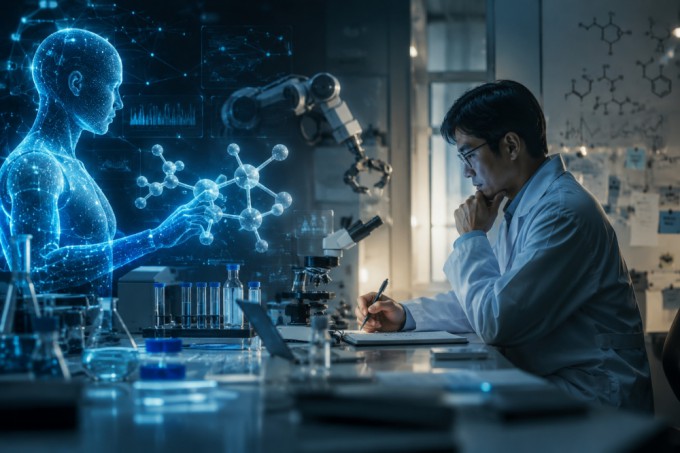
The Ministry of Science, Information and Communications is promoting the following projects: develop Artificial Intelligence (AI) “co-scientists” who do the actual research in the lab. The goal is to create domain-specific artificial superintelligence (ASI)-level artifacts with capabilities far beyond humans.
In order to ensure national competitiveness, the ministry announced plans to build AI models specialized in science and technology such as biotechnology, geology, mathematics, materials, chemistry, semiconductors, displays, and secondary batteries.
AI will also be introduced to research and development management. The ministry hopes to realize full-scale innovation by incorporating AI into its research and development administration. However, “AI administrative colleagues” will be developed directly by government officials. The ministry said it is already rapidly building AI “colleagues” that analyze trends in key power technologies, the landscape of innovative companies by region and the distribution of companies across investment stages.
No one can deny that “generative AI”, which first appeared in November 2022, has amazing potential. It is also true that AI has acquired considerable inference ability that goes beyond simple data organization and analysis.
Still, no one can guarantee whether current generative AIs can truly act as “colleagues” for human scientists in the lab or government officials in the ministries. Rather, we should be concerned about the possibility that AI colleagues could undermine research ethics and administrative fairness, cutting off the lifeline of human resource development.
●AI that won the Nobel Prize
There’s no denying that generative AI is transforming the world. Scientific research and science and technology administration are no exception. In fact, the “AI research colleagues” that the Ministry of Science, Information and Communications is eagerly awaiting is not a distant future.
Chemistry, long fascinated by graphics and other advanced information technologies, is leading the way. “AI chemists” who use synthetic AI to design and execute synthetic routes for actual compounds are on the verge of practical application. It aims to analyze the many factors that experimental chemists must consider, design optimal conditions and routes for molecular synthesis, and identify the most appropriate reagents and experimental methods.
In addition to self-searching and learning resources from Wikipedia, the American Chemical Society (ACS), and the Royal Society of Chemistry (RSC), AI chemists also directly control lab robots to conduct real-world experiments that mix and heat liquid samples. It can also autonomously correct and improve errors in the code used to control these robots.
Demonstrating impressive performance, we successfully engineered a Suzuki reaction using palladium catalysts in less than 4 minutes, which is widely used in the synthesis of simple organic compounds such as aspirin and paracetamol, as well as in pharmaceutical synthesis.
Unlike human chemists, AI chemists can continuously generate ideas, run experiments, and identify improvements 24 hours a day. We may need to worry about the possibility of human chemists being “kicked out” of the laboratory. In that sense, the situation facing human chemists in the lab is not that different from that of factory workers who fear the arrival of humanoid robots on their assembly lines.
AI in the lab is no longer in its rudimentary development stage. It has already achieved remarkable success. In fact, the 2024 Nobel Prize in Physics and Chemistry will be dominated by artificial intelligence.
The physics prize went to John Hopfield of Princeton University and Jeffrey Hinton of the University of Toronto for building the foundations of machine learning using artificial neural networks. The chemistry award went to David Baker of the University of Washington, who developed AI-based software to predict and design protein structure and function, and Google DeepMind CEO Demis Hassabis and senior research scientist John Jumper.
● Good rhetoric hides deep data dependencies
Generative AI’s most powerful weapon is its mastery of language. No ungrammatical sentences are generated, and there are no hesitations, redundancies, or ramblings. All sentences are concise and clear.
The story structure has a clear beginning, development, turns, and conclusion, and the argument is free of forced logic, leaps, and exaggerations. Generative AI’s incredible persuasive power stems precisely from this impressive rhetorical fluency. Just as it is difficult to casually dismiss someone who has extraordinary eloquence.
This incredible fluency comes from large-scale language models (LLMs), which apply statistical methods to knowledge about individual words within a sentence. By stringing words together into probabilistically plausible sentences that match the learned patterns, the generative AI ends up demonstrating the kind of exquisitely sophisticated rhetorical skills that are difficult to match.
However, the ability to “explain” a concept in language is different from accurately understanding that concept and actually “using” it. This point has been raised by Meta’s Yann LeCun and AI philosopher Jacob Browning. We should not confuse the “shallow understanding” of language models with the “deep understanding” that humans acquire by living in the world and interacting with other people and cultures.
Some have harshly concluded that generative AI is nothing more than a “probabilistic language combination program” that completely ignores coherent logical systems. If we’re not careful with immature generative AI, we may end up reliving the exhausting “science wars” sparked by New York University mathematical physicist Alan Sokal in 1996, this time as part of our daily lives.
The cold reality is that the quantity and quality of data available for AI deep learning will always be insufficient. In reality, it is impossible to provide an unlimited supply of high-quality data to train general-purpose generative AI.
After all, generative AI that must rely on whatever data humans can realistically provide is doomed to suffer from “illusions” that cannot be completely avoided. This means you must always be on guard against errors in trend analysis and similar output produced by generative AI.
In reality, generative AI cannot distinguish between “truth” and “falsehood” or between “good” and “bad.” Furthermore, it is difficult to expect generative AI to have anything like human “creativity” or a human “self.”
Because generative AI cannot formulate truly original questions on its own, it will not be able to uncover new scientific facts hidden in nature like Einstein or produce imaginative literary works like Shakespeare. Of course, we cannot expect to create an original artistic style like Salvador Dali. We should heed linguist Noam Chomsky’s warning that generative AI is nothing more than a low-level “plagiarism machine.”
Some observers have warned that we need to be wary of “deliberate” lies in generative AI. There is a system of brazenly betraying others, boasting, and deliberately deploying deception. For this reason, there are growing calls for the government to quickly enact an “AI safety law” that would regulate the possibility of AI tricks.
● Creativity and ethics remain the responsibility of human scientists.
AI is great, but it is not an all-powerful “magic wand.” Nor can we expect AI to have the “creativity” necessary to discover completely new routes that no one has ever discovered before. We must not let our guard down in the face of AI’s sophisticated rhetoric.
AI has the potential to contaminate scientific literature. Generative AI could be the most practical tool for fabrication, falsification, and plagiarism, three forms of fraud that scientific research strictly strives to eliminate. In particular, bibliographic information provided by generative AI should never be relied upon uncritically.
It is entirely up to us to prevent generative AIs with “good rhetoric” from degenerating into new “bad actors” in laboratories that disrupt scientific research practices. human scientists.
We need specific and explicit education and guidelines on the use of generative AI in analyzing research results and writing papers. Be very careful about premature enthusiasm for “AI research colleagues” or “AI management colleagues.”
Berkeley Law’s recently adopted strict “AI policy” is worth considering as a guide. At its core is ensuring that human scientists are clearly aware of this imperative. Before using AI co-scientists, human scientists themselves must have sufficient “thinking skills” and “cognitive abilities.”
We should not expect our AI research colleagues to define research topics or write papers for us. We must never forget that the actors responsible for implementing national research and development programs are, and must continue to be, “human scientists.”
*About the author
Lee Deok Hwan He is Professor Emeritus of Chemistry and Science Communication at Sogang University. He served as the president of the Korean Chemical Society in 2012 and has published more than 3,200 columns and papers on social issues such as science and technology, education, energy, environment, and public health. he translated It seems so, but it’s actually not, A short history of almost everything, the missing spoon (Korean title: History of atoms that make up our bodies), alchemy of illnessand Now: the physics of time (Korean title: science now) is the author of Lee Deok Hwan’s Science World.
CopyrightⓒToa Science. Unauthorized reproduction is prohibited.


