Singapore – A registry of artificial intelligence agents is being developed to help Singapore’s 150,000 civil servants use cutting-edge AI in their work without compromising data security.
This registry is a safeguard for tracking the ownership and activity of AI agents that can make decisions and take actions at machine speed.
This is part of a suite of tools being rapidly developed at the Government Technology Agency (GovTech) to improve oversight of government employees. AI is increasingly used for everything from coding to report generation to meeting scheduling.
The suite, called AI Assistant Desk, aims to provide all government employees with a secure personal digital assistant, GovTech chief executive Goh Weiboon told The Straits Times.
“We want to help people use AI agents correctly, with a layer of customizable rules, sanctioned AI tools, and registries to improve visibility and security,” Goh said.
AI agents can use tools on a computer just like human users, actively understanding the sequence of steps needed to make online transactions or perform risk assessments with minimal or no human intervention. This is made possible by advances in natural language processing and reasoning, allowing AI to understand and dynamically respond to human language.
The AI assistant desk is still in development and being tested by some civil servants ahead of a wider rollout planned for late 2026.
The use of AI agents by the public sector is part of a larger national goal to push the boundaries of AI automation. On August 28, 2025, Digital Development and Information Minister Josephine Teo said the public sector is already experimenting with AI agents, for example to help navigate administrative requirements across multiple agencies, such as business license applications and social assistance documentation.
Goh said the AI Assistant Desk’s security layer remains the same even when third-party AI tools are added or replaced. Security measures might include preventing the agent from deleting files or sending email to external recipients, or imposing restrictions on recipients. Minimize spam.
The automated hygiene checker built by GovTech also ensures that no offensive language is used in the prompt or that the AI output does not contain offensive language.
This kind of granular control is consistent with GovTech’s original mission of empowering the public sector to become autonomous technology users.
The agency launched in 2016 with 1,800 employees and has since spearheaded technology transformation in the public sector. Today, our 3,900 employees support the technology needs of more than 50 public sector organizations.
In addition to managing current IT infrastructure, GovTech is driving large-scale AI deployment for 150,000 civil servants to Integrate AI into your daily work.
“It brings technology closer to the field, enabling teams closest to real-world problems to develop more agile and impactful solutions,” Go said. “This evolution aims to transform agencies into stronger product owners by building deeper in-house capabilities.”
GovTech has approximately 1,600 engineers on an ongoing basis in various government agencies. For technical support. However, with AI-assisted coding removing technical barriers, civil servants without engineering backgrounds are increasingly expected to proactively design and propose workflow automation.
Govtech’s The first hackathon – called {build} – was held in 2025 and 600 civil servants participated. Several projects have since been developed into working prototypes and are currently undergoing testing.
One example is an AI marking assistant called Mark.ly, which is currently being piloted in 18 local schools. This tool aims to help teachers mark handwritten English, Geography, and History scripts faster and more consistently. The tool will be integrated with Google’s classroom tools that teachers currently use, as well as future versions of the existing Student Learning Space e-learning platform.
Another example is LangBuddy, a web-based AI voice-enabled chatbot designed to help students improve their native language. The virtual bot can converse with students in Chinese, Malay, and Tamil. If a student stumbles, such as using an English phrase in a sentence, the bot will step in and provide a translation. LangBuddy is currently being piloted with around 300 students from 10 secondary schools and junior colleges, with more schools expected to join.
Leading by example from the public sector, GovTech engineers are already using AI-assisted development tools, but non-engineering teams are increasingly using low-code AI tools to support their work.
This reflects a broader national effort to achieve AI fluency, defined as the ability to combine domain expertise and AI know-how to solve real-world work problems. Singapore’s goal is to have 100,000 AI-proficient talent across all sectors by 2029 through customized upskilling programmes.

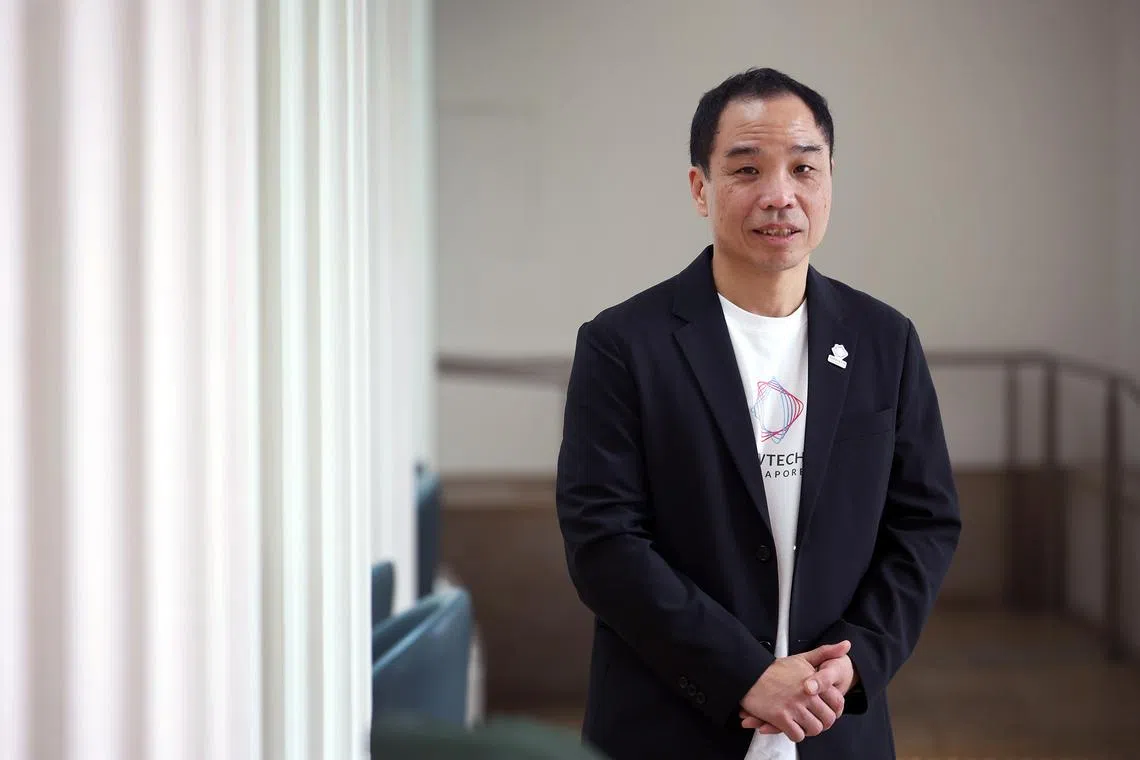
Goh Wei Boo, chief executive officer of GovTech, said the AI Assistant Desk’s security layer remains the same even if third-party AI tools are added or replaced.
Photo: Jason Quar
More than half of Singapore’s 150,000 civil servants already regularly use Pair, the government’s AI chatbot, to improve productivity, writing and research, according to GovTech.
Cybersecurity is another key pillar of Singapore’s drive to adopt advanced AI across the country.
GovTech develops AI tools to conduct automated penetration tests on approximately 2,000 government systems containing citizens’ data and transactions. Penetration testing (or “penetration testing” in technology parlance) is the practice of simulating authorized hacks of computer systems to identify and fix vulnerabilities before malicious hackers can cause actual damage.
“This process is very time-consuming. You can do it manually yourself or hire a vendor to do it for you. It can take months each time, which is not very sustainable,” says Goh. “If you ‘penetrate test’ every year, you’re only safe once a year, right? With AI automation, you can test your systems continuously.”
The use of AI has become important after the cyber-espionage group UNC3886 attacked a telecommunications company in Singapore in 2025.
GovTech has been using automated penetration testing tools since January. Plans are underway to gradually expand the use of AI tools for automated penetration testing across government.
Since October 2025, GovTech is incorporating AI smarts into its threat detection tools to protect public sector systems. These AI tools are designed to proactively identify traffic anomalies, helping government agencies detect stealthy cyber threats.
“These developments are critical to Singapore’s ongoing digital transformation to better deliver public services and ensure national security,” Mr Goh said. “With rising expectations and a rapidly evolving threat environment, our job is more than just maintenance.”