At least that’s what Norbert Barszczewski, the video’s creator, told me. Barszczewski lives in Poland and is something of an expert in A.I. slop. For more than a decade, he made some money posting video-game commentary on a YouTube channel, but he struggled financially and was constantly looking for other ways to make money online. Videos often came across his social media feeds telling him how to earn a quick buck, doing things like drop shipping (getting paid to sell products on behalf of retailers) or trading cryptocurrency. These were mostly scams, selling overpriced online “courses” or seeking to extract credit card numbers. But in the spring of 2025, Barszczewski saw a video promoting an advertising company called Affiliate Network. It was looking for people to make A.I. videos.
[0–>
There were no job requirements. Creators were simply expected to make new, anonymous social media accounts and post videos every day. The more views the videos got, the more money the creators would make, at a rate of about $2 per thousand views. Barszczewski didn’t need to pay for anything. Affiliate Network would even teach him how to generate videos. Though wary of how easy it all sounded, he signed up and spent the next half year figuring out how to go viral.
Because TikTok and Instagram limit the number of accounts you can manage on one device, Barszczewski bought multiple phones and scrolled through feeds daily, trying to identify trends. He applied to create advertising videos for an Affiliate Network campaign and posted constantly. Very little came of it; he barely made any money in his first months with the network.
There’s no exact science to virality in the age of A.I. One post might get a million views; a nearly identical post might get eight. But Barszczewski did manage to pick out some broad patterns:
He had previously thought that the best A.I. content mimicked human-made content, but it turned out that many of the most viral videos had their own logic.
Late last year, Barszczewski began playing around with videos for a new Affiliate Network ad campaign promoting an A.I. video-generating platform. Creators were required to use characters already on the platform — like Tung Tung Tung Sahur — and link to the company captioned in the videos. But when Barszczewski realized he could also introduce his own characters to the platform, he saw an opportunity: Instead of being limited to the existing brain rot, he could create new characters so unapologetically stupid that viewers would laugh in disbelief at their very existence.
After a few misses, he came up with a mustachioed version of Tung Tung Tung Sahur — with traits taken from another brain-rot figure called Amir — and the first video featuring the character he calls Tung Tung Tung Amir took off. Barszczewski is not really sure why, but the next one did as well, and so did the one after that. His TikTok channel gained tens of thousands of subscribers and began raking in millions of views every month. The girlfriend video has received more than 1.7 million views.
Money followed. In April, Barszczewski wrote on the Affiliate Network Discord channel, “Everything is possible bros, trust in Affiliate Network team with all your heart and you will not regret it.” He added that “you will all change your life for the better” and included a picture showing that in March, after posting 296 videos over the course of a month, he had been paid $37,281.94.
[0–>
The line between advertising and entertainment has become blurred in the internet age. Food reviews might turn out to be paid for by restaurants; the top-rated ergonomic chair in a listicle might be one produced by the company that owns the website; singers in music videos sip from glasses with logos carefully turned toward the camera. Because the best advertising is, as the 1980 trade book “Positioning: The Battle for Your Mind” puts it, “like a light fog, a very light fog that envelops your prospects,” the more exposure an ad gets, the better it works. This is why successful advertising today is so much about going viral. Roman Khaves, the founder of Affiliate Network, echoes the accepted wisdom when he tells me that “attention is the most valuable resource in the world.”
Khaves is 35 and has been running social media promotions under one name or another since his senior year of college. Affiliate Network, his most recent endeavor, is best described as a social media middleman that links businesses with online content creators who make ads for them. Early on, most of these creators were influencers with large followings who would post raves about a product or suggest the utility of some service. (Many content creators still make their money through these sorts of deals.) But in recent years, as platforms like TikTok, Instagram and YouTube began relying on personalized algorithms to determine what viewers see, the identity of a post’s creator became less important; the trick became producing whatever content the algorithm was determining to be popular.
In 2023, to adapt to this shifting prospect, Khaves and his team began recruiting content creators to advertise one of his own products — an A.I. dating assistant called the RIZZ App — through Affiliate Network with promises of easy money. One video format, called Texting Stories, consisted of fabricated messages scrolling above gameplay, as might be seen in Minecraft, until an advertising plug is worked into the conversation. This format operated on the same principles of virality you can see in Barszczewski’s videos: hook viewers quickly, play to their desires, get weird.
As Texting Stories spread across social media (sometimes gaining tens of millions of views), Affiliate Network started to use the principles for recruiting, as well. One Affiliate Network video begins with a man filming an intersection from behind the wheel of a BMW. Pointing at the passing cars, he narrates: “Nine-to-five, nine-to-five, nine-to-five, nine-to-five — you notice how everybody who works a nine-to-five doesn’t drive this?”
Then the video cuts to a different man, standing in a yard, who says, “Skipping this video is possibly the dumbest thing that you could ever do.” The man goes on to explain how he made more than a hundred dollars on a post from an account with fewer than 40 followers — and he did so “in four simple steps,” which consist of creating a new social media account, going to Affiliate Network and signing up to make advertising videos as instructed. “And no, this isn’t a get-rich-quick scheme,” the man continues. “But if you do post consistently and take action, you will see results.”
Pedro Camargo, a 21-year-old from Mato Grosso, Brazil, heard about the RIZZ App and Affiliate Network from a friend in 2024. Camargo had been casually posting content on YouTube for years, but it took a lot of effort for little payoff. At a time when the output from A.I. video generators was beginning to improve in quality, Affiliate Network was shifting its approach by recruiting creators to make what would come to be called A.I. slop.
Once, slop was just what was fed to pigs: scraps of unwanted food and refuse. It’s not that pigs wouldn’t have enjoyed a salmon fillet; it’s that they were also content to eat old lettuce and bread, so throwing barely edible things together in a trough was the cheapest and easiest way to fatten them up. To understand modern slop, you have to think of humans as consuming content in the same way that pigs consume food. The goal of pig slop is to maximize nutrient intake while minimizing cost; the goal of A.I. slop is to maximize time spent consuming content while minimizing cost. There’s comedy slop, literary slop, art slop, niche slop, slop for kids, political slop — but the substance of slop always matters less than the fact that you’re looking at it.
Under Affiliate Network’s new slop paradigm, Camargo didn’t need a camera or equipment. He could use ChatGPT to make a script, then feed that script into another A.I. program called Vsub, which for $99 a month enabled him to generate enough content for five ready-to-publish videos every day. It didn’t take Camargo long to get the hang of it. “I’m just here, I get up, I go to the P.C. and I make,” he told me on a video call from his bedroom. Within a year, he had made $78,000.
When a company hires Affiliate Network, it agrees on a campaign with Khaves’s organizational team, settling on the video’s format, the way in which the product must be advertised, the amount of money paid per thousand views and any content that’s off limits. This is not an unusual arrangement these days, as more so-called digital promotion companies have emerged in recent years with claims of being able to game social media algorithms. Their method is to pump out mass-produced “clips” from longer videos and fabricate posts stylized to seem authentic.
[0–>
Some of Affiliate Network’s more than 50 current clients include the prediction market Kalshi, the cryptocurrency platform Pump.fun, the male beauty app LooksMax AI and the online casino BiggerZ. As a creator, once you join the network, you can apply to work on specific campaigns (most of which are based on A.I. slop), and your application will be evaluated by a campaign manager. Posts are submitted to an oversight team. Although most creators make very little money in this way — Khaves told me that the top 10 percent of creators on his platform make 90 percent of the money — success stories are widely shared, which attracts more recruits. In the last three years, more than 200,000 people have joined Affiliate Network.
One afternoon in May, I visited Khaves and a handful of his co-workers at Affiliate Network in a meeting room at the top of Khaves’s apartment building, not far from where he grew up in south Brooklyn. I was curious about whether they had any qualms about their work. It’s not hard to make an argument against what they’re doing: profiting by supplying the sort of content that satisfies our mindless desire for dopamine hits and immediate gratification.
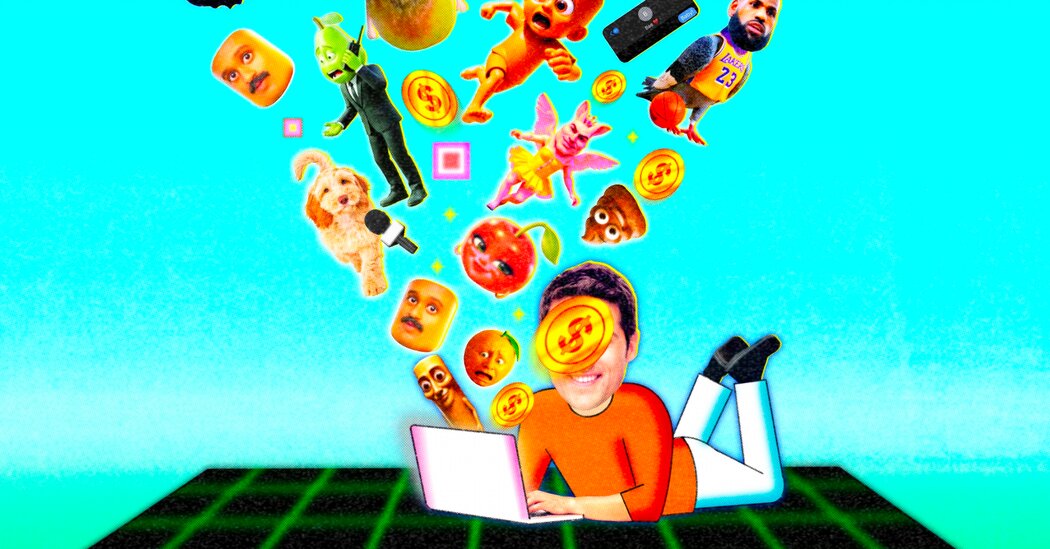
But Khaves and his employees were surprisingly earnest about their work — and the potential criticisms of it. They often referred somewhat enviously to the “Fruit Love Island” genre of video that had been circulating recently. In these microdramas, A.I.-generated anthropomorphized fruits with names like Watermelina and Bananito compete on dating shows, cheat on each other and have babies that look suspiciously like their paramour fruits. The original series, posted through a TikTok channel called ai.cinema021, gained more than three million followers in nine days and became one of the fastest growing channels in the platform’s history.
For many, this looks like paradigmatic slop, but when I suggested as much to the Affiliate Network team, Sean Kim, a 25-year-old computer engineer, disagreed. “As much fun as we make about Love Island fruit,” he said, “they’re making characters, and they’re telling a story.” Netflix has been using A.I. in its special effects, he pointed out, and large advertising agencies used it in Super Bowl commercials.
But if simply using A.I. doesn’t make something slop, what does, then? Appealing to instant gratification? A lack of narrative continuity? Those qualities also characterize many artworks. Parents used to tell their children that television rots the brain; now it’s considered a medium for legitimate art. In Proust’s “In Search of Lost Time,” Marcel’s grandmother dismisses “light reading as unwholesome as sweets and cakes.”
Indeed, the makers of A.I. content will tell you that craft is essential — that a certain knack is required to make “amazing content,” as Khaves puts it. Sudharshan Mahesh, a slop creator based in India, told me that the many channels with completely A.I.-automated material “really suck.” The pacing is wrong, the editing unnatural. “To make quality content,” he said, “you need human touch.” Trends change quickly, too, which can render virality one month irrelevant the next. Barszczewski told me that his success depends as much on a knowledge of human nature as of the algorithm. He doesn’t spend much recreational time on TikTok, and his goal is to evoke as much emotion as possible in 10 seconds. “I try to make videos in ways that make me laugh,” he says.
There are, of course, other criticisms that can be leveled at A.I. slop: its contribution to reduced attention spans, a lack of human connection, an increasingly fuzzy border between advertising and entertainment, the eternal return of Tung Tung Tung Sahur. But, when I brought these things up with Khaves and his team, I heard a kind of social critique echoed back to me. Slop, they said, is the art of democracy. Khaves kept mentioning that “a guy in his parents’ basement” could now influence a large part of the culture. Kim added: “A 15-year-old can directly compete with the biggest ad agency in New York. And it’s kind of beautiful.”
Barszczewski now works closely with the management at Affiliate Network, where he is one of the company’s top earners. He plans to pay the court fees for his parents, who have been living under the threat of eviction, and buy a house for them. “If I am able to continue this a few months further, then I will certainly,” he told me. He insisted that his life had completely changed for the better. “The best part of it,” he said, choking up, “is that it is actually the beginning.”