The shift from on-premises computing to software as a service changed the technology model and forced information technology organizatios to modernize how it builds, buys and operates software.
It also reshaped how software vendors price, deliver, and add value. But for most buyers, SaaS didn’t fundamentally change how the company made money or how work got done day to day. The business became more agile and IT became less of a friction point, but the operating model of the enterprise largely stayed intact. SaaS transformed software companies and IT departments first – and mostly stopped there.
How this AI wave is different
Artificial intelligence is different. In our view, this wave reaches past the IT function and into the core mechanics of the enterprise – how decisions get made, how work gets executed, how risk gets governed and how capital gets allocated. The reason is most companies still run as federations of departments with their own application stacks, their own data models and business logic trapped inside systems that were never designed to coordinate as one. Those systems can be “deterministic” inside a silo, but across silos the enterprise runs on reconciliation – spreadsheets, meetings, approvals and tribal knowledge. That’s not an IT problem. That is an organizational tax.
The promise of AI is to eliminate much of that tax. Not by sprinkling copilots onto yesterday’s apps, but by bringing probabilistic intelligence into the enterprise in a way that is governed by deterministic constraints. Frontier models are the core engine of this shift – they are getting more capable and more functional, and they will remain a linchpin of the future software stack.
But model power alone doesn’t solve the enterprise problem. The winners will be the organizations that build a complete system around those models – one that connects to existing deterministic applications, creates a shared truth layer, controls agents as they take action, and uses human feedback to continuously improve.
This is why we believe the upside is so large. Enterprises that get this right won’t just run more cheaply – they will run differently. They will scale with less proportional labor growth, compress cycle times from insight to action, and start to behave more like platform companies, with compounding advantage that is difficult for competitors to copy.
In this Breaking Analysis, we use George Gilbert’s model to describe how that transformation unfolds – and why it requires a complete stack revolution to provide:
- A way to preserve and extend deterministic applications while probabilistic systems reason across them;
- A System of intelligence layer that harmonizes enterprise truth in real time so agents can act with confidence;
- An agent control and engagement loop that keeps humans in the approvals, exceptions and learning cycle.
Enterprise software today and the deterministic myth
The slide below gets to the core tension we keep coming back to in Breaking Analysis” Enterprises want deterministic outcomes, but they are trying to bolt probabilistic systems onto an environment that is not actually deterministic in practice. Generative AI is probabilistic by nature. If agents are going to take action confidently, the surrounding system has to provide guardrails, shared semantics and predictable recovery. The problem is that the “deterministic software stack” most enterprises point to is really a jungle of disconnected application islands as shown here.
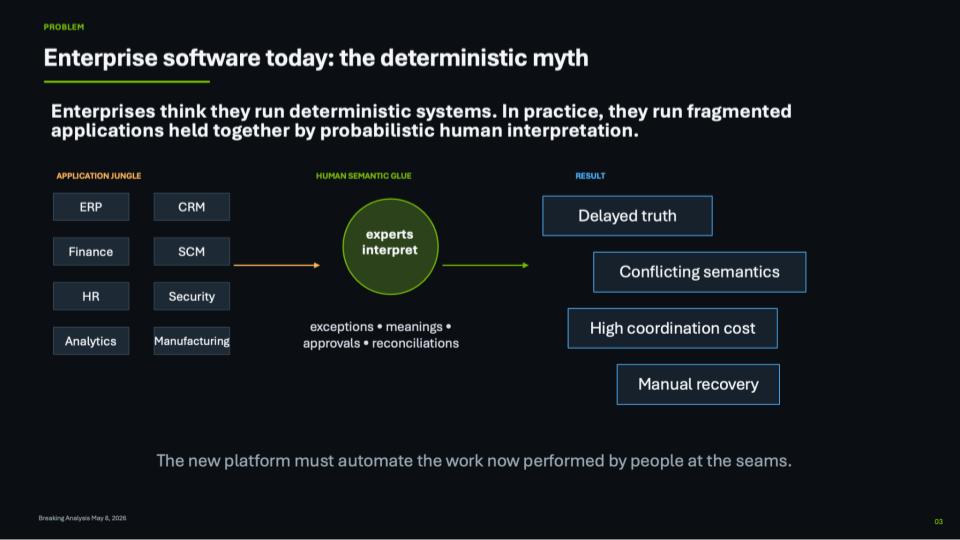
On the left above are the application domains (enterprise resource planning, customer relationship management, finance, supply chain management, human resources, security, analytics, manufacturing and more). In the middle is the real integration layer enterprises rely on today – human experts with their own tools (for example spreadsheets) interpreting exceptions, meanings, approvals and reconciliations using tribal knowledge. On the right are the business friction that falls out from that approach:
- Delayed truth: The “truth” shows up late because it’s reconciled after the fact.
- Conflicting semantics: The same term can mean different things across systems and departments.
- High coordination cost and lots of human hours wasted: Meetings, spreadsheets, rework and escalation paths become part of and essentially define the operational model.
- Manual recovery: When something breaks, humans reconstruct state and intent.
There’s a point here that we think is deceptively important. Even though the applications themselves are deterministic, the amount of human semantic glue required to make end-to-end processes work means the outcome becomes effectively probabilistic. Same inputs do not reliably produce the same outputs because interpretation, exception handling and cross-department coordination vary by person and circumstance. We compare this to a craft-work economy – before the assembly line, every part was slightly different, so every finished product was slightly different. That is what enterprise operations look like today in many companies – deterministic machines, craft processes.
The implication is economic. When outcomes depend on human glue, costs rise with revenue because scale usually means more coordination, more exceptions, more specialists and more management overhead. The goal, in our view, is to make knowledge work more repeatable: Add leverage to the economics while also increasing quality. There’s also an important nuance we need to stress in that the destination is not “industrial sameness.” If this is done correctly, companies can get repeatability and customization – differentiated outcomes delivered with the economics of repeatability.
Let’s ground this in simple terms: Craft economics shows up as labor. At volume, marginal economics look more like a services business than a software business. That is why we keep using the phrase service as software. The thesis is that as these islands get harmonized and integrated, more companies can operate with software-like marginal economics – and that changes operating models and business models, not just IT architectures. In the best case, companies start behaving like platforms – and that dynamic shows up in every industry.
Before debating which model, which agent framework or which toolchain “wins,” enterprises need to internalize what this slide is really saying. The current stack is held together at the seams by people. The new platform has to automate the seam work – semantics, reconciliation, coordination and recovery – so agents can act inside a system that is finally deterministic where it matters, while still taking advantage of probabilistic intelligence where it adds leverage.
The service as software (SaSo) tech stack
Let’s dig into the technology model and the important changes we see coming. This is where the “service as software” idea becomes real. The shift from on-prem to SaaS forced vendors and IT teams to re-architect and retool – but the impact mostly stopped there. What this technology shown in the slide below implies is that agents will change the customer’s operating model, not just the vendor’s delivery model. Any company that wants agents to do more than automate small tasks has to rebuild how the business coordinates work across silos – because end-to-end outcomes don’t live inside a single application boundary.
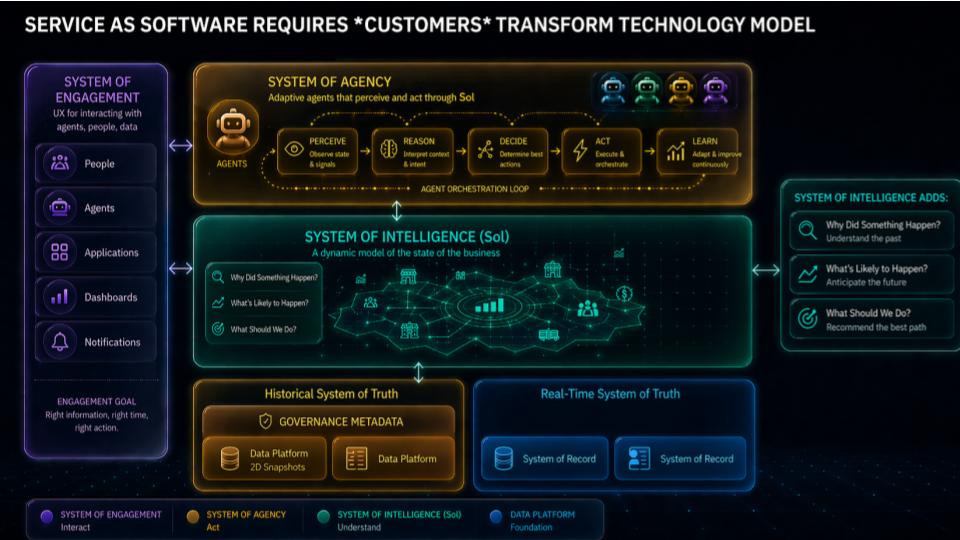
At a high level, the slide above lays out a full stack for an agentic enterprise – and it’s deliberately not just a new AI layer bolted onto an existing x86-powered, general-purpose stack. It’s a model where deterministic and probabilistic systems coexist, where the agent loop is grounded in shared semantics, policy and real-time state, with human feedback. Let’s step through the blocks:
- Historical system of truth: The data platform world (snapshots, governed metadata, “what happened” analytics).
- Real-time system of truth: Systems of record (operational truth, but still siloed by app boundaries).
- System of intelligence (SoI): A dynamic model of the business that harmonizes entities, meaning, rules, and state across the enterprise.
- System of agency: Agents that perceive, reason, decide, act and learn – orchestrated against business outcomes, not just app workflows.
- System of engagement: The human and application touchpoints — people, dashboards, notifications, approvals – and critically the feedback loop that teaches the system over time from the reasoning traces of humans.
The bottom line is service as software is not a an large language model bolted onto a CRUD database. It’s a replatforming of how enterprises represent truth, coordinate action and compound learning – and it requires a new middle layer that most enterprises do not have today.
System of intelligence (SoI): A new, high-value layer in the AI stack
We believe the green layer is the money layer – and it’s also the missing layer. Everyone talks about agents. Everyone talks about orchestration. But agents that aren’t grounded in a shared enterprise model mostly produce local automation – not enterprise transformation.
For 60 years, we built silos – analytic silos and operational silos. If an agent is going to transform the business, it has to perceive and reason across those silos. Otherwise you’re just accelerating work inside the same fragmented structure. That’s why the SoI sits between “systems of truth” and “system of agency.” It is the piece that turns a pile of applications into a coherent enterprise.
This is also where the slide’s system of intelligence details become critical. The SoI is what upgrades the enterprise from retrospective dashboards to forward-looking guidance, addressing not only what happened but:
- Why did something happen?
- What’s likely to happen next?
- What should we do now?
Our view is that you don’t get credible answers to those questions at enterprise scale without harmonizing semantics and rules across applications. Business logic is trapped today inside ERP, CRM, human capital management, security platforms, data stacks and departmental workflows. “Single source of truth” has been promised for decades by the tech industry; but the reality is humans still reconcile the seams – with tribal knowledge, meetings, spreadsheets, exceptions and escalations.
One nuance that’s easy to miss is the SoI isn’t only “data as an asset.” The industry learned that lesson decades ago. The next step is rules as an asset – extracting and normalizing the business rules embedded in operational systems so the enterprise can execute and reason consistently across domains. That’s a major part of what “digital twin of the enterprise” actually means in practice – a real-time representation of state, entities and processes, not just a prettier analytics layer.
The key takeaway we want to stress is that the SoI is the control point that lets agents act confidently across the enterprise. Without it, you’ll see a lot of agent pilots and point automations – and very little durable, cross-functional transformation.
System of engagement and agency
This stack slide also makes a point that often gets lost in agent platform marketing. Specifically, learning is not optional. The system has to improve as it runs. That’s why we keep coming back to the “system of engagement” box in the diagram. We want to clarify this is not social media engagement. It’s a feedback system that is proprietary to a firm.
The practical dynamic is that agents will operate until they hit uncertainty – then humans step in. The key is what happens next. We envision a loop where exceptions become training fuel – the system learns from human approvals, corrections, reasoning traces and escalations. As an example, early Tesla Autopilot wasn’t good because it was perfect on day one. Rather it got good because millions of edge cases were captured, learned from and fed back into the system. Enterprises need the equivalent learning loop for business operations.
This is also where the “system of agency” box earns its cred. It’s not just task automation. It’s adaptive agents orchestrated against outcomes, with the ability to perceive state, reason, decide, act and then learn. If the SoI is the shared semantic truth and business-state layer, the system of agency is where work gets executed and coordinated – and where the business benefits start showing up in throughput, cycle time and organizational leverage.
The key point we want to stress is that the agent era will not be won simply by better prompt engineering. It will be won by enterprises that build a closed loop model with shared state (SoI), governed action (agency) and continuous learning through engagement.
The green layer land grab
A key strategic point that we believe is directionally right is that every major platform vendor is now jockeying for the green layer – because it becomes the highest-value piece of real estate in the stack. The debate is which companies have it and where it lives. Specifically:
- Does it emerge inside application silos (CRM, ERP, IT service management, HCM – each building their own “mini-SoI”)?
- Or does it become an enterprise-wide layer that sits above and harmonizes across those systems?
We contend that the only company that has shown real traction building something like this is Palantir Technologies Inc.– but the model is expensive and not yet broadly repeatable. We liken what Palantir are doing to SAP SE’s early days where a heavy, customer-by-customer buildout was necessary. Palantir must rely on forward deployed engineers at roughly $950,000 per year per engineer. This is not a mass-market operating model. That’s why we often bring Celonis SE into the discussion because it’s attempting to turn process-level harmonization into something more repeatable and accessible across the silos.
This is also where pricing power enters the story. If you own the layer where agents actually execute end-to-end work – and you can see that work – you can price on outcomes. If you’re below that layer (feeding data, feeding context, supplying tools), the pricing looks a lot more like consumption and utility pricing. Salesforce Inc.’s bid to push toward “Headless 360” so any agent can access customer context without the user interface is an interesting strategic move and signals a broader shift away from seat-based pricing toward usage and outcomes as agents become the users.
We cite a useful discussion from VeeamON as it relates to the new AI stack. Chief Executive Anand Eswaran put forth the argument that the missing layer in AI is “data and AI trust.” The more nuanced calibration in our view is that trust, compliance, privacy and security are essential – but they are supporting infrastructure around the SoI, not the SoI itself. The SoI is the missing AI layer that will drive productivity. These other elements are part of the “supporting cast” of the SoI that make agents safe to deploy at scale. The green layer is still the system that represents enterprise state and semantics – and without it, “trust” doesn’t have anything coherent to govern.
The bottom line is this is a land grab for the future platform layer. The winners will be the companies that can make the green layer real, enterprise-wide and repeatable – not just bespoke – while pairing it with the harnesses that make agent-driven operations governable and safe.
The north star: A full-stack digital twin
The slide below is where the conversation focuses on the desired end state. It’s not just a cool architecture diagram – it’s a north star for how the AI stack has to evolve if enterprises actually want agents making decisions, taking action and improving over time without blowing up the business. The slide calls it The Full-Stack Digital Twin – Architecting the Expertise Refinery and that phrase has meaning to us. The point isn’t that every company is about to build a twin. The point is that the enterprise is going to have to manufacture intelligence – and then refine it into repeatable outcomes the way a factory refines raw inputs into products.
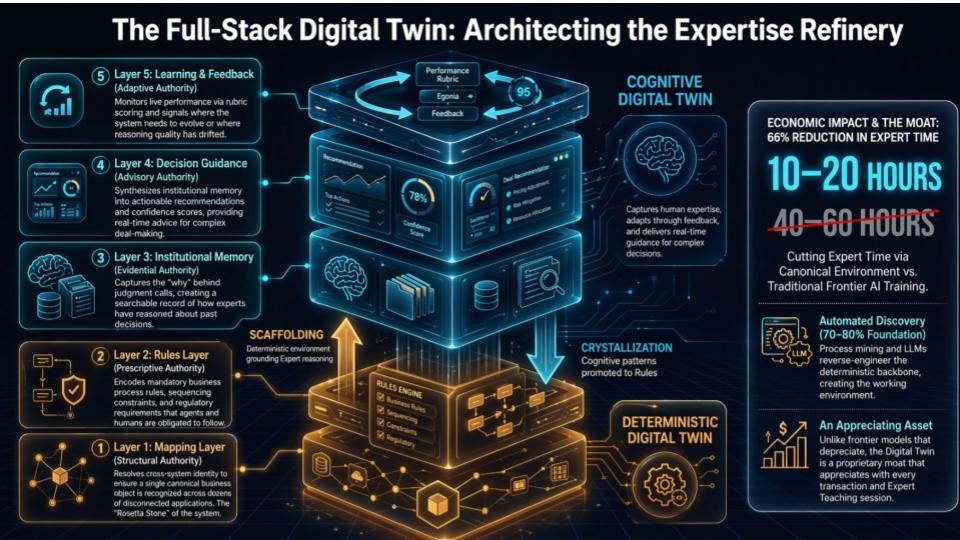
At a high level, the slide is split into two halves:
- The deterministic digital twin at the bottom – the “scaffolding” – where the enterprise defines what is true and what is allowed;
- The cognitive digital twin at the top – the “crystallization” – where the system captures how experts make judgment calls when the rules aren’t enough, and then learns from it.
And the key idea is simple but difficult to execute. Specifically, you don’t get the cognitive twin without the deterministic twin. The context graph talk that went viral earlier this year – “tacit knowledge,” “tribal knowledge,” “why behind decisions” – won’t stand on its own. In our view, it only becomes economically viable when it’s integrated with the deterministic foundation that defines the state of the business.
Deterministic digital twin first – then the ‘why’
The five layers on the left side of the slide are essentially a maturity ladder. The bottom two layers are the deterministic foundation – and that’s where George thought he was “done” earlier in the year until the industry started fixating on the context graph problem: What happens when rules break down, conflict or don’t exist?
Here’s the structure the slide above lays out – and it’s worth being explicit because each layer builds on the one below it:
- Layer 1 – Mapping layer brings canonical identity across systems. This is the “Rosetta Stone” step – the same business object recognized across dozens of disconnected apps.
- Layer 2 – Rules layer brings prescriptive business and regulatory rules. The mandatory constraints – sequencing, approvals, compliance.
- Layer 3 – Institutional memory is the evidential authority – capturing the record of how experts reasoned about past decisions, not just what they decided.
- Layer 4 – Decision guidance is the advisory authority – synthesizing that memory into recommendations and confidence, in context, in real time.
- Layer 5 – Learning and feedback is the adaptive authority – scoring reasoning quality, detecting drift, and feeding learning loops so the system improves continuously.
The important nuance is that enterprises can’t jump straight to Layers 3 to 5 by “sprinkling AI on top.” The cognitive piece only works when it’s anchored to the deterministic state of the business – otherwise you’re just collecting narratives without a machine-verifiable foundation.
The cost problem and why deterministic scaffolding changes it
George’s research is grounded in a principle that we think many enterprises are still underestimating. Specifically, frontier labs are spending enormous sums capturing reasoning traces – essentially paying for expert teaching at scale. Enterprises are not doing that today except in narrow pockets because the cost and burden of teaching is too high.
The claim here isn’t that enterprises need to act like frontier labs. The claim is more practical in that if you set up expert teaching inside the deterministic twin, business process by business process, you narrow the surface area of ambiguity. Experts don’t have to explain everything – they explain the exceptions, where the rules stopped being sufficient. That is where the economics change, and why this “expertise refinery” concept isn’t just a research idea – it’s a path to turning judgment into an asset.
What’s actually in the ‘scaffolding’
This is where we want to push hard, because “scaffolding” is becoming a hand-wavy term in the market. Vendors want to position themselves as the missing layer. Veeam Software Group GmbH, for example, is leaning into “trust” – compliance, governance, security, recovery – and we pressed on whether that trust layer is part of the scaffolding or something else inside the SoI. We also pointed out that Dell Technologies Inc.’s Dataloop acquisition has a knowledge graph component, and could contribute to its cyber resilience practice. It’s hard to believe other data protection players such as Cohesity Inc., Commvault Systems Inc. and Rubrik Inc. aren’t thinking along similar lines.
Regardless, the migration path starts with what customers are asking for right now: Dimensional semantics. Metrics and dimensions. Standard definitions of things such as bookings and RPO. That’s real work, but it’s not the end destination.
The destination is what we call out as stateful rules – the moment when rules aren’t just definitions living in a catalog, separate from the data, but are combined with the live state of the business. That’s when the digital twin becomes real, because only then can the enterprise ask and answer questions like:
Why did this happen, what’s likely to happen next and what should we do next?
If rules and state are separate, you don’t have a system that can reliably answer those questions. You have documentation.
This has potential implications as well for recovery. Today, recovery occurs at the data level (for example, recover a file or dataset). But there’s no notion of process logic in that recovery. In the future, business resilience will require granular recovery of the state of the business – including not just what an agent did when, but also why an agent took an action and the corresponding logic behind it.
Governance shifts from ‘who can see what’ to ‘what can you do’
We also dig into governance because this is where the agentic era challenges old assumptions.
Governance today is largely resource-based – who can access this dataset, this column, this row. That model doesn’t disappear. But it isn’t sufficient once agents are doing work, because the whole point of an agent is you don’t know exactly what it will do ahead of time.
So governance has to evolve into something that is intent-based – policy encoded into the twin that constrains what actions an agent is allowed to take within an activity space. For example, which tools it can invoke, what actions it can perform, what boundaries it can’t cross. In our view, this is the beginning of the control plane that makes agents safe at enterprise scale.
This “North Star” slide is the blueprint for where the AI stack is heading – and why the “missing layer” debate is getting noisy. The deterministic twin is what makes agents safe. The cognitive twin is what makes them useful at scale. And the critical components of trust, governance, resilience, recovery – becomes the ingredients that let enterprises move from experiments to real operating model change. We believe the vendors that understand their role in that system – and don’t confuse scaffolding with the system of intelligence itself – have a chance to expand their total available market dramatically as enterprises start treating “state of the business” as something that must be managed, governed and eventually recovered with the same seriousness as data.
The economics of a new operating model
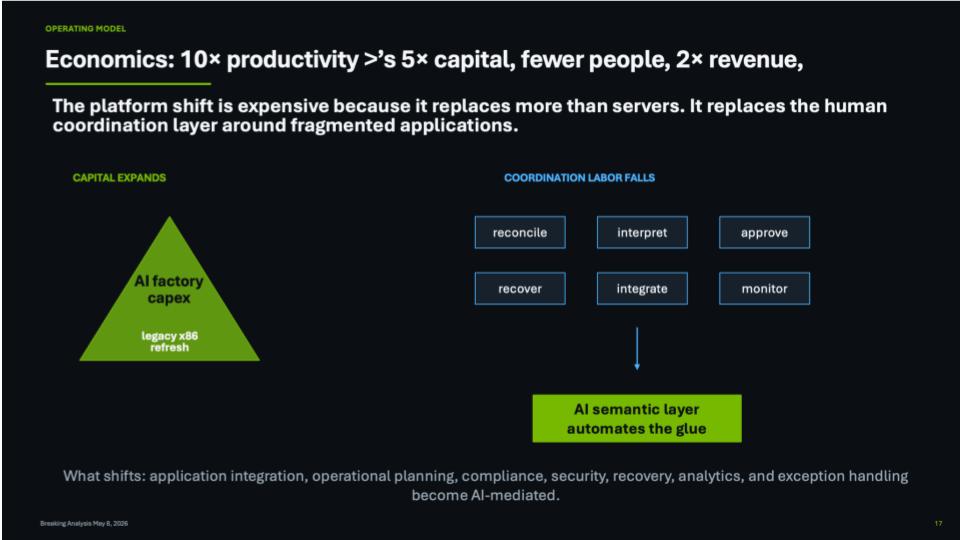
The slide below brings us back to business impact. The left side says capital expands – AI factory capex stacks on top of (and eventually eclipses) the legacy x86 refresh. The right side says coordination labor falls – reconcile, interpret, approve, recover, integrate, monitor – because an AI semantic layer starts automating the “human glue” that holds fragmented enterprise software together. In our view, that’s the real platform shift – not “more servers,” but less human coordination wrapped around brittle systems.
Tokens become a P&L line item
Jeff Clarke put the premise on the table at his Dell Technologies World 2026 keynote this week: Tokens become a line item on the profit-and-loss and the operating model changes. We agree. Enterprises will get the productivity boost one of two ways: They either build AI factories and manufacture tokens internally, or they tap intelligence through application programming interfaces and neoclouds. Either way, the point is the same: Scale revenue without scaling labor.
That’s why we keep coming back to the stack discussion from the prior slides. The AI factory produces intelligence, but the operating model impact is seen when that intelligence starts coordinating what humans do today at the seams – reconciling data, adjudicating exceptions, managing recovery, pushing approvals and translating insight into action in real time.
Client Zero proof: Dell compresses weeks into minutes
A credible here wasn’t a vendor promise – it was Doug Schmitt, Dell’s chief information officer and president of services describing how Dell itself is changing the way work gets done. The example is familiar:
A cross-functional meeting (logistics, parts, finance, sales, go-to-market) gets stuck on a basic question because the data doesn’t reconcile. People argue about whose numbers are right. Someone gets assigned to “go find the truth.” A week goes by. They come back with a new cut. It’s still not the right cut. Now it’s email tennis. Two weeks later, maybe you finally converge – and by then the business has moved.
Schmitt’s point was that Dell built a data mesh (its term for connecting their data together) and now shows up with a “single version of the truth.” In the meeting, they don’t wait a week – they prompt and reprompt in real time until they get the right answer (for example, “not city-level, county-level”). The loop compresses what used to take days or weeks into a single session – 15 to 20 minutes, maybe a half-hour. That’s an example of an operating model changing in the room.
From org charts to shared truth and outcome alignment
The “why” behind that Dell anecdote is the difference between:
- A bunch of highly productive individuals, and;
- An organization with a shared model of the state of the business that orients everyone’s activity toward collective outcomes.
In our view, this is where the system of intelligence earns its value. It’s not a dashboard. It’s not “a better warehouse.” It’s a platform that matches the inputs (information+agents+human expertise when needed) to the outcome the business is trying to achieve. When we say “platform,” we are being literal – core functions are additive and compatible with the model.
We also challenge a narrative that’s getting oversold right now – the “single-person billion-dollar company” trope. We’ve heard versions of this movie before (the “solo merchant” era of early web hype) and what we got wasn’t a universe of solo merchants – what we got was Amazon. The reason is personal productivity is not the same thing as coordinating planning, control and resource allocation for collective outcomes. Firms exist because coordination is hard – and valuable.
So the directional bet is not “companies get smaller.” The directional bet is that winning firms get bigger and more platform-like because they can coordinate agents and people through a system of engagement on top of shared truth – without relying on the old org chart as the primary coordination mechanism. In that world, the org chart gets subordinated to a hierarchy of business metrics:
- activity-level metrics;
- process-level metrics;
- North Star metrics.
And once you do that, you get the platform economics we laid out:
- High fixed costs to stand up the system of intelligence and encode expertise;
- Low and declining marginal costs because human expertise gets pulled in mainly for edge cases;
- Compounding advantage as every transaction and every expert teaching session adds to the system’s value.
Bottom line
Our view is the “AI operating model” is a migration from human-driven coordination across fragmented systems to AI-mediated coordination built on shared truth. That’s why Clarke’s prediction of tokens on the P&L resonate. It forces leadership teams to treat intelligence like a production input, not an experiment – and it forces the enterprise to confront the real bottleneck which is coordination cost.
Next week we’ll go deeper and address the question: How far do data platforms evolve into the system of intelligence – and what happens when “observability” stops meaning “Datadog for apps” and starts meaning “Datadog for agents,” with the data volumes, evals and learning cycles that come with it.
Image: theCUBE Research
Disclaimer: All statements made regarding companies or securities are strictly beliefs, points of view and opinions held by SiliconANGLE Media, Enterprise Technology Research, other guests on theCUBE and guest writers. Such statements are not recommendations by these individuals to buy, sell or hold any security. The content presented does not constitute investment advice and should not be used as the basis for any investment decision. You and only you are responsible for your investment decisions.
Disclosure: Many of the companies cited in Breaking Analysis are sponsors of theCUBE and/or clients of theCUBE Research. None of these firms or other companies have any editorial control over or advanced viewing of what’s published in Breaking Analysis.
Support our mission to keep content open and free by engaging with theCUBE community. Join theCUBE’s Alumni Trust Network, where technology leaders connect, share intelligence and create opportunities.
- 15M+ viewers of theCUBE videos, powering conversations across AI, cloud, cybersecurity and more
- 11.4k+ theCUBE alumni — Connect with more than 11,400 tech and business leaders shaping the future through a unique trusted-based network.
About SiliconANGLE Media
Founded by tech visionaries John Furrier and Dave Vellante, SiliconANGLE Media has built a dynamic ecosystem of industry-leading digital media brands that reach 15+ million elite tech professionals. Our new proprietary theCUBE AI Video Cloud is breaking ground in audience interaction, leveraging theCUBEai.com neural network to help technology companies make data-driven decisions and stay at the forefront of industry conversations.