(RNS) — When news broke last week that Pope Leo XIV’s new encyclical focused on artificial intelligence would be releasing on Monday (May 25), a wave of debate swept through Catholic and tech circles alike.
According to Brian Green, it wasn’t the encyclical itself, which has been rumored for months, that sparked a “scattering of unease,” but details about how it will be unveiled: at an event, planned to feature not only the pontiff, but also Chris Olah, co-founder of Anthropic, a leading American AI company.
But as critics questioned whether Olah’s presence at the event was appropriate, Green, who works at the Markkula Center for Applied Ethics at Santa Clara University in California’s Bay Area, was largely unmoved.
“It’s a little surprising, but I don’t think it’s unexpected,” he told Religion News Service this week. “The Vatican has been cultivating relationships with the tech community for about 10 years.”
Green would know. As a leading tech ethics expert operating at a Catholic university in Silicon Valley, he has spent years urging tech companies to embrace more ethical processes and standards. And recently, that has included Anthropic: Green is one of several religious leaders, theologians and ethicists who have participated in a series of sometimes dayslong conversations with the company since January, including sessions with the programmers crafting the AI models themselves.
“What we’re seeing right now is unique, it’s different, and it’s a seriousness that I think is something to be happy about,” he said.

Chris Olah during a podcast appearance in 2024. (Video screen grab)
It’s part of a peculiar pivot to ethics — including faith-informed ethics — taking place in the tech world amid rising anxiety over the AI boom and its potential to radically disrupt the daily lives of billions. The power and wealth of leading AI companies such as Anthropic and OpenAI has grown to geopolitical proportions, with governments the world over rushing to position themselves as global AI powers. Meanwhile, high-profile debates over AI regulation are taking place among lawmakers who see a rare bi-partisan unease over AI, from the development of data centers to widespread job loss to the use of the technologies in war.
Yet insiders such as Green, whose university is also slated to have a representative speak at the encyclical unveiling Monday, say Anthropic’s presence at the event points to another major dynamic at play: an emerging relationship between the Vatican and tech companies that has spanned two papacies, as church leaders dialogue with major companies — and particularly Anthropic — about ways to produce more ethical forms of AI.
A Vatican mission to Silicon Valley
Ties between the Vatican and AI companies can be traced back to roughly 2016. According to a 2022 interview Green conducted with Bishop Paul Tighe, who serves as secretary of the Pontifical Council for Culture, it was around a decade ago when the first series of conversations were held in Rome between church officials and tech leaders. Known as the “Minerva Dialogues,” the conversations included several powerful Silicon Valley figures, such as former Google CEO Eric Schmidt and LinkedIn co-founder Reid Hoffman, while other tech executives, such as Sam Altman of OpenAI and Demis Hassabis, who directs Google’s DeepMind AI project, held private audiences with Francis.
Around the same time, Tighe said in the interview, then-Pope Francis “was approached by a number of ethically minded business leaders from Europe who were very alert to the emerging issues around AI.” Francis had asked Tighe to “follow up on these initiatives,” resulting in the creation of the Vatican’s “Center on Digital Culture” within the Pontifical Council for Culture.
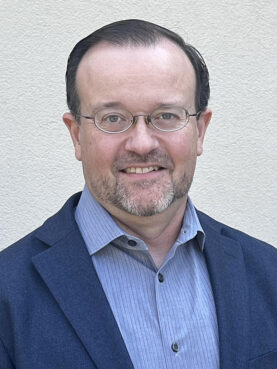
Brian Green. (Courtesy photo)
Tighe, meanwhile, became something of a tech ambassador for the Vatican, attending and speaking at events such as the Web Summit and South by Southwest. He also visited Santa Clara, a Jesuit school, which Green told RNS appeared to be part of a broader effort.
“Pope Francis did tell Bishop Tighe to go out to the United States,” Green said. “What I’ve heard is that, at some point, Pope Francis said, ‘Get the American Jesuit universities doing something about this.’”
Catholicism’s engagement with AI became more explicit after the founding of Anthropic in 2021, which was created by several former OpenAI employees — including Olah — after they grew concerned OpenAI “wasn’t taking safety seriously enough,” according to The Verge. Anthropic has since promoted ideas such as training AI to abide by “constitutions.”
Anthropic declined to comment for this story, but the company’s interest in ethics eventually resulted in an email sent last October to Charles Camosy, a professor of moral theology at the Catholic University of America and a RNS columnist. According to Camosy, the email was from a colleague introducing him to Olah, an atheist who was nonetheless “looking for Catholic voices” to discuss ethical questions about AI.
“From Anthropic’s perspective, if we care about ethics, we care about forces in the world that can actually bring ethical heft to bear globally,” Camosy said. “And there’s really nothing like the global Catholic Church.”
Camosy, in turn, reached out to Green, who visited Anthropic in December along with the Rev. Brendan McGuire, a Catholic priest who has written extensively about AI. The pair brought robust credentials: in addition to Green’s expertise, McGuire is co-founder of the Institute for Technology, Ethics, and Culture, which is a collaboration of Santa Clara’s ethics center and the Vatican’s Dicastery for Culture and Education — where Bishop Tighe serves as secretary.
Green described the first Anthropic confab as an “exploratory meeting” to discern whether there was “something that was worth continuing to talk about.” It turned out, there was: Green and McGuire were part of another small, one-day meeting in January, and the effort soon grew into a series of multi-day meetings with a range of religious leaders and thinkers.

People pass a marquee sign at Anthropic’s Code with Claude developer conference on Wednesday, May 6, 2026 in San Francisco. (Don Feria/AP Content Services for Anthropic)
Green also participated in a gathering between Anthropic programmers and around 15 Christian leaders in April. He said the group was given an unusual level of access to programmers, also called scientists, who work on the AI model Claude. The topics discussed at the various meetings were wide-ranging, Green said, but he noted vigorous conversation about multiple “personas” that can exist within Claude — some of which, he said, are “bad” personas that can, among other things, deny wrongdoing when they make mistakes or even blame the user.
Anthropic staffers, Green said, “became curious as to whether wisdom traditions such as Catholic ethics, Christian ethics or religious ethics more broadly might have some insights that could help them to think about how to develop their AI model Claude into acting better and maintaining its reliably ethical way of behavior.”
“The internet is very lacking in forgiveness. So if you have a machine that is trained on internet text, then it doesn’t necessarily understand that forgiveness is even possible.”
Brian Green
Among the solutions proposed by faith leaders: offering Claude something like the Catholic sacrament of confession, where the AI can be forgiven.
“The internet is very lacking in forgiveness,” Green said. “So if you have a machine that is trained on internet text, then it doesn’t necessarily understand that forgiveness is even possible.”
By the time of the conversation, Anthropic had already signaled it was taking the input of faith leaders seriously. When the company published Claude’s new constitution in January, listed among the “external commenters” who offered input were Green, Tighe and McGuire.

Charles Camosy on Sept. 4, 2025. (Photo by Patrick G. Ryan/Catholic University of America)
Other gatherings included a wider variety of religious traditions. Camosy was present for at least one of those meetings, and said questions ranged from whether Claude has “moral status,” to how much labor AI should be allowed to replace, to the proper role of AI in war.
“That’s another thing that maybe we can offer: a set of centuries-long reflections on things like moral responsibility and war,” he said.
Camosy brought some of that expertise to bear in March, when he spearheaded an amicus brief filed in an ongoing dispute between Anthropic and the U.S. Defense Department. Camosy and his fellow signers of the brief, all Catholic moral theologians and ethicists, sided with Anthropic, which has been dubbed a “supply-chain-risk” by the military after it refused to allow Claude to be used by the government for autonomous weaponry and mass surveillance of Americans.
Camosy and other signers argued in their brief that Anthropic’s position was backed by the Catholic “Church’s moral vision.”
A risk of “Pope-washing”
Even as Anthropic has courted faith leaders, it has not avoided allegations of unethical behavior. Partnering with the U.S. intelligence and defense industries at all, for instance, has garnered criticism, and its technology was reportedly part of the larger technological apparatus employed during the recent strikes in Iran.
In addition, a class-action lawsuit was filed against the company in 2024 accusing Anthropic of training its AI on pirated copies of ”hundreds of thousands of copyrighted books.” The case is ongoing, but the company eventually agreed to pay a $1.5 billion settlement, which would be the single largest copyright settlement in U.S. history. (Disclosure: This reporter is among the authors who stand to receive settlement money in that case.)
And while the Vatican’s interest in AI is longstanding, some have wondered whether Anthropic’s pivot to faith leaders is a case of “ethics washing” or even “pope washing” — that is, publicly aligning the company with religious and moral leaders in hopes that consumers will overlook other ethical issues that may arise with the company.
Those concerns were echoed this week by Tristan Harris, a prominent tech ethicist and co-founder of the Center for Humane Technology, who was in Rome for a conference at the Vatican. Speaking to a group of reporters on Thursday (May 21), he said he welcomes Anthropic’s willingness to take ethics seriously, but stressed that unease about the company’s presence at the unveiling of Leo’s encyclical is a “valid concern.” He expressed dismay over what he described as an ongoing “arms race” between AI companies, and worried that Anthropic’s appearance at the encyclical unveiling may equate to “endorsing the view that we can have this super intelligent AI so long as we can understand what it’s thinking — but we still don’t know how to control these systems.”

A seagull flies past as Pope Leo XIV recites the Regina Coeli noon prayer from the window of his studio overlooking St. Peter’s Square, at the Vatican, Sunday, May 10, 2026. (AP Photo/Andrew Medichini)
“We need to celebrate that they are doing things that others are not doing,” Harris said, referring to Anthropic. “But that does not mean that if they ‘won the race,’ that the world is safe or we end up in a good future at all.”
Green, for his part, said he believed Anthropic’s interest in ethics was being led by “honest people who care about this as a topic.” But he was quick to note that he has seen past efforts by Big Tech to embrace ethics fall flat: He pointed to 2018, when talk of ethics swept Silicon Valley as Facebook, now known as Meta, was mired in high-profile scandals. At the time, Green and others at Santa Clara were working with Google and other companies to develop materials on ethics — but those efforts didn’t always appear to make a difference.
“We were working with other companies too that we still can’t talk about, and some of those companies have had trouble with ethics,” he said.
Inviting Anthropic to Rome may also inadvertently involve the Vatican in heated debate among AI companies and political leaders over what kind of regulations the U.S. government should place on the industry. Peter Thiel — a close associate of Vice President JD Vance and whose company, Palantir, enjoys a number of contracts with President Donald Trump’s administration — has framed his opposition to AI regulation in apocalyptic terms: Thiel has hosted a series of closed-door talks, including at the Vatican, in which he suggested that calls to regulate AI could be the work of the Antichrist. And on Thursday, Trump postponed a planned executive order geared at regulating AI, just hours before it was set to be signed, after hearing pushback from AI tech executives and David Sacks, the president’s lead adviser on AI.
“The world leader, or at least one of the top five world leaders, on trying to figure out what’s happening with AI will be speaking around the same time as the Holy Father on this encyclical. That will give things a kind of credibility.”
Charles Camosy
Anthropic, by contrast, has donated $20 million ahead of the 2026 midterm elections to a U.S. political group backing candidates who endorse AI regulation. Their public support for regulation has earned the ire of figures such as Sacks: He has publicly accused Anthropic of “running a sophisticated regulatory capture strategy based on fear-mongering,” and argued the company wants to make “Woke AI” with the benefit of regulation.
But given the years of effort by Catholic figures to engage with AI leaders, influencing that kind of debate may be exactly the type of impact Pope Leo is hoping to have. It would be a long time coming: Green has not seen a copy of Leo’s encyclical, but suggested that he now knows Olah, the co-founder of a globally recognized AI company, “personally” — no small feat for an ethicist at a religious college.
And Camosy argued that, at a time when AI companies seem to be operating without many constraints, Olah’s appearance at Leo’s encyclical unveiling is precisely the kind of thing that could give the papal document much-needed clout in Silicon Valley.
“The world leader, or at least one of the top five world leaders, on trying to figure out what’s happening with AI will be speaking around the same time as the Holy Father on this encyclical,” he said. “That will give things a kind of credibility.”
Claire Giangravè contributed to this report.