
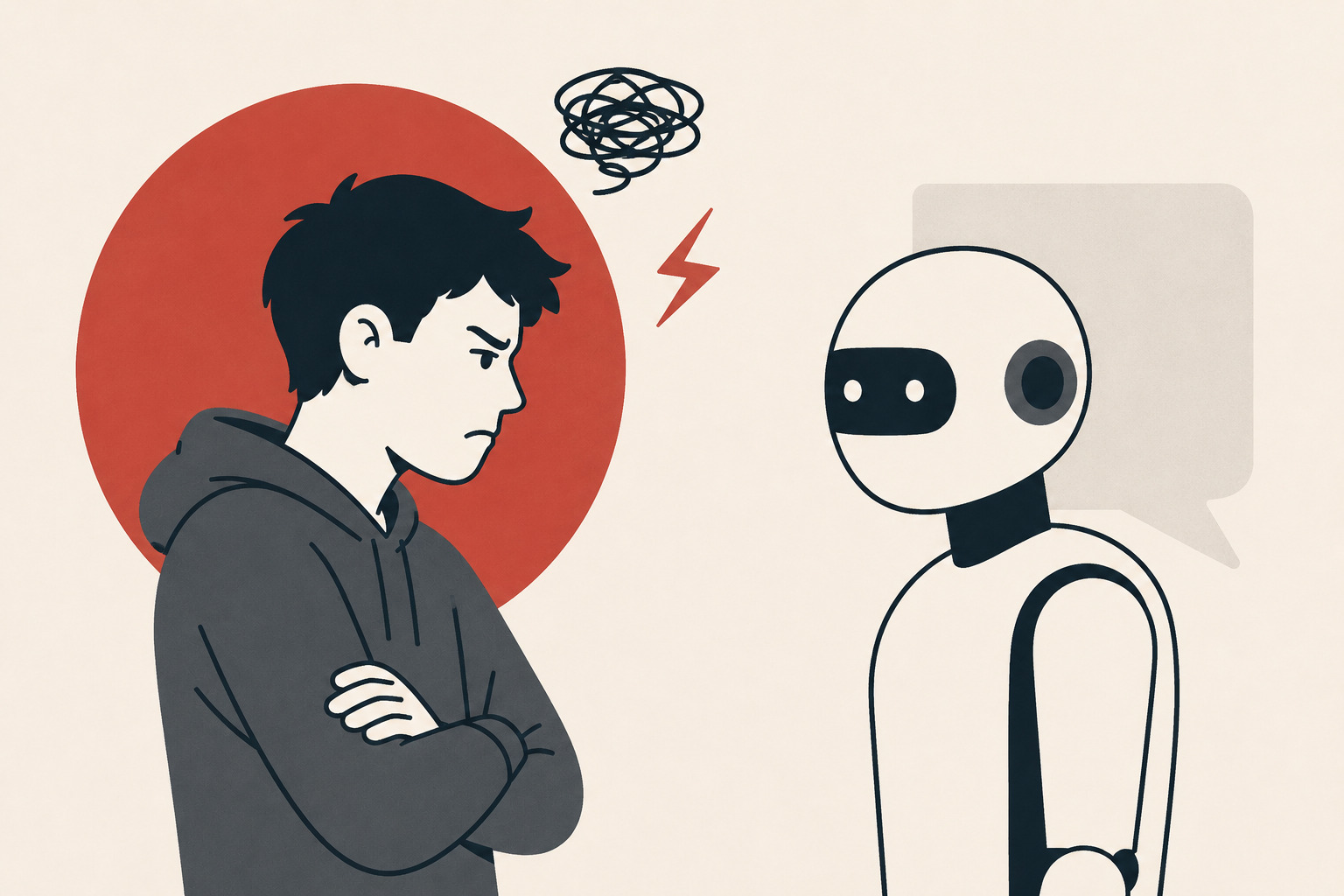

Artificial intelligence was sold as a shortcut to creativity, productivity, and opportunity. Especially for young people, who tend to be more knowledgeable and receptive to new technology, AI was supposed to be a huge asset. But data shows that the more young people use this technology, the more they dislike it.
It’s not laziness or incompetence (as some media likes to portray). In fact, younger generations appear to be leading the pushback against the technology, with Generation Z being the loudest and clearest critics of AI.
Forced feeding technology
It’s been about three years since tech giants started aggressively promoting chatbots like ChatGPT and Gemini. There is no doubt that this technology is amazing, and even most skeptics and haters have to admit that the current level is impressive. But the problem is that these chatbots (and AI technologies more broadly) are now everywhere, whether we want them to be or not.
AI is frequently used in classrooms, recruiting pipelines, office workflows, and even creative platforms. It fundamentally changes the way knowledge and work work. Students were expected to use it while telling them not to cheat. However, the education system progresses much slower than the technology itself.
In classroom settings, AI was first used to summarize dense reading and outline (or flat-write) essays. As chatbots get better, they’re increasingly being used for coding and email. But now a strange pattern is emerging. The generation that is most familiar with these tools is also becoming more skeptical of them.
Approximately 51% of 14-29 year olds use generated AI at least weekly, according to data from the Walton Family Foundation, GSV Ventures, and Gallup. But they seem to like it less and less. The number of people who say they are excited about AI has decreased from 36% to 22%. The number of people who felt hopeful decreased from 27% to 18%. Meanwhile, anger rose from 22% to 31%.
Even worse, the heaviest users are often the most disillusioned. Everyday user excitement has decreased by 18 percentage points in just one year.

Other polls appear to be pointing in the same direction. According to a study by Harvard University and Gallup, 74% of young Americans use chatbots at least monthly, but most are concerned that AI fosters laziness, instant gratification, and shallow engagement with ideas. 65% say chatbots can prevent real understanding, and 79% are worried that AI will make humans lazy. A recent Gallup poll also shows that Gen Z is becoming more pessimistic about AI.
So why are young people so adamantly opposed to AI, even though we are using it?
The backlash appears to be starting in the classroom, where AI has eroded any remaining trust between students and professors.
In the UK, a 2026 study by the Higher Education Policy Research Institute found that the use of AI among undergraduate students has become almost universal. A whopping 95% of students said they were using AI in at least one way, and 94% said they were using generative AI to assist with their assessed assignments. Students used it to explain concepts, summarize academic material, and structure ideas. At the same time, the report also found that fewer students were simply pasting AI-generated text into their assignments, suggesting that many students had moved on to more targeted usage. However, one respondent blatantly said, “I don’t use my brain at all.”
There is no doubt that AI is very useful and helpful. But this convenience comes at an emotional cost. Students are asked to use tools to improve their performance without knowing what they are actually learning. It’s like having a cheat code. Skipping the adversity that comes with learning and cognitive growth leaves students very unsatisfied. At first it’s cool and things get a lot easier, but then they realize they’re not really learning or growing.
At the same time, we feel we need to continue using AI to keep up.
Approximately 68% of young adults express concern that delegating cognitive tasks to AI will cause mental “muscle atrophy”, resulting in a lack of effort and hindering the development of basic skills. And that concern appears to be correct, according to a study published by researchers at the MIT Media Lab.
In this study, participants wrote essays under different conditions, including without the tool, using a search engine, and using ChatGPT. Researchers used electroencephalography (EEG) to measure patterns of brain activity during writing tasks. They reported that participants using ChatGPT had weaker neural connections during the task and had more difficulty recalling aspects of the essays they had written. The authors described this as a possible accumulation of “cognitive debt.”
Next is the workforce
As Gen Z enters the workforce, the anxiety becomes even more acute. This generation is maturing and increasingly feels that the education of the world that prepared them for them no longer exists.
First, in many fields, AI is obliterating the first rung of the workforce ladder. AI is being marketed to young workers as a productivity tool, but many are hearing a different message. This means that tasks that once helped beginners become competent are becoming automated.
Entry-level jobs always involve tedious tasks. A junior lawyer reviews the document and an analyst prepares the first draft. The new reporter must reread and transcribe the text, and the assistant must summarize and prepare the meeting. These tasks may be boring, but they are also an apprenticeship. It’s a tedious task, but you’ll gradually get better at it and be ready for the next step in your career.
But now this system is evaporating.
This tedious task is exactly what AI is good at, and companies are eager to outsource it to AI. The British Standards Institute’s 2025 report, featured in the Guardian, warned that global companies are increasingly considering AI before hiring new talent. In a survey of more than 850 business leaders, 41% said they were using AI to reduce headcount, 31% said they considered AI before hiring, and 39% said they had already eliminated entry-level roles through automation.
This is how resentment grows. Leaders value efficiency, but workers (especially young workers) value deals in which they are always on the losing side.
Resentment is becoming mainstream
Most resistance is subtle or cultural, from slow adoption to avoidance of tools to ridicule of AI content. However, a shocking 44% of Gen Z workers admit to having “sabotaged” their employer’s adoption of AI. This sabotage is often a response to forced adoption strategies that link the use of AI to performance reviews and job security.
But even more alarming is the rise in neo-Luddite sentiment and, in one alleged incident, violence. The report cites an incident on April 10, 2026, when a 20-year-old boy from Texas allegedly stormed the residence of OpenAI CEO Sam Altman with a Molotov cocktail before attempting to attack OpenAI’s headquarters.
That’s an extreme outlier. They should not be treated as representatives of Gen Z.
But the broader fears it reflects are no longer fringe. With polls showing that half of Gen Z are scared of AI and about a third are angry, we are clearly in deep trouble. At the same time, you can’t put the AI genie back into the lamp.
So what can you do?
Will I be able to get my agency back?
The clearest thread that seems to run through all of this is not ignorance or fear of newness, but agency. Or rather, that’s what’s missing.
Agencies do not rely on the performance of the latest models, but rather on the selection of institutions and companies. Schools can incorporate AI as a useful tool, but they must radically and immediately re-evaluate their practices in light of AI (something schools and universities are notoriously weak at). The goal is not to remove all difficulties from thinking or working. The key is a certain level of difficulty. It’s how people learn, improve, and become themselves.
The same goes for employment, but again, historically, companies haven’t always been keen to protect their workers (particularly entry-level workers) from emerging technologies.
Beyond school and the workplace, we are all facing broader cultural exhaustion. Young people have seen the internet filled with synthetic images, generic posts, automated comments, fake product reviews, chatbot answers, and machine-written summaries of machine-written summaries. The phrase “AI slop” has become shorthand for this deluge of cheesy and outlandish content.
Ultimately, we are on the path to industrializing artificial intelligence, but this can happen in many different ways. AI can either flatten thinking or inspire better thinking. It can erase entry-level learning, or it can be designed around new forms of apprenticeship. Sometimes the web is full of miscellaneous information, and sometimes it’s managed in a way that maintains trust.
This resentment is a strong signal. It would be wise to keep that in mind.


