summary
According to a recent Gallup poll, the percentage of U.S. employees using AI in the workplace increased from 40 percent to 45 percent from the second quarter of 2025 to the third quarter of 2025.
Frequent use, or use a few times a week or more, increased from 19 percent to 23 percent over the same period. However, daily usage only increased by 8-10%. The findings are from a representative survey of 23,068 full-time and part-time U.S. employees conducted by Gallup from August 5-19, 2025.

Chatbots and virtual assistants are the most popular AI tools in the workplace, with over 60% of users relying on them. AI-powered writing and editing tools are used by 36 percent, while coding assistants lag behind just 14 percent.
Although dedicated tools for data analysis and programming are still relatively uncommon overall, those who use AI frequently rely on them heavily. This difference is most noticeable in Coding Assistant. 22 percent of frequent users utilize these tools, compared to just 8 percent of infrequent users. This intensive usage helps explain why companies like OpenAI and Anthropic are competing fiercely for developer attention.
advertisement
Knowledge workers lead AI adoption, while frontline industries lag behind
Employees in knowledge-based fields use AI tools much more frequently. According to Gallup, 76% of employees in the technology and IT industry use AI several times a year. In finance, this number drops to 58 percent and professional services to 57 percent. Industries with large numbers of front-line employees tell a different story. Only 33 percent of retail employees use AI in their jobs, along with 37 percent in healthcare and 38 percent in manufacturing.

42 percent of AI users use the technology to summarize information. This is also Microsoft CEO Satya Nadella's best use of AI. Another 41 percent use it to generate new ideas and 36 percent use it to learn something new. Those percentages are largely unchanged from Q2 2024, according to Gallup.
Almost a quarter of employees don't know if their company uses AI
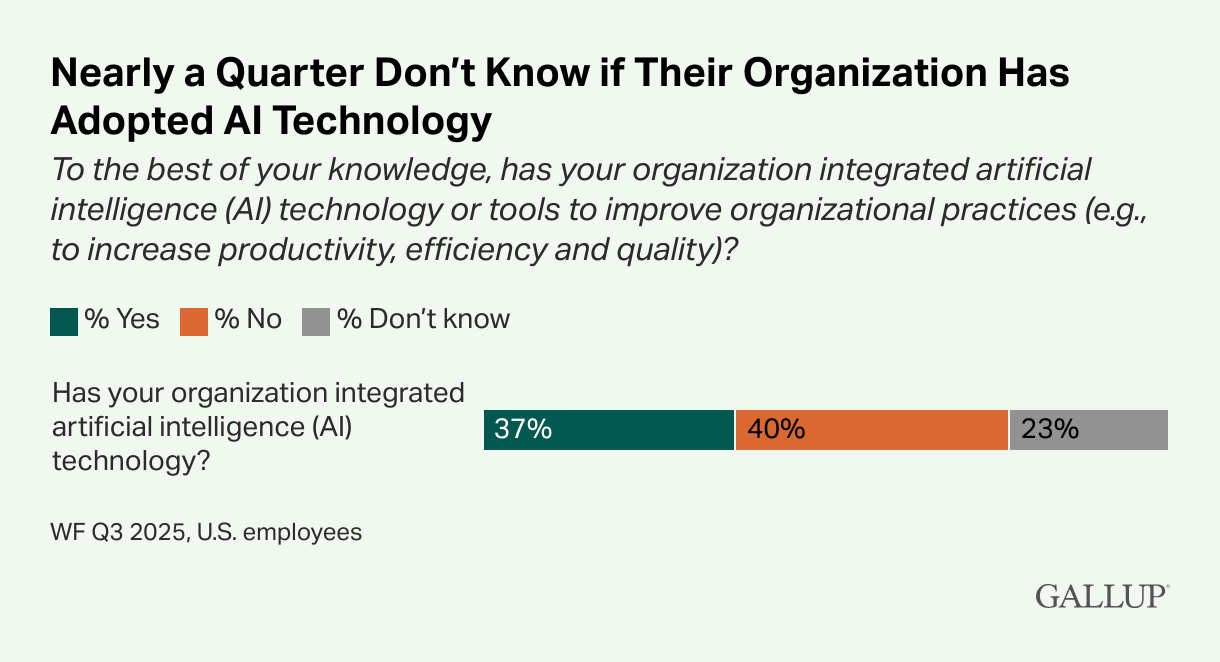
When asked if their organization has implemented AI technology, 23% of respondents said they don't know. Only 37 percent said yes and 40 percent said no. Knowledge gaps vary widely by role.
Among individual contributors without management responsibilities, 26 percent don't know, compared to 16 percent of managers and just 7 percent of executives. Part-time employees, field employees, and front-line staff also showed higher levels of uncertainty.
Shadow AI thrives when workers hide its usage from employers.
Gallup points out a glaring gap. 45% of employees use AI at least a few times a year, but only 37% know for sure that their company has formally implemented AI. This suggests that some employees are using personal AI tools without knowing their employer's AI strategy.
recommendation

This use of so-called shadow AI has also appeared in previous research. In some cases, the explanation may simply be that the company doesn't offer useful tools. But social factors also come into play. According to Slack research, nearly half of office workers don't tell their boss that they're using AI. They worry about being seen as lazy or incompetent, or fear that their job is at risk.
Microsoft and LinkedIn refer to this phenomenon as “AI shaming.” 52 percent of AI users are hesitant to admit that they rely on AI for core tasks, and 53 percent worry that using AI will make them look replaceable.
Even if a company offers a stable AI tool, employees may still prefer their tools, especially if the workplace tool tracks usage. Workers who don't want their employers to know how much AI is helping them can simply launch ChatGPT on their personal mobile phones.