
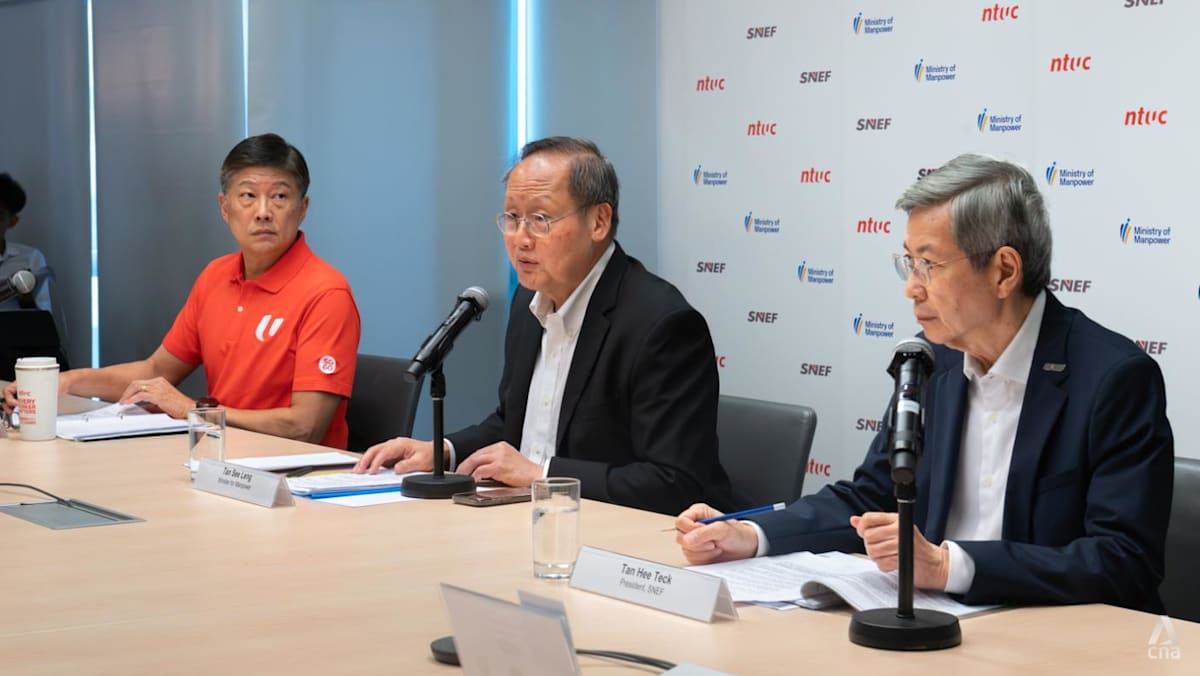
SINGAPORE: A new council launched by the National Trades Union Congress (NTUC) will bring together tripartite partners to better support workers and businesses navigating the impact of artificial intelligence.
The establishment of the Tripartite Employment Council was jointly announced by the Ministry of Manpower (MOM), NTUC and Singapore National Employers’ Federation (SNEF) on Thursday (30 April) ahead of the labor movement’s May Day rally.
“The Tripartite Employment Council will scale up advocacy, accelerate policy implementation and better direct resources where they are needed most, to strengthen AI-readiness of workers across the employment ecosystem,” NTUC Secretary-General Ng Chee Meng and NTUC Chairman K. Tanaretchimi said in a May Day message.
On Wednesday, Ng said in a media briefing that the new council will support the National AI Mission and National AI Council announced in this year’s budget.
He said the creation of the council demonstrates a tripartite commitment to strengthening job security in the age of AI, supporting business transformation for better jobs, and uplifting workers through training and job matching.
“AI is changing the way we work, and it’s important that employees are not left behind,” said Ng.
“The Tripartite Employment Council can bring together and expand the capabilities of the three parties under one roof, taking collective action to be close to workers from all walks of life, especially PMEs and young people,” he said, referring to experts, managers and executives.
Manpower Minister Tan See Leng highlighted three areas of focus for the council. It’s about helping companies deploy AI in ways that benefit growth, jobs, and workers. Provide broad and domain-specific AI training to your workforce. Provide targeted transition support to at-risk workers.
“We will lead a transformation that is comprehensive, forward-thinking, agile, pragmatic and pragmatic,” he said.
He pointed to around 1,600 hand-picked AI courses under SkillsFuture and six months of free access to premium AI tools for Singaporeans in government-selected courses.
Dr Tan said the idea is to make AI literacy “as pervasive as possible” into the workforce, allowing workers to assess their level of readiness before honing their skills to master AI.
“You don’t even have to connect it to a job, but you just have to take these courses first and get used to it and then use it like a language,” he said.
He also said there is scope for third-party partners to engage companies on the use of AI. He cited a survey of 2,560 companies conducted in the first quarter of 2026 that found that about 70% of them had not implemented AI.
SNEF Chairman Tan Hee Teck said employers are recognizing the potential of AI to improve productivity, drive innovation and maintain competitiveness.
“However, many businesses, especially small and medium-sized enterprises, face very real challenges, including implementation costs, skills gaps and lack of in-house expertise,” he said.
According to official data, the AI adoption rate among small and medium-sized enterprises (SMEs) tripled to 14.5% in 2024, but this was still lower than the 62.5% of large enterprises that adopted AI.
“If this trend continues, the gap will widen not only between small and medium-sized enterprises and large enterprises, but also between workers,” Tan said.
In the first quarter of 2026, SNEF worked with more than 420 companies to help them diagnose their business needs, redesign jobs and workflows, and integrate AI into their processes.
Mr Tan called for the council’s formation to be timely, saying: “We need both speed and coordination to help employers seize new opportunities arising from AI while building an AI-enabled workforce.”
Details of its composition and plans will be announced in the coming months.


