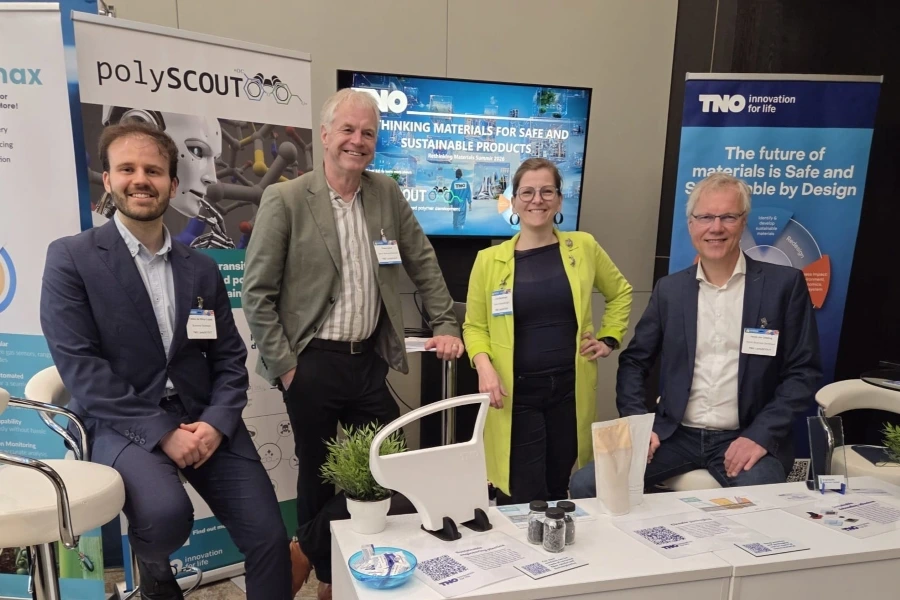
The Netherlands Organization for Applied Scientific Research (TNO) announced its PolyScout venture to develop bio-based and biodegradable polymers with packaging applications at the Re Thinking Materials 2026 Innovation and Investment Summit (28-29 April) in London, UK.
“Our PolyScout and TNO teams attended Re Thinking Materials to discuss value chains with our partners and how we can collaborate with each other to find sustainable solutions to important challenges,” said Peter Imhoff, Senior Business Developer at TNO and Commercial Lead for PolyScout. Packaging insights.
“We discussed regulations, some of which are already scheduled to come into force in 2030, and also looked at finding circular alternatives to critical, hazardous or fossil-based materials.”
“We approached Summit from multiple angles, focusing on material design with the market and customer in mind. We considered not only physical and mechanical properties, but also specifications such as end-of-life, safety, cost, and environmental impact.”
Imhof explains that PolyScout combines AI and advanced experimentation techniques to take into account social and material requirements for product use and end-of-life.
“AI modeling is based on real, verified data from the literature, experiments, and collaboration with value chain partners. This differs from standard approaches, where all available data is taken into account – garbage in, garbage out.”
In addition, the team behind PolyScout provides market, polymer, technology, and AI expertise that translates market needs into requirements, material and application properties, and models, Imhoff said.
packaging application
Imhoff said PolyScout’s biobased polymer research is relevant to a variety of applications, including in the packaging sector.
“Strict regulations matched with innovation and processing procedures usually impose limitations on some solutions,” he added.
“A good example is the ‘soup pouch’ project, where a mono-material design was introduced to address high demands such as regulations, processing at high temperatures and package integrity. This includes leak-proofing, sealing of the package after filling with hot soup and high safety standards.”
Imhoff said TNO worked with ingredient suppliers, soup producers and brand owners to make this happen.
“Another example is the design of sustainable packaging for medical applications,” he added.
research approach
According to TNO, PolyScout combines polymer science and machine learning solutions to speed up and improve materials design.
Additionally, PolyScout can accelerate and improve materials design by combining polymer science with machine learning solutions.
“Furthermore, we can not only manufacture the designed materials, validate the polymers, and demonstrate them in applications, but also scale them up to the required quantities,” says Imhof.
“Typical development cycles for new polymers take at least 10 to 15 years, but in this way the design and demonstration of new material development is accelerated by years.”
“Furthermore, the available designs come from a much wider solution space than traditional approaches, increasing the likelihood of success in a shorter period of time.”
Imhof added that another approach TNO has implemented with this year’s Re Thinking Materials is the Safe and Sustainable by Design approach.
“This includes advanced adhesion and delamination techniques that allow researchers to achieve desired properties in the product while maintaining the ability to return to the base material at the end of its useful life. For example, this can be achieved by causing delamination of layers in composites or laminates with a magnetic field.”
Also at Re Thinking Materials, Polytag and Kraft Heinz showcased a collaboratively connected data carrier approach to optimize recycling and traceability.
https://www.packaginginsights.com/news/re Thinking-materials-2026-polytag-kraft-heinz.html