Artificial intelligence is reshaping industries at a pace that few could have predicted. But while much of the conversation around AI focuses on large-scale language models, generative tools, and enterprise automation, some of the most meaningful applications of AI are occurring far from the boardroom: on factory floors, construction sites, and mining operations, where workers face invisible, painless, and persistent health risks.
One of the most significant of these risks is occupational noise-induced hearing loss. And AI is now fundamentally changing the way we detect, predict, and prevent it through a new generation of intelligent technologies. Hearing test evaluation It is a platform that focuses on data science as well as healthcare.
The scale of the problems that AI is being mobilized to solve
The numbers are astonishing. Occupational noise-induced hearing loss is one of the most prevalent work-related health conditions worldwide, affecting tens of millions of workers in manufacturing, construction, mining, agriculture, and transportation.
Why is management so difficult?
- it is painless — There are no distress calls when hearing is damaged
- it is gradually — After years of repeated exposure, damage accumulates silently
- it is cumulative — Every time a noisy shift occurs, total damage increases with no visible signs
- it is irreversible — Once the hair cells in the inner ear are destroyed, they cannot regenerate.
Traditional hearing tests (hearing tests performed annually by a technician) have represented the standard of care for decades. But it was essentially reactive. It was recorded after the damage had already occurred. And because of reliance on manual analysis, subtle early warning signs are routinely missed until they progress to clinical significance.
This is a problem that AI is now being deployed to solve, and the results are starting to gain traction across the occupational health sector.
Machine learning comes to audiology clinics
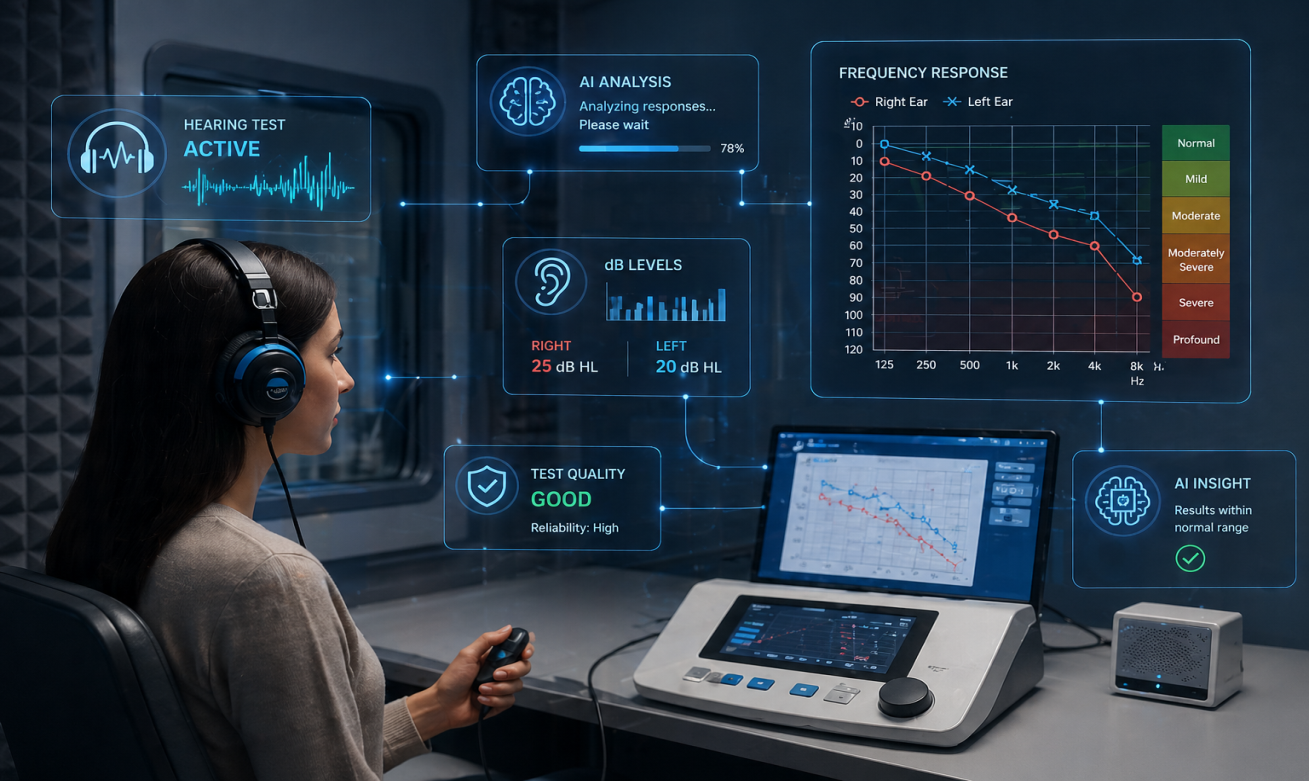
The first and most influential wave of AI in hearing testing came from machine learning. Modern ML algorithms applied to audiometric datasets can identify patterns in auditory data that are completely unrecognizable to human analysis.
How does AI-based evaluation differ from traditional methods?
| Traditional evaluation | Evaluation using AI |
| Annual snapshot of hearing data | Continuous real-time monitoring |
| Manual comparison of results | Multidimensional predictive modeling |
| Detect damage after it occurs | Predict deterioration in advance |
| single data source | Multiple integrated data sources |
| Reactive intervention | active prevention |
These are multidimensional predictive models that simultaneously analyze a worker’s audiometric results in the context of dozens of variables.
- Age and length of service — Longer exposure history carries compounding risks
- Role and task types — Different jobs have different noise profiles
- Cumulative noise exposure history — Track and model total exposure over a lifetime
- Specific frequencies affected — Early radio frequency loss is an important early warning indicator
- Rate of change over time — How fast the degradation progresses is just as important as the current level
- Cohort pattern matching — Risk benchmarking and comparison to employees with similar profiles
Deep learning neural networks take this capability even further, identifying nonlinear relationships, detecting anomalies that deviate from known patterns, and continuously improving its accuracy as new data enters the system.
NLP, computer vision, and multimodal evaluation
Audiometric data is not the only thing emerging from cutting-edge AI-powered hearing health platforms. The integration of natural language processing and computer vision is creating multimodal assessment systems that derive diagnostic intelligence from multiple data sources simultaneously.
Three pillars of AI-powered multimodal hearing testing
- Natural language processing (NLP)
NLP algorithms analyze workers’ self-reported symptom descriptions and extract clinically relevant signals from unstructured language. The main indicators that NLP systems are trained to detect include:
- Difficulty hearing in noisy or crowded environments
- Feeling of pressure or obstruction in the ears after a noisy shift
- Persistent or intermittent tinnitus — ringing, buzzing, or hissing
- Fatigue after prolonged exposure to noisy environments
- Difficulty distinguishing between speech and background noise
- Machine learning of audiometry data
ML models process structured numerical audiometry data across multiple variables and build predictive risk trajectories for individual employees based on their unique profile and exposure history.
- computer vision
High-resolution imaging of the ear canal and eardrum is processed by an AI vision model trained on thousands of labeled clinical images to identify structural indicators of chronic noise trauma that may be missed entirely by human examiners.
The combination of these three techniques creates diagnostic images with unprecedented completeness and accuracy. This is simply impossible to achieve with traditional manual evaluation.
Moving to IoT integration and continuous monitoring
Perhaps the most important development in AI-powered hearing health is the integration of hearing assessment systems with IoT sensor networks deployed throughout the workplace.
How IoT and AI integration works in practice
- smart noise dosimeter Worn by individual workers and continuously transmits real-time exposure data throughout the workday
- AI platforms ingest this data Build a dynamic model of cumulative noise exposure for each worker in parallel with audiometry results
- Prediction algorithm Identify when worker exposure patterns exceed thresholds associated with accelerated deterioration
- real-time alerts occurs – giving safety managers an opportunity to intervene before damage occurs
- Continuous model improvement — The system learns from every data point and improves accuracy over time
Fundamental changes in surveillance architecture
- from: Regular and reactive annual evaluations
- To: Continuous, predictive, real-time monitoring
for Occupational safety and health expert For users of these platforms, this means they can offer their clients a level of protection that was not possible before the advent of AI.
compliance dividend
Beyond clinical benefits, AI is also bringing significant value to the compliance side of hearing health care.
Key compliance challenges that AI solves
- schedule complexity — Track testing schedules across hundreds or thousands of employees
- record management — Maintain accurate, audit-ready documentation of all results
- Follow-up identification — Flag workers with results that require clinical follow-up action
- regulatory reporting — Generate compliance reports on demand for regulatory purposes
- Prevention of slippage — Eliminate administrative gaps that put employers at risk
AI-powered compliance platforms automate this entire process, making compliance frameworks self-managing, reducing administrative overhead, and ensuring that workers don’t fall through the cracks of under-resourced manual systems.
What’s next — an AI roadmap for hearing health
where technology is heading
| technology | Current situation | short term possibility |
| wearable noise dosimeter | widely implemented | Real-time adaptive noise cancellation |
| ML predictive model | In operation | 5-year auditory trajectory prediction |
| federated learning | emerging | Training cross-organizational models without data sharing |
| Individual protection plan | early | Fully automated and dynamically updated AI plans |
| Integrating genetic risk | research stage | AI models that incorporate individual genetic hearing risk factors |
Key takeaways for AI and occupational health leaders
- AI is transforming occupational hearing health by: Reactive documentation to full-scale prevention
- By combining ML, NLP, computer vision, and IoT, Multimodal evaluation system of unprecedented power
- Compliance automation allows administrative burden It has historically created disparities in worker protection.
- As a long-term outlook, Completely eliminate occupational noise-induced hearing loss Moving from aspirations to true possibilities
final thoughts
AI has found one of its most humane applications in protecting worker hearing. Technology already exists to detect hearing loss earlier, predict it more accurately, and prevent it more effectively than at any point in history.
Workplace and occupational health programs that implement these AI-powered tools will not only be better legally and financially protected, they will also be the most trusted by employees when it comes to their long-term health.
Noise-induced hearing loss is irreversible. But with the full analytical power of modern artificial intelligence, the goal of preventing it from happening in the first place is finally within reach.