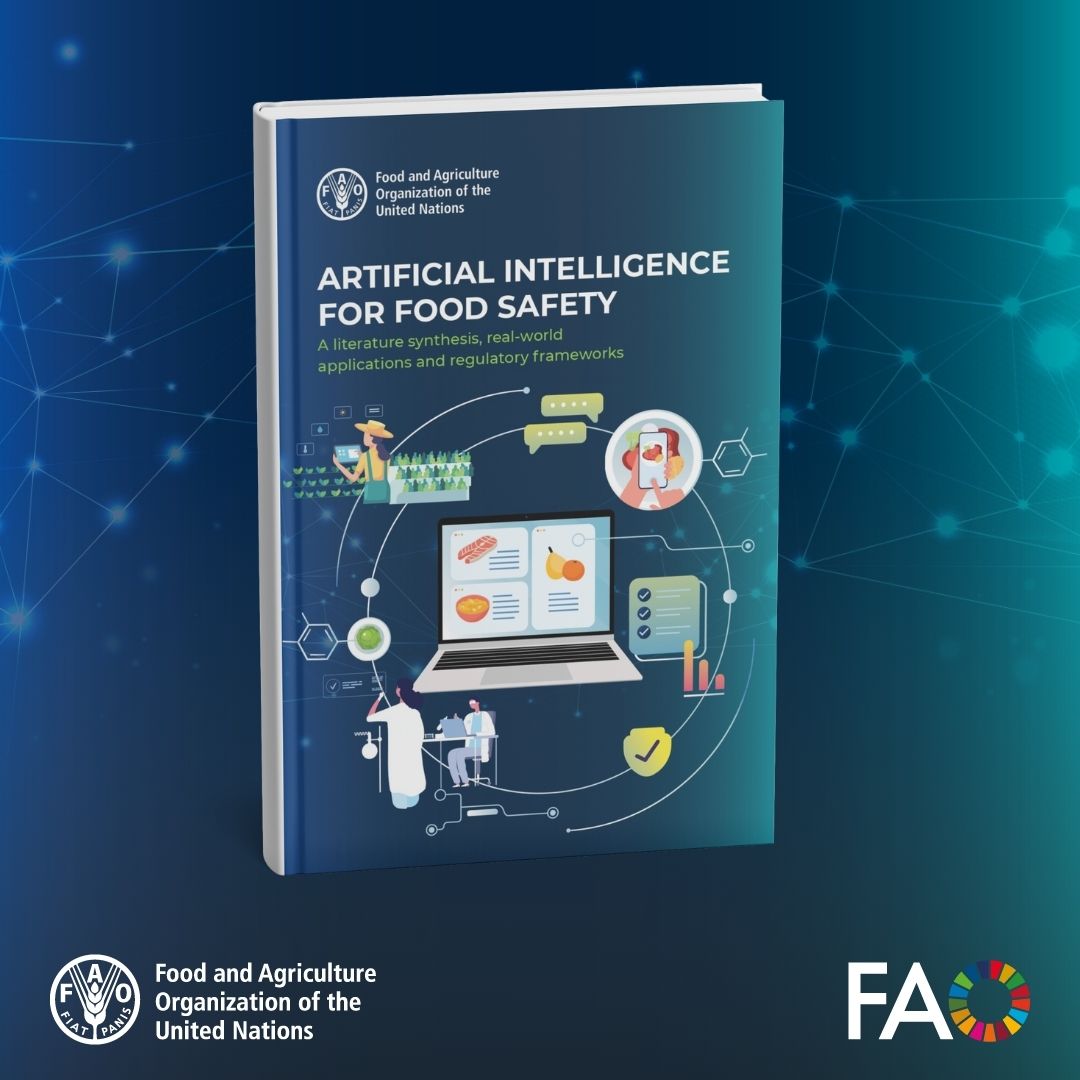
This publication, produced jointly by the Food and Agriculture Organization of the United Nations (FAO) and Wageningen Food Safety Research, evaluates 141 recent scientific papers and presents practical case studies, including new examples from low- and middle-income countries. It also reviews global and national governance frameworks and highlights the importance of responsible and trustworthy AI implementation in the agricultural sector.
“In food safety, particularly in the area of risk assessment, high-quality datasets have been critical for decades. Unfortunately, however, the generation and integration of such data is a challenge for many countries, especially those facing priority conflicts or resource constraints. Therefore, we sincerely hope that the increased use of AI will make people reassess the need to prioritize data collection, especially given the importance of having high-quality data sets,” said Masami Takeuchi, FAO Food Safety Officer.
The publication notes that while enthusiasm for AI is growing, many food safety authorities are facing a lack of data and capacity constraints. Strengthening AI and data management literacy, especially in the public sector, is key to unlocking the benefits of these technologies in risk-based prevention.
“From my academic perspective, investing in AI literacy is essential. Only when people understand what these tools can and cannot do, they can make informed choices about how to use them responsibly in food safety,” said Floor van Meer, one of the lead authors of the Wageningen Food Safety Study.
Eric van Ingen, FAO’s Senior Specialist for Digital Agriculture and Innovation, highlighted the opportunity to move towards more open cooperation in this area. “There is a wealth of knowledge around machine learning and food safety using structured data. The field of generative AI is still quite open when it comes to food safety, and that’s something to explore further,” he said. “We have the potential to really move from a closed innovation model to an open innovation model when it comes to AI for food safety.”
This publication is based on insights gathered at the FAO Global Seminar held on 6 November 2024. At this seminar, 1,023 participants from 107 countries discussed current applications of AI in food safety and shared challenges and lessons learned. As AI continues to rapidly evolve, FAO will continue to support Member States in seeking responsible solutions that help reduce food-borne risks, improve regulatory coverage and strengthen global food safety.
Download publication: https://doi.org/10.4060/cd7242en
Citation: van Meer, F., van der Velden, B. & Takeshita, M. 2025. Artificial intelligence for food safety – literature synthesis, real-world applications and regulatory framework. Rome, FAO. https://doi.org/10.4060/cd7242en