introduction
Over the past decade, machine learning has evolved from experimental data science projects to mission-critical enterprise workloads. However, many organizations still struggle to move away from siled notebooks and prototypes. The real challenge is not building the model, but making it operational at scale.
Data scientists can create highly accurate models in a controlled environment, but a different reality arises in production. Models behave differently than real-world data, deployments become manual and inconsistent, teams lose track of model behavior over time, and collaboration across data science, engineering, and operations begins to break down. This gap between experimentation and production is often referred to as the last mile problem in machine learning.
MLOps is a discipline that bridges this gap. It introduces automation, standardization, and governance across the model lifecycle, just as DevOps did for application delivery. In this blog, we provide practical ways to bridge that last mile and build a reproducible, scalable, production-ready path from model development to reliable inference.
core concept
The central idea is simple. It means treating machine learning as a continuous flow rather than a one-time experiment. A healthy MLOps setup moves at a predictable cadence, from source changes to builds, training, model tracking, deployment, and monitoring. Each stage flows cleanly into the next, so your team spends less time fighting fires and more time improving the model. MLflow connects pipelines by keeping experiment results and model versions in one place. This shared record keeps everyone aligned from training runs to live inference updates. It also makes model promotion a controlled step rather than guesswork. Security and operations are part of the pipeline, not an afterthought. Secrets, access controls, and logs are handled as a standard part of your daily workflow, making troubleshooting faster and making it easier to trust the operation of your production environment.

Figure 1. Basic MLOps pipeline
A pipeline is initiated when a meaningful change is introduced, either in data preparation, model logic, or service behavior. This change triggers a repeatable build path and packages and stores artifacts in a way that keeps versions organized and easy to track.
From there, running training produces model output along with the context you need to understand the model, such as metrics and execution history. Rather than treating each run as separate, the pipeline captures results into a shared tracking layer, allowing teams to compare experiments and confidently decide what needs to move forward.
The final stage focuses on releasing and operating the model in production. Deployment promotes the selected model version to live service, and monitoring closes the loop by monitoring health, predictions, and runtime behavior over time. This transforms machine learning from a one-time activity to a trusted product lifecycle.
Broadly speaking, the pipeline covers seven key elements: sources and triggers, builds, artifact storage, training, tracking and registries, deployment, and observation. Oracle Cloud Infrastructure (OCI) services and open source tools naturally map to these steps, providing a practical structure that is easy to follow without weighing down the process.
End-to-end architecture overview
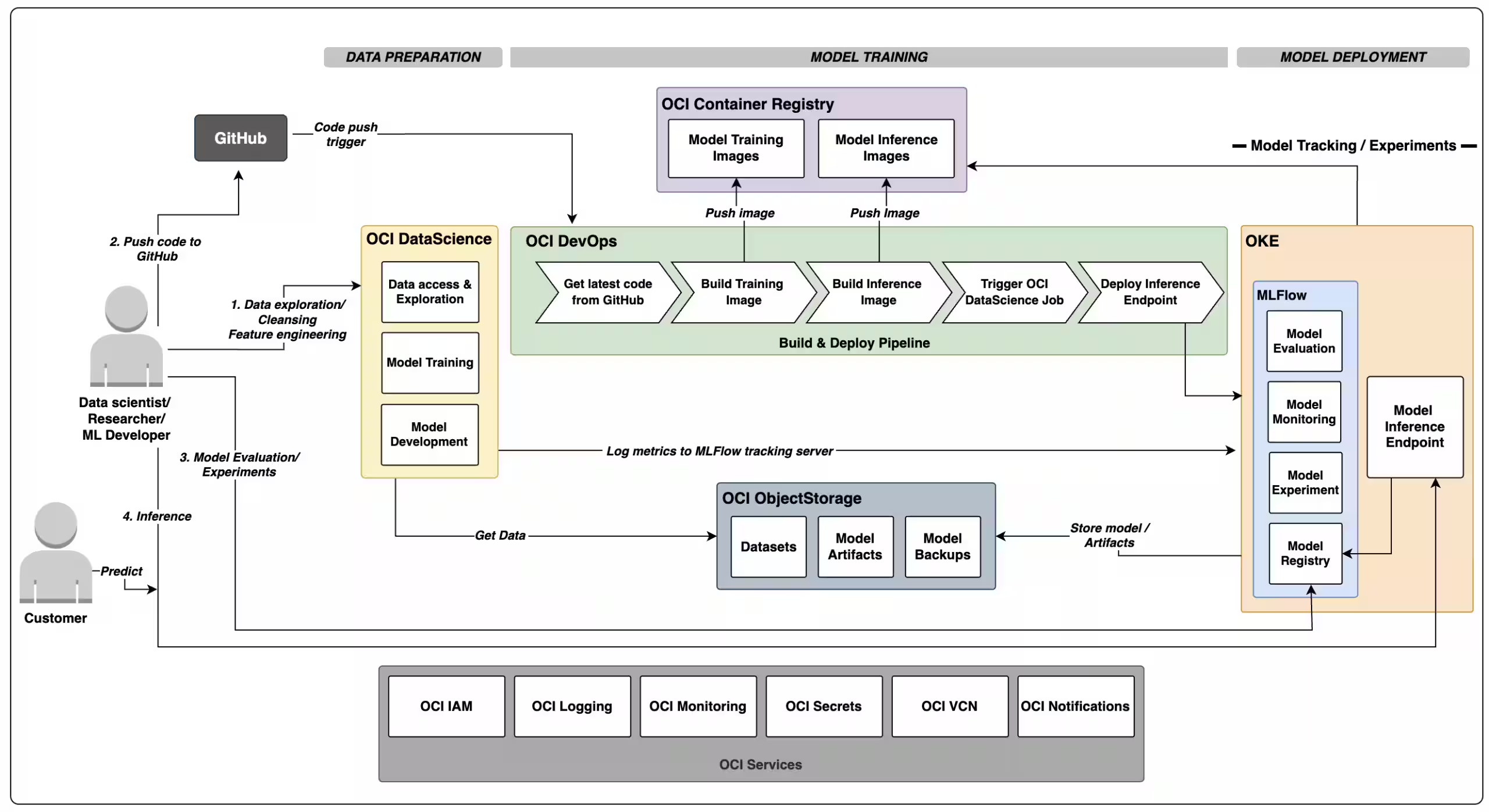
The following architecture diagram illustrates the entire lifecycle and service interactions described in this section.
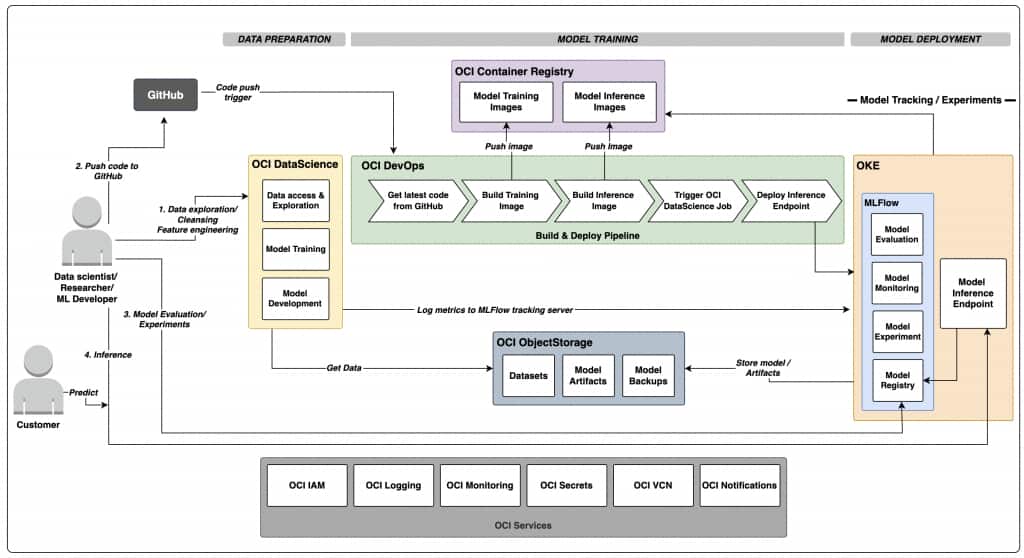
Figure 2. MLOps architecture on OCI
The flow starts with GitHub. A push to the main branch scoped by the configured path filter triggers OCI DevOps. The build pipeline prepares two image passes. One for training and one for delivery. Both images are pushed to OCIR so they are versioned and available for controlled deployment.
After the build phase, the pipeline triggers the execution of the OCI data science job. Here, the model is trained in a managed containerized runtime. A training run records experiment details and model artifacts in MLflow. Artifacts and datasets are supported by OCI object storage, where data is externalized and persisted rather than tied to ephemeral job runtimes.
Once training is complete, the deployment pipeline updates the processing workload on OCI Kubernetes Engine (OKE). The app providing the service exposes health and prediction endpoints and retrieves the appropriate model state through MLflow tracking configuration. Deployments are pipeline-driven, so rollouts are consistent and repeatable, and you can reuse the same process for future model updates.
Networking is structured to support both access and control. OKE runs inside a VCN with dedicated subnets, and services such as MLflow and model serving can be exposed through load balancer endpoints. OCI Data Science runs use configured subnet placement and logging configurations, so you maintain operational visibility from day one.
Observability spans the entire chain. DevOps project logs capture CI/CD behavior, and OCI data science job logs capture details of training runs. This becomes important during incident handling. For example, if a training run fails, your team can quickly determine whether the problem is the model code, network reachability, secret access, or endpoint configuration.
Key benefits of OCI over MLOps
One of the big benefits is the ability to integrate services without forcing teams into fragmented tools. OCI DevOps, OCI Data Science, OKE, OCI Logging, OCI Vault, and OCI Object Storage can be configured into a single, consistent workflow rather than stitched together. This reduces glue code and operational overhead.
Another advantage is the clarity of operation. OCI data science jobs provide a managed training runtime that works well with container workflows. OKE provides the flexibility to provide modern APIs and model inference services. OCI Logging and OCI Identity and Access Management (IAM) make it not only functional, but practical to do this in a way that is observable and controlled.
An equally important benefit is that OCI can continue to use open source tools without having to redesign workflows. Teams can build using familiar packages like MLflow, scikit-learn, pandas, FastAPI, and Docker/Kubernetes patterns, and OCI provides a managed foundation for them. This balance is valuable because it avoids heavy reliance on proprietary model formats or platform-specific service delivery logic, making it easier to move workloads, retrain elsewhere, or expand into multicloud and hybrid environments over time.
When secrets and access are treated as a feature of the platform, your security posture improves significantly. By using Vault-based secrets, scoped OCI IAM policies, and Terraform-managed resources, teams can avoid many common risks caused by ad-hoc credentials and manual configuration drift.
OCI is also powerful when scaling from a single team setup to broader organizational use. This same pattern of workspaces can be extended across environments, projects, and model families with minimal redesign. Everything is infrastructure-as-code, making standardization a reality.
summary
Good MLOps is about removing uncertainty, rather than adding processes for its own sake. This workspace clearly demonstrates that principle. This means training, tracking, deployment, and service delivery are connected in a repeatable, monitorable, and secure path.
By combining support services through OCI DevOps, OCI Data Science, OKE, MLflow, and Terraform, projects move from “running on a notebook” to “running as a system.” The value is not just speed, but trust. The team knows what is being deployed, how to get there, and how to diagnose it if something goes wrong.
This architecture provides a practical and scalable foundation if you’re looking to operationalize ML in a production-ready way without becoming too complex.