
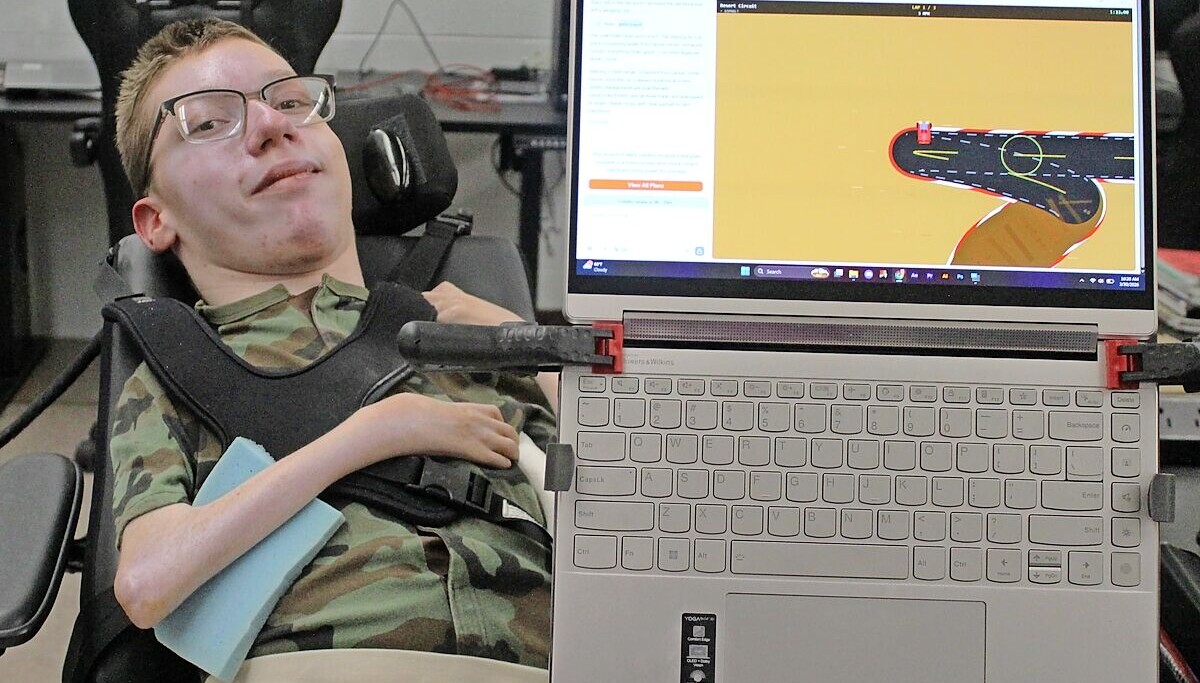
Carter had a strong interest in art, which grew into a passion for character and game design.
A student at Jefferson County Joint Vocational High School is pursuing his dream of becoming a video game designer with the help of an artificial intelligence program.
Chuck Carter, a senior in JVS’s multimedia and design program, used Base44 app builder to create “Rally Racer,” a racing game that features a series of turns on a multi-surface course. Using Base44, we were able to convert text-based instructions into applications to build tracks and establish game parameters.
After graduation, Carter, the grandson of Dean and Mary Carter of Adena and a student at Buckeye Local High School, plans to attend Kent State University in Tuscarawas to study animation and gaming. He also plans to take a 3D modeling class.
Cody LaRue, a multimedia and design lecturer, said Carter created the game in a short amount of time and gave it features that were accessible to everyone.
“In 10 minutes he created a racing game,” LaRue said. “Chuck wants to study game design. This is one way to use AI to improve his workflow. From his perspective, with his physical limitations, this is a useful tool to help him learn the fundamentals of game design.”
Carter was born with arthrogryposis. Arthrogryposis is a congenital disease that affects the joints, making them short and stiff. He uses a switch-operated wheelchair. He has been assisted by aide Laura Morrison since fifth grade and continues to work with her at JVS.
Despite his physical challenges, Carter developed a strong interest in art, which grew into a passion for character and game design. He designed games on a touchscreen computer with a stylus between his teeth. He said the project was inspired by a game he played as a child that he was never able to find again.
“There was a game I played on my iPad 10 years ago that I could never find again,” Carter said. “It was very similar to this and I wanted to play this game again. I thought, ‘I could design this myself.'”
He used Base44 to develop circular tracks that simulated asphalt and dirt surfaces, and updated the game’s cars to follow mouse controls. The speed at which a vehicle travels on a course is determined by the distance it travels.
“It took many iterations to create a truck that felt good to drive,” he said. “This is a project I worked on that took about an hour to complete. The hardest part was knowing what to enter and which problems to fix.”
LaRue said the real-time testing process is helping Carter better understand the physics of the game.
“He’s using AI and testing it in real time, and he’s learning a lot about the physics of the game,” LaRue said. “Being able to explain it helps him build it from scratch. He had real-world physics in mind and thought this was a cool use of AI.”
Larue also introduced the Application of AI course this year. He said the goal is not to persuade students to use artificial intelligence, but to study it from a neutral academic perspective, including the ethics involved.
Carter said he used to have concerns about AI, but the project has changed some of his views.
“AI allows us to better respond to the problems we encounter in everyday game design,” says Carter. “It’s more of a collaboration, coding things that I can’t do. I’m doing the main design side, and then I just write the code. It’s a learning tool for leveraging AI.”
Carter said he plans to continue improving the game by adding features such as countdowns for each race, icy roads, and slide controls. He hopes to eventually release the game to the public.
“People can challenge themselves and reap the rewards,” Carter said. “It was much more fun than I expected.”


