
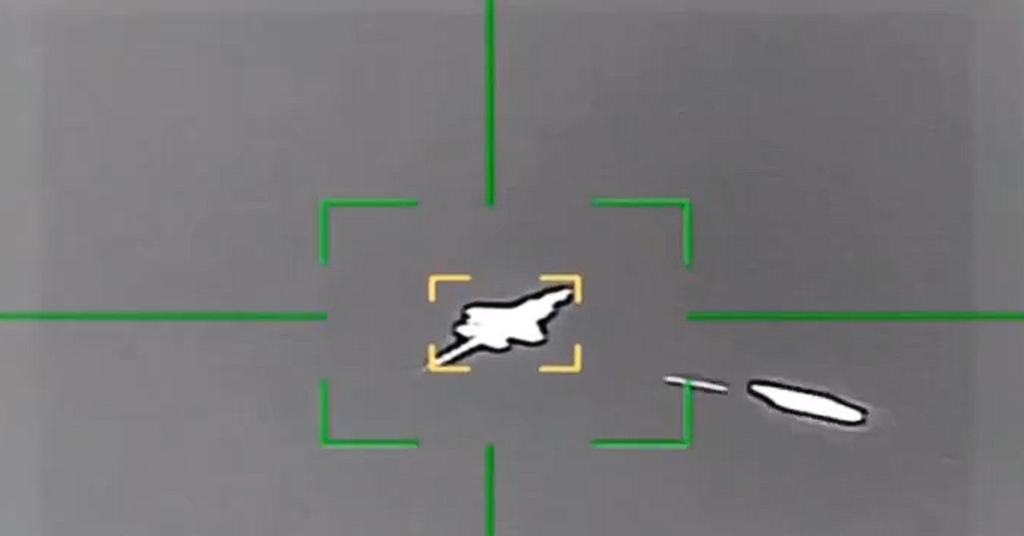
A video shared by Iranian state media on March 19 purports to show a US-operated Lockheed Martin F-35 stealth fighter jet being attacked by unspecified Iranian air defense weapons.
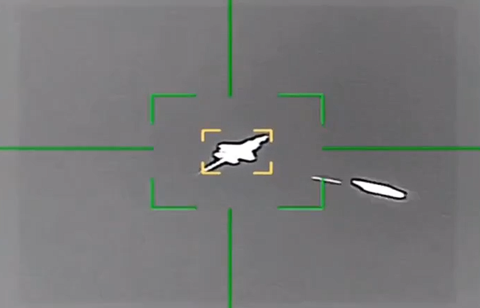
of picture It shows an F-35 in level flight being followed by some sort of infrared search and track thermal sensor. An unidentified flying object approached the aircraft from below and exploded at close range.
A flash of explosion briefly erases the gray thermal vision, then reveals an F-35 with a changed engine exhaust profile and what appears to be a second stream of hot gas or fuel emerging from the lower fuselage.
It may be the result of fragmentation damage from a close-in explosion.
The Islamic Republic of Iran News Agency shared the footage shortly after U.S. Central Command confirmed the incoming U.S. F-35. experienced On March 19, an unspecified in-flight emergency occurred during a combat mission over Iran.
CENTCOM said the accident aircraft landed safely and the pilot was in stable condition, indicating probable injuries.
However, the Pentagon does not acknowledge that enemy fire is the cause of the emergency, or even the nature of the emergency itself.
A report by American broadcaster CNN, citing unnamed sources, is the source of claims that the Iranian fire influenced the F-35 incident. The network relies on much of its coverage of the Iran war from anonymous sources, including a series of articles in early March alleging that a ground attack on Iran was being prepared by Kurdish militias.
The report strongly suggested that such an operation was imminent. In the end, no such operation took place, and Iraqi Kurdish leaders rejected any idea of acting as ground forces in a joint US-Israeli air war.
The circumstances surrounding the F-35’s emergency landing are complex, but a video of the incident purportedly released by the Iranian government appears suspicious.
Analysis by FlightGlobal found multiple discrepancies indicating possible manipulation by artificial intelligence software or outright fabrication. Depictions of temperature gradients along the F-35’s fuselage, depictions of incoming munitions, and contours of detonation of explosives were all identified as suspicious.
Experts with knowledge of explosive weapons also called the F-35’s detonation signature, uniform temperature gradient, and perfectly stable tracking by thermal sensors suspicious.
However, these problems could also be explained by low-quality thermal cameras made in Iran, sources told Flight Global. That person was not authorized to speak on the record.
To further examine the video, individual frames were fed into multiple large-scale language model AIs, including two models: Anthropic’s Claude and Google’s Gemini 3.
All three AI agents were shown frames depicting an F-35 in level flight, the approach of incoming munitions, a thermal image of a close explosion, and a damaged F-35 in flight after a collision, and were then asked to reach a conclusion about the authenticity of the footage.
The results were in remarkable agreement with human evaluations.
Claude from Anthropic describes the video as follows: It is “likely not real” and consists of either real forward-looking infrared sensor footage overlaid with computer-generated explosions or fully synthetic AI creations.
Google’s Gemini reached a similar conclusion, saying the footage was “almost certainly a propaganda fabrication” and likely based on an open-source video game graphics engine.
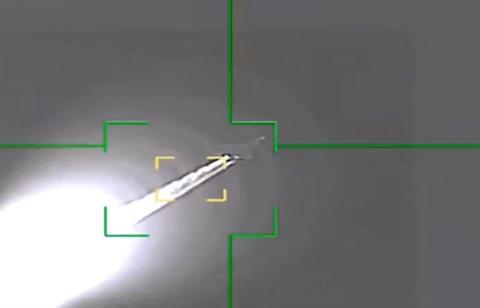
Both AI analyzes flag unrealistic thermal blooming (whiteout of a thermal camera when capturing an explosion event) as inconsistent with a genuine explosion, along with stable and uninterrupted tracking of the target during a thermal bloom.
As recognized by human analysts, the Human AI raised questions about the “near-perfect concentric rings” the munitions displayed almost immediately after impact.
Actual explosion events captured in FLIR footage appear more asymmetrical or turbulent, rather than a “mathematically smooth” radial gradient.
Similarly, Gemini AI, like human analysts, identifies thermal signatures presented by the F-35 itself as simplistic and inaccurate.
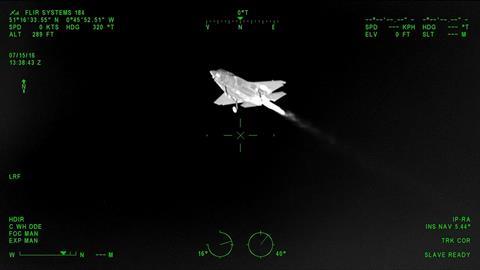
Rather than the entire fuselage appearing uniformly white, as in the Iranian video, real thermal images of the fighter jet in flight show higher surface temperatures on the leading wingtips and exhaust nozzles, and varying levels of brightness along the rest of the fuselage.
That reality was captured by US defense manufacturer Teledyne FLIR using one of its 380-HDc multispectral sensor units at the 2016 Farnborough International Air Show. thermal video A view of the F-35B performing flight maneuvers.
The Teledyne FLIR footage shows how much more data is captured and displayed by a genuine infrared tracking sensor, but the discrepancy can be attributed to the perhaps more rudimentary equipment available to Iranian forces.
Despite all indications that the Iranian video was at least partially manipulated, the possibility of a successful attack on the F-35 cannot be completely ruled out.
One plausible scenario put forward by industry insiders is that Iran successfully detonated an explosive near the F-35, but had no footage of the encounter and fabricated the recording.
Another possibility is that the encounter never occurred at all and that Iran completely fabricated the footage based on details contained in the CNN report.
Yet another explanation is that the Iranian footage, while legal, was shot with a particularly low-quality thermal camera.
Regardless of this particular incident, doctored images will always have a place in propaganda, and AI will make it increasingly easier for warring parties and others to fabricate them. For example, in the May 2025 clash between India and Pakistan; Suspicious images Reports of the alleged shooting down of an Indian Air Force Dassault Rafale went viral on social media.
U.S. Central Command has not confirmed tactical details about the incident, including the exact nature of the onboard emergency.


