
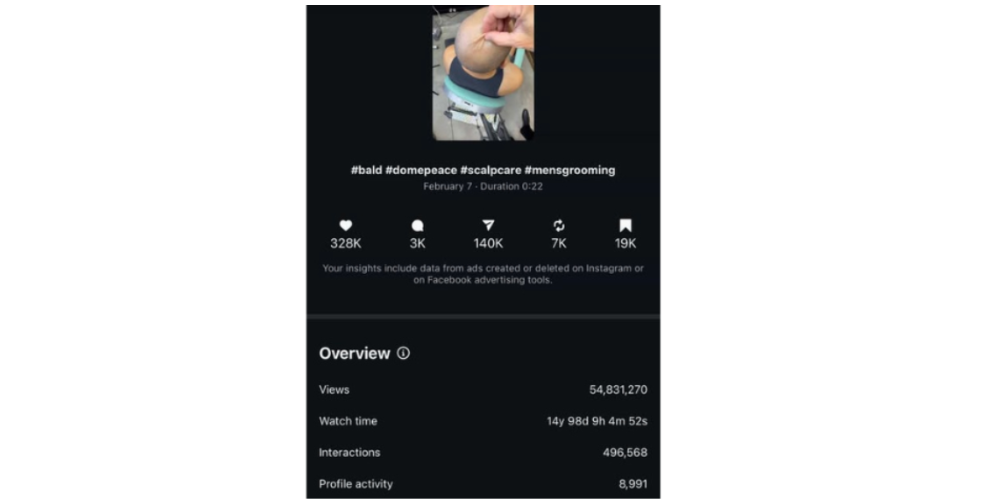
The clip was short. The result was… over 53 million views. It wasn’t some magical prompt that made it possible. It was an AI video workflow built for speed and repeatability, the kind of thing you could run on a random Tuesday without needing an entire production staff. Our CMO, Edwin Disla, designed that system for us. dome piece. He treated everything like an operator would. We reduced friction, tightened decision-making, and shipped more reps.
On a practical level, if your goal is momentum rather than perfection, you can think about your AI video process like this: Some AI tools can help move through the boring parts faster, but the real lever is the workflow itself. That is, how to choose an idea, shape it in the first second, block dead air, and learn from the platform’s instructions.
53M Views Case Study and Proof About AI Video
Story moments are simple. The video content begins with a hook that feels a little “wrong” in a good way. Unnatural tugging of bald skin. quick. visual. It’s a bit like hypnosis. It looks like something you shouldn’t be looking at, so your brain puts on the brakes mid-scroll, but you can’t look away either. The hard work was done in that one second. People stopped and stayed. Because this clip did not waste their attention. It earned it. And once the audience was locked in, the reels took a strangely satisfying turn. It’s a simple routine that makes scalp care feel less like “work” and more like a ritual you can actually stick to.
That’s been proven. Because the “atmosphere” doesn’t pay the rent. This reel racked up over 53 million views, amassed a huge amount of watch time, and elicited true intent signals such as shares, saves, and profile actions. The combination is important. Views alone can be a fluke. Share means “This is worth sending.” Save means “I want this later.” Profile activity means “I want to know more about whatever this is.” These are the metrics we value most because they show that the viewer did something afterward rather than just watching. In the middle of the reels, we also revealed the routine. The centerpiece of the video clip introduced all four products, provided step-by-step instructions on how to use them, and ended with a clear CTA to visit the website and follow the full instructions. It’s not a pushover. A simple next step delivered while your audience is still paying attention.
This is the real point. AI didn’t “make it go viral.” The platform made decisions based on retention and engagement. What AI did for us was remove resistance. This allowed us to move from idea to first cut faster, creating more reps without exhausting our team. That’s a benefit that most creators miss. AI is not a spark. It’s a treadmill. This allows you to perform further experiments, iterate the hook, tighten the clip, and ship again before the moment passes. And when you find something that works, you’re ready to follow up immediately instead of starting from scratch.
Development stages, how to share ideas and choose what can be shipped quickly
On this stage, Edwin runs the show like an operator. We share ideas quickly, keep the team moving, and treat every hook like a small bet. The goal is simple. Find that first second that captures attention and build the rest of your story behind it.
We actually tested over 25 hooks. Dozens. It’s enough that I’m starting to see a pattern rather than an opinion. Most of these tests still get real reach, typically 1.5,000 views or more, which is a useful lower bound. It means the platform gives us a fair chance and the concept is “watchable”. But it also tells us something important. Reaching 1.5K is not difficult. The hard part is finding those weird, engaging moments that make people stop scrolling and keep watching.
AI delivers that volume without disruption. Use AI-powered tools to generate batches of hook concepts, rewrite them with tighter visuals, and build quick variations without wasting time to perfect them. This led us to test things like goldfish-like hooks swimming in a bowl, the ice-pick scalp effect, and even the creepy ingrown hair concept. The point of their extremeness was the range. Edwin wanted to know what tension the audience would respond to: curiosity, satisfaction, discomfort, surprise.
After the test sprint, you continue to narrow down the fields, but your selections include more information. We select a few ideas that show the right signals early on. That means a strong hold in the first few seconds, a clear understanding even with the sound off, and a concept that aligns with our vision enough to build a routine around it. Then commit to those winners, shoot a clean version, and scale your iterations. It’s a developmental stage in real life, where you take a lot of swings, learn quickly, and then execute boldly.
Pre-production, script, scenes and video creation process
In pre-production, the entire video creation process ceases to be an idea and becomes a simple plan that can be executed immediately. The script is well structured: Hook → Proof → Payoff → CTA. The hook is a scroll stopper. The proof is a simple statement: “This fixes it.” The result is a simple step-by-step routine. And CTAs are the obvious next move. Scene planning is equally rigorous. Viewers first see unusual visuals, then the scene moves into routines and product steps, ending with a clean summary. The technical choices are finalized early on, so there are no complications later. Things like vertical aspect ratios, close camera framing that keeps the action centered, and simple lighting that looks sharp and natural while avoiding harsh glare on bald skin.
Higgsfield production, text to video conversion, camera movement, and clip generation
In production, Higgsfield AI plays that role in the stack. Turn concepts into ready-to-use clips without the usual reshoot and reblock interactions.
Upload some pretty image inputs (key frames or still images of your product/scene), some reference footage to help set the mood, a short prompt that describes the action in easy-to-understand language, and use text-to-video conversion to generate variations close enough to be ready to cut and test.
The big key is being able to get “new angles” on demand. Generate camera movement and controlled motion within the clip itself, rather than resetting the camera and shooting again. For example, a subtle push that makes the opening moment feel more intense, or a smooth tracking shot that glides over your scalp and product as your routine transitions from hook to step. One example we used is that the opening skin-pulling moment starts out tight, and when you let go, the camera “floats” forward and slightly off-center, creating a natural release of tension and keeping the viewer looking throughout as the frame literally moves the viewer from one beat to the next.
Why AI is becoming the default for brand videos
AI is changing the economics of attention and is quickly becoming the new way for brands to create videos. This reduces the cost of testing, accelerates the time from idea to publication, and turns content into a repeatable system rather than a once-a-week production event. The more variations you can create, the more you can learn. The more you learn, the less you will guess. This allows you to build complex workflows.
For bootstrap brands, this is a real money saver. You don’t have to rent space, book talent for multiple reshoots, or pay hefty post-production costs every time you test a new hook. You can create more clips with fewer resources and put your budget where it really matters: the winners. Rather than spending thousands of dollars upfront to “make it perfect,” spend a small amount, learn quickly, and scale something that proves you can get noticed.
Also, your content is never locked in one place. Clips that work organically can become ads. The same creative can be adapted to different platforms, whether it’s Instagram or TikTok, with a few edits to the pacing, caption, and first second. That’s the new normal. Build content that can survive as a post, and then scale it as paid once you’ve proven that you can keep people watching. AI is not replacing brands. This gives brands more shots, speed, and leverage at a reasonable cost when building lean.


