
The Ateneo Institute for Intelligent Visual Environments aims to co-develop machine learning solutions with industry experts to address complex challenges in healthcare, urban planning, and public safety.
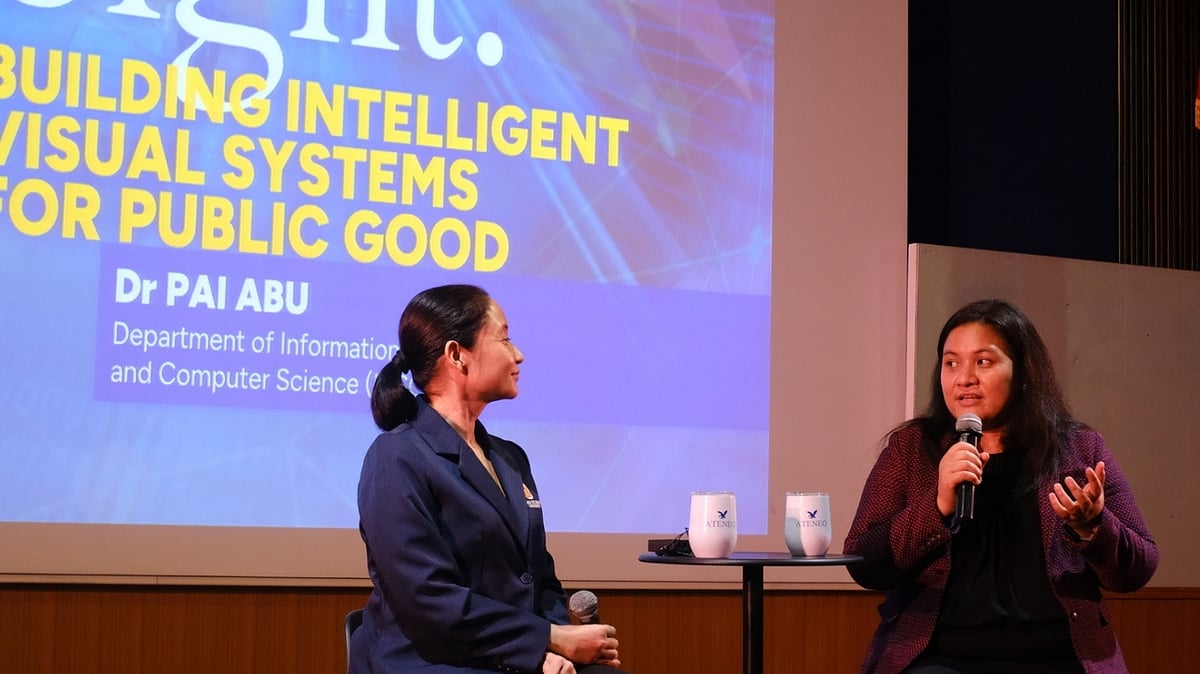
Promoting interdisciplinary collaboration was the central theme of the second Ateneo Breakthroughs Lecture held last February 26 in Escaler Hall. During the event, Dr. Patricia “Pai” Angela R. Abu, Associate Professor and Dean of the Department of Information Systems and Computer Science at Ateneo de Manila University, delivered a lecture titled “Smarter Vision: Building Intelligent Visual Systems for the Public Good.”
Abu, who leads the ALIVE team, explained that while machine learning allows computers to identify patterns that are difficult for human experts, these systems struggle with tasks that humans can intuitively understand.
Young children can recognize faces with little instruction, but computer vision systems require large datasets and continuous testing to deal with changes in lighting, angle, and weather.
“Building reliable machine learning systems requires bridging messy reality and mathematical models,” Abu said, noting that systems need to prove they can withstand real-world conditions, not just controlled laboratory demonstrations.
The ALIVE Institute has already developed several applications aimed at public welfare. In the medical field, the team created dental image support tools and deep learning models to detect bone metastases, helping experts identify subtle patterns at scale.
In urban management, the lab has developed V-PROBE (Vehicle and Pedestrian Real-Time Observation and Behavior Evaluation), a system designed to monitor traffic, predict parking availability, and flag congestion.
The Institute’s current priority is to advance research beyond the Institute by partnering with industry leaders. Abu said these partners provide the operational environments, data pipelines and expertise needed to test systems against practical constraints such as speed, privacy and hardware limitations.
By collaborating with external stakeholders, research teams can ensure that laboratory experiments turn into innovations that meet the specific needs of end users.


