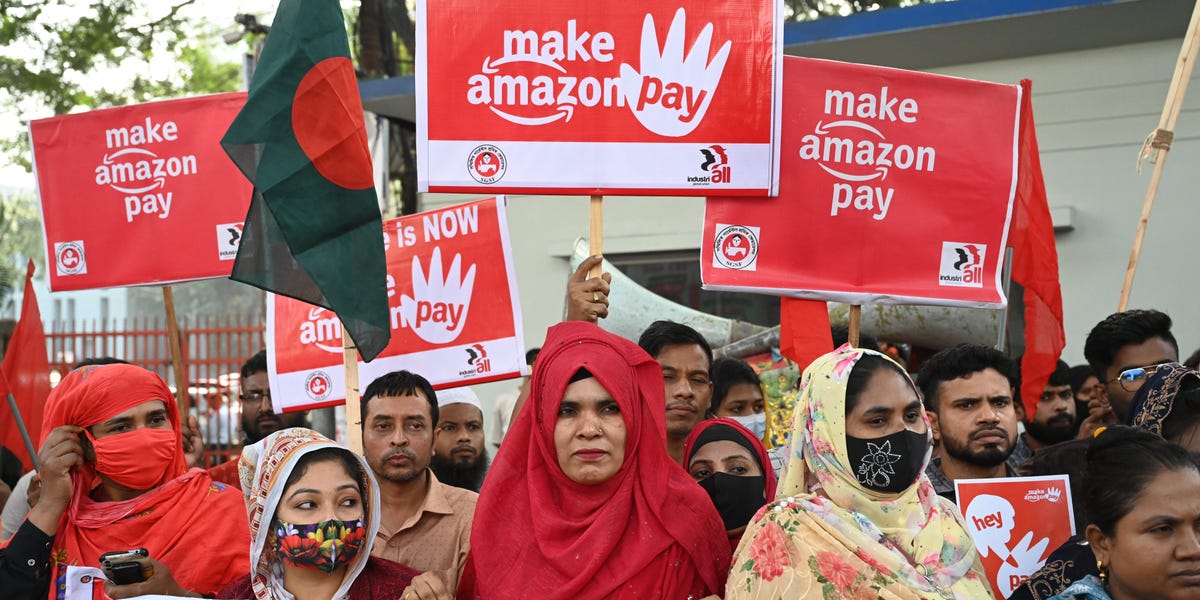
Amazon workers in more than 30 countries began organized strikes and protests on Black Friday, launching the sixth annual “Make Amazon Pay” campaign in what organizers say is the largest mobilization ever.
The wave of strikes, rallies, and demonstrations will continue until December 1, spreading to warehouses, data centers, offices, and public spaces around the world. The protests are being organized by UNI Global Union, which represents millions of service sector workers around the world, and Progressive International, a global network of labor and activist organizations.
Organizers say the action reflects growing frustration over everything from heat-damaged warehouses and aggressive productivity pressures to Amazon’s burgeoning AI and cloud operations, growing impact on climate change, and collaboration with immigration and law enforcement.
“Amazon, Jeff Bezos, and their political allies are betting on a future of tech authoritarianism, but on Amazon Pay Day, workers around the world are saying enough is enough,” UNI Global Union General Secretary Christy Hoffman said in a statement. “For years, Amazon has crushed workers’ rights to workplace democracy through support for unions and authoritarian politicians.”
In a statement, an Amazon spokesperson said: “In fact, Amazon offers great pay, benefits, and great opportunities all from day one. We directly employ more than 1.5 million people around the world, and we offer a modern, safe, and attractive workplace, whether you work in our offices or in one of our operations buildings.”
Amazon workers in India demand labor protections
This year, thousands of workers have rallied in New Delhi, Kolkata, Mumbai and more than 20 other Indian cities, demanding fair wages, safe conditions and protection from the extreme heat.
A UNI Global Union survey of 474 Amazon warehouse and delivery workers in India conducted between June and July found that labor concerns were the driving force behind this year’s action. Three-quarters of respondents said they or a colleague needed medical attention due to heat exposure. More than half reported working conditions that were “very hot and unsafe” or “unbearable.”
The findings come a year after the Indian Human Rights Commission called for an investigation into labor practices at the Amazon facility near New Delhi. Workers there were reportedly prevented from taking water breaks during a severe heat wave. Amazon workers in India also protested over this last year.
“Workers should not be forced to risk their health or lives for the benefit of Amazon,” Hoffman said. “Heat measures must be enforceable and workers themselves must have a say in setting standards.”
Protesters criticize Amazon’s environmental impact and relationship with ICE
More than 1,000 Amazon employees have published an open letter criticizing the company’s use of artificial intelligence. The letter alleges that Amazon is abandoning its commitment to combating climate change by funding AI infrastructure, citing its $150 billion investment in new data centers despite the company’s pledge to reach net-zero emissions by 2040.
The workers demanded that Amazon power all of its data centers with renewable energy, establish a worker committee with authority over AI deployment decisions, and refuse to make AI technology available for what they called “violence, surveillance, or mass deportation.”
This year’s expanded agenda for “Make Amazon Pay” emphasizes what organizers call a “techno-authoritarian future,” or the convergence of Big Tech companies and authoritarian political forces. The coalition said Amazon is funding President Trump’s inauguration and that the company’s most recent filings show it paid $1.4 billion less in taxes.
Beyond Amazon, organizers are planning protests in multiple U.S. cities, including Chicago, Newark, New York, Oakland, San Bernardino, and Washington, D.C. Demonstrators are focusing on Amazon’s work with Immigration and Customs Enforcement and demanding that the company stop providing infrastructure that they say affects Amazon’s deportation operations.
“Amazon is no longer just a retailer; it is a pillar of a new authoritarian order built on surveillance and exploitation,” Progressive International co-coordinator David Adler said in a statement. “From ICE raids to the oppression of Palestinians, Amazon’s technology is embedded in systems of violence around the world.”
Amazon workers call for unionization efforts
In Germany, service union Verdi coordinated work stoppages at nine logistics facilities, Reuters reported. According to the union, about 3,000 workers have participated and are continuing to press for a collective bargaining agreement.
Amazon maintains about 40,000 employees at its distribution centers in Germany, with an additional 12,000 seasonal employees in preparation for the holiday rush. The company told Reuters the strike did not affect deliveries to customers and that compensation was competitive.
Additional protests erupted in Canada, with major labor union CSN and immigrant worker advocacy group CTI holding a demonstration in downtown Montreal calling for a boycott of Amazon.
The protests came after Amazon closed several distribution centers in Quebec, resulting in the loss of 4,500 jobs, City News Montreal reported. Union leaders have accused Amazon of retaliating against workers’ unionization efforts, with one organizer pointing to the timing between the warehouse’s unionization and Amazon’s decision to close facilities in the region.
Other actions were taken in Australia, Indonesia, Taiwan, Nepal, Brazil, Bangladesh, Colombia, Denmark, Luxembourg, Poland, Greece, the United Kingdom, South Africa and Gaza.
Amazon workers achieved a union victory in 2025. A warehouse in Delta, British Columbia, became the first Amazon facility in Canada to gain union representation after labor officials ruled the company had unfairly interfered with an organizing drive. Amazon is contesting the ruling.
Any tips? Email Pranav Dixit. pranavdixit@protonmail.com or at a traffic light 1-408-905-9124. Use a personal email address, non-work WiFi network, and non-work device. Here’s a guide to sharing your information securely.