
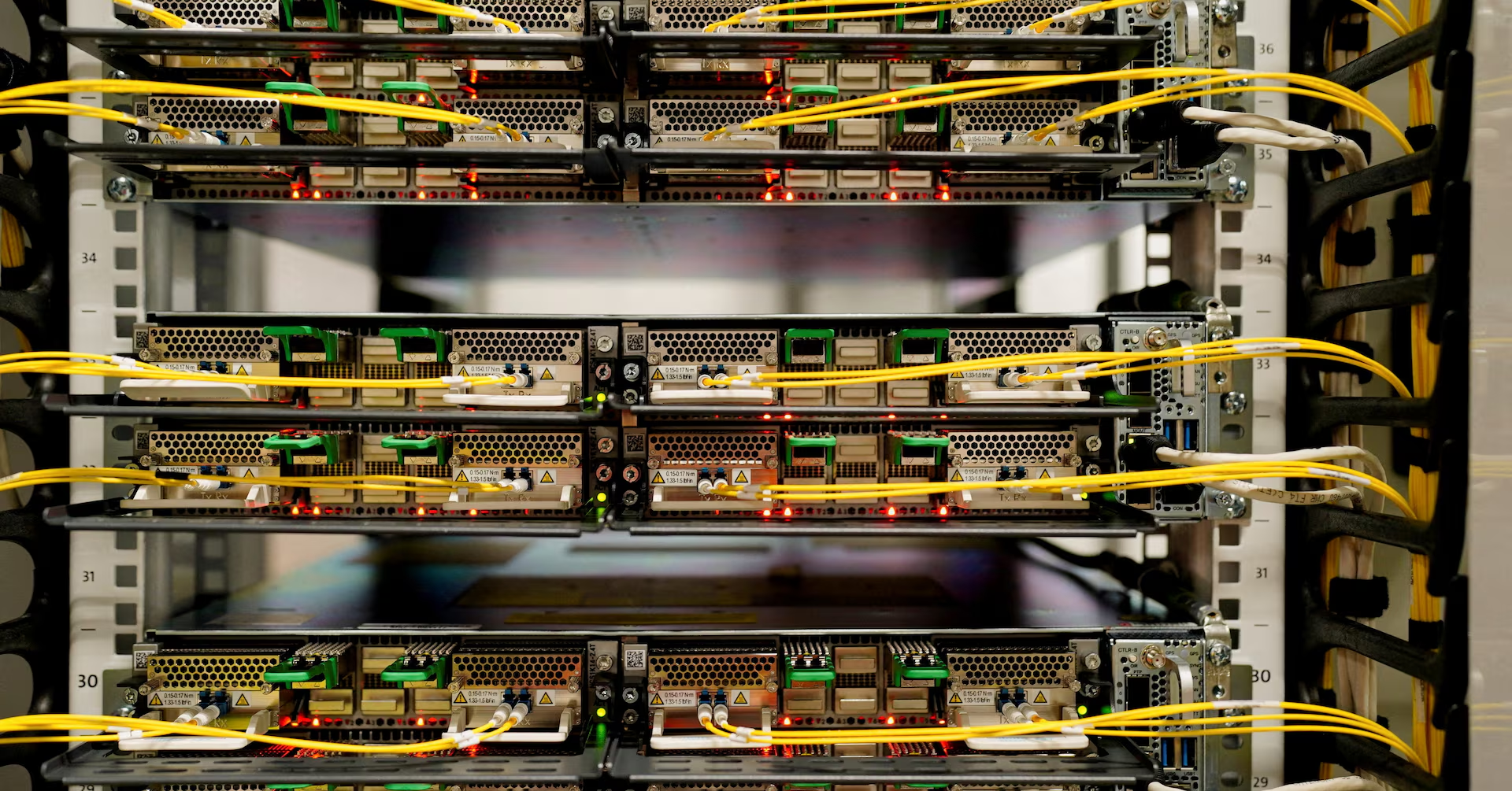
LONDON (Reuters) – As AI fever drives global stock prices to record highs, companies are increasingly relying on debt to finance the data centers needed to strengthen the technology, raising concerns about the risks.
AI data center and project finance deals have soared to $125 billion so far this year, up from $15 billion in the same period in 2024, and increased supply from the sector is expected to be crucial for credit markets in 2026, according to a UBS report last month.
sign up here.
“Public and private credit appears to be the primary source of funding for AI investments, and their rapid growth is causing some concern,” said Anton Dombrovskis, fixed income portfolio specialist at T. Rowe Price.
“While supply increases have so far matched relatively healthy demand, this is an area to watch, especially given the large capital requirement estimates,” Dombrovskis added.
Christopher Kramer, a portfolio manager and senior trader in Neuberger's investment-grade credit team, told Reuters he sees a tectonic shift in the market as the biggest technology companies fund their AI infrastructure ambitions.
“From a debt issuance perspective, these haven't been the focus of our market, but obviously that's changing dramatically… Whenever that happens, it creates a lot of opportunity,” he said on Nov. 28.
“We're excited just from the standpoint that the market is changing. There's going to be a different dynamic. It's going to create opportunities to take risks and create value for investors,” Kramer added.
Here are five charts showing how debt is funding the AI space race.
1) Oracle: CDS surge reflects investor concerns
Technology company executives, whose companies have long relied on strong cash flow to fund spending on new initiatives, say this spending is needed for technology that transforms work and makes business more efficient, and say the bigger risk is underinvestment rather than overspending.
On the back of a $300 billion deal with OpenAI, Oracle stock has nearly doubled in value since the beginning of the year to its peak in September. However, it has since fallen 42%.

2) Rapid increase in AI investment-grade borrowing
JPMorgan estimates that AI companies make up 14% of its investment-grade index, outpacing U.S. banks as the leading sector.
But Big Tech deals represent only a fraction of the roughly $1.6 trillion in U.S. IG bond issuance expected in 2025.

3) Increase in AI-related “high-yield” bonds
The high-yield bond market is also seeing AI-linked issuance, offering higher returns to investors despite lower credit ratings for issuers.
Overall, junk tech bond issuance is at an all-time high, according to data from Dealogic.
Al Cattermole, fixed income portfolio manager and senior analyst at Mirabeau Asset Management, said as of November 25, his team had not invested in any of the AI-related IGs or high-yield bonds that have recently come to market.
“Until the data center is delivered on time, on budget, and provides the computing power for which it was intended, and there is still demand for it, it will not be tested,” Cattermole told Reuters.
“And since it's untested, I think it needs to be compensated like equity rather than debt,” he added.

4) Increasing role of private credit in AI financing
Private credit, provided by investment firms and others rather than banks, is also funding AI data centers.
UBS estimates that private credit AI loans could have nearly doubled in the 12 months to early 2025.
Morgan Stanley estimates that private credit markets could provide more than half of the $1.5 trillion needed to build data centers by 2028.

5) ABS transformation?
Securitized products such as asset-backed securities (ABS) can also help fund the growth of the AI industry, according to Morgan Stanley.
These are illiquid assets such as loans, credit card debt, or, in the context of AI, rent paid by Big Tech tenants to data center owners, packaged into tradable securities.
Digital infrastructure accounts for only 5%, or $82 billion, of the roughly $1.6 trillion U.S. ABS market, but BofA notes that the market has expanded more than nine times in less than five years. The company estimates that data centers support 63% of that market, and expects to add $50 billion to $60 billion in supply by 2026.
ABS has been viewed with caution since the 2008 crisis, when billions of dollars worth of products were found to be backed by bad debts and highly illiquid and complex assets.

Report by Lucy Raitano. Editing: Amanda Cooper, Darla Ranasinghe, Alexander Smith
Our standards: Thomson Reuters Trust Principles.


