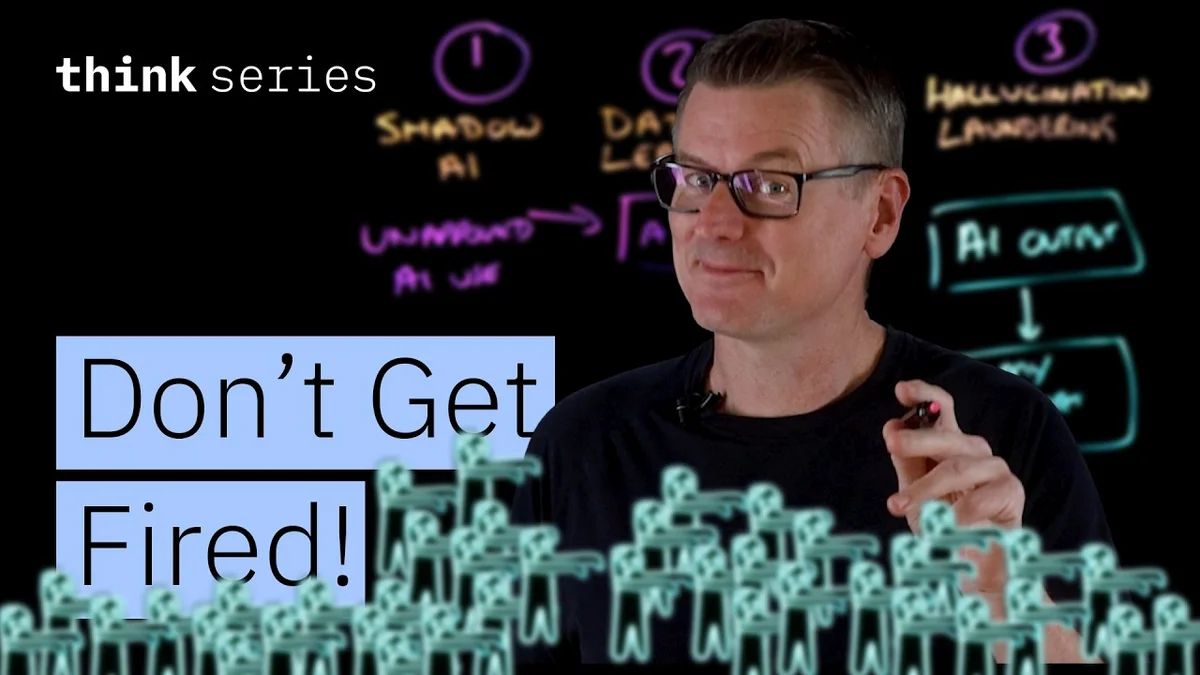
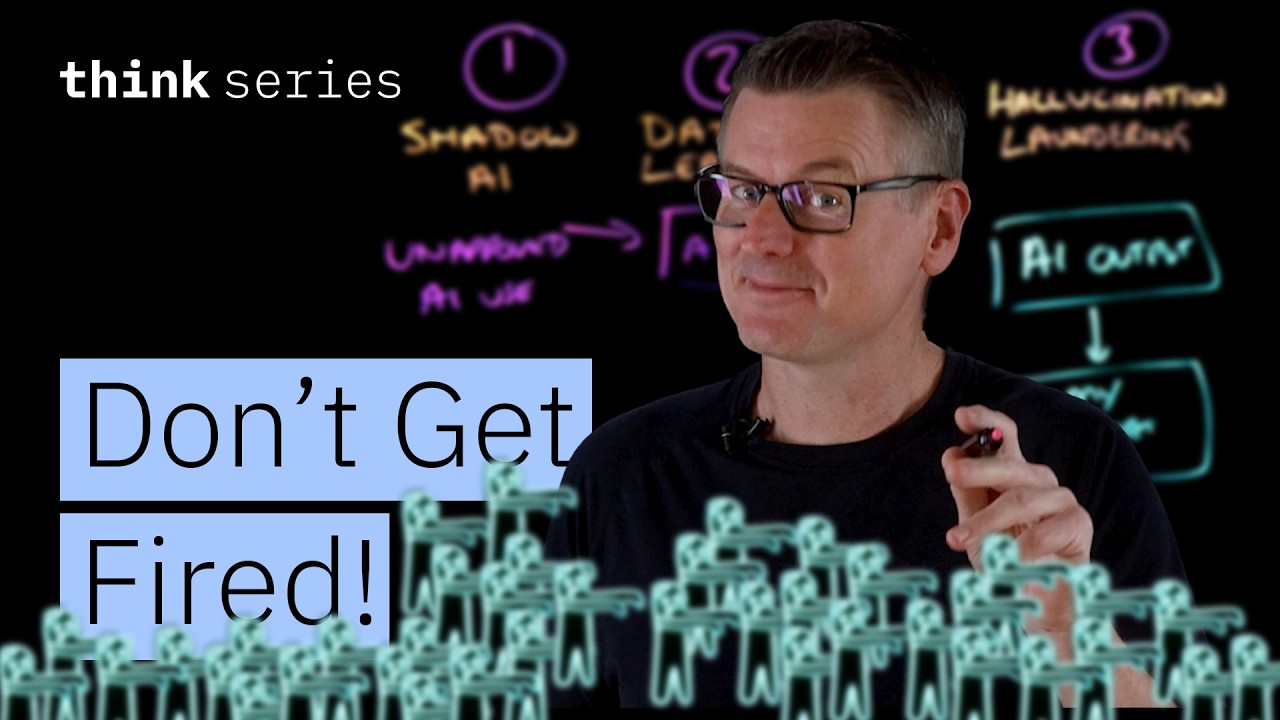
In the rapidly evolving world of artificial intelligence, it’s important to stay ahead of the curve, but it’s also important to understand the potential pitfalls. IBM Master Inventor Martin Keen outlines five major AI risks that could get you fired. From “shadow AI” to “zombie AI agents,” Keen provides a clear and concise overview of how employees can misuse AI tools and put their careers at risk.
Visual TL;DR. Unauthorized use of AI leads to shadow AI. Shadow AI causes data leaks. Data leaks can result in job termination. Illusion laundering can lead to dismissal. Inserting a prompt may cause the job to terminate. AI agent risk can result in turnover. AI governance mitigates the use of unauthorized AI. AI governance reduces data breaches. AI governance reduces illusion laundering. AI governance reduces immediate adoption. AI governance reduces risk for AI agents.
Unauthorized use of AI: Employees are using AI tools without approval from the company’s IT department.
Shadow AI: Unapproved AI tools create security vulnerabilities
Data breach: Sensitive company data fed into third-party AI models
Illusion laundering: AI output is presented as fact without verification
Prompt injection: Manipulating AI agent behavior with malicious input
AI agent risks: Autonomous AI agents can cause unintended consequences
Layoffs: Mismanaging the use of AI can put your career in jeopardy
AI governance: essential for managing AI risk and compliance
Visual TL;DR
Risks of unauthorized use of AI
Keen highlights “shadow AI” as the first big risk. This refers to employees using AI tools for work without the knowledge or approval of the company’s IT department. This behavior can lead to serious security vulnerabilities such as data leaks. He cites an IBM report showing that 20% of organizations have experienced a data breach due to unauthorized use of AI. These breaches can occur when a company’s sensitive data, such as proprietary code or customer records, is fed into an AI model hosted on a third-party server, potentially exposing it to unintended access or misuse.
Data breaches and AI governance
The second risk, “data leakage,” is a direct result of shadow AI. If an employee enters sensitive information into an unvetted AI tool, that data could become part of the AI’s training set or be stored in an insecure location. This means that data that should be private can be accidentally exposed in future AI outputs or accessed by unauthorized parties. Keene emphasizes the importance of robust AI governance policies that govern which AI tools are approved, how they can be used, and what data inputs are allowed. Without such governance, companies face significant risks to their intellectual property and customer data.
Complete discussion can be found here: IBMYouTube channel.
5 AI risks that could get you fired and how to avoid them (from IBM)
“Hallucination laundering” and immediate injections
Mr. Keene then delves into the third risk, “illusory laundering.” This occurs when AI generates information that sounds plausible but is factually incorrect, and employees present this AI-generated content as their own work without verifying it. This can lead to poor decision-making and damage to your company’s reputation. The fourth risk, “prompt injection,” is described as a malicious technique in which an attacker creates input that tricks the AI into bypassing the original safety instructions. This could allow the AI to divulge sensitive information or perform unintended actions. Keen points out that while new AI models are more resilient, it’s still a big concern, especially when AI agents interact with internal systems.
AI agents and their risks
The fifth risk we will discuss is rogue agent AI. This includes deploying AI agents that allow employees to interact autonomously with corporate systems, databases, or APIs without proper supervision. If not properly managed, these agents can perform actions that violate corporate policies and security protocols, such as deleting data or sending unauthorized communications. Keene emphasizes that the lack of visibility and control over these agents poses a serious risk as their actions are unmonitored and can have unintended consequences. He draws parallels to “zombie AI agents” that continue to operate with old or compromised credentials and can pose a persistent threat.
The importance of AI governance
Keen concluded by highlighting the critical need for comprehensive AI governance. He says simply banning AI tools is not a viable long-term strategy. Instead, organizations should establish clear policies for the use of AI, including vetting processes for new tools, guidelines for data handling, and protocols for monitoring AI agent activity. By implementing strong AI governance, companies can reduce the risks associated with shadow AI, data breaches, hallucinations, instant injections, and unauthorized AI agents, and enable employees to safely and effectively leverage the benefits of AI.