
The word “AI” is being thrown around so much that you may feel optimistic or pessimistic depending on where you stand on it. However, AI as a field has been around much longer, and has been used in various technologies (like mobile phones) long before chatbots and generative AI tools emerged. Most people associate artificial intelligence with generative tools, but it’s the often-ignored AI that smartphones rely on to function. For example, adaptive battery settings, which are offered as a way to extend your phone’s battery, also use AI without your knowledge.
According to Samsung, based on a Talker Research survey of 2,000 respondents, “90% of Americans use AI in their phones, but only 38% realize they are actually using it.” That’s because smartphones use AI for many of their important functions. That said, while the survey’s numbers may be true, they still don’t necessarily encapsulate the full picture of the recent AI push. The AI in many of the examples Samsung cited, such as weather forecasting, call screening, and automatic brightness, operates in the background and is different from generative AI.
What AI actually does for your smartphone
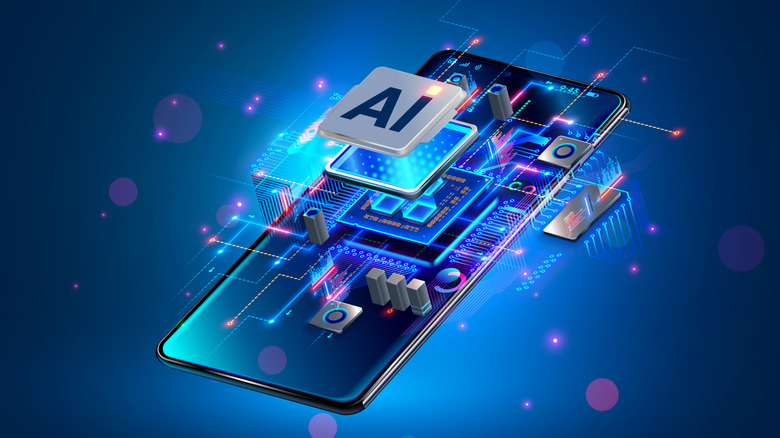
Modern smartphones have built-in methods to improve AI processing using specialized neural processing units (NPUs). NPUs are specialized chips that actually process the calculations that use AI to power your capabilities without consuming too much battery. This includes most things that use on-device AI processing, such as voice recognition and gesture control. Ironically, the most commercially available AI features, such as Google Photos’ Magic Editor and Android’s Circle to Search, may still require cloud processing because NPUs cannot handle such large calculations offline.
Smartphone cameras are also an example of using AI. This is achieved by relying on computational photography to bridge the gap between physical cameras and smartphone cameras. This is because smartphone cameras are not necessarily powerful enough to replicate the performance of DSLR or mirrorless cameras, and instead leverage AI to overcome the physical limitations imposed by smaller sensors and lenses. A good example is when the AI adjusts the exposure so that the photo isn’t too bright or too dark around the subject you’re photographing. Another example involves using artificial technology to reconstruct details lost after super-zooming into a subject. Additionally, AI can be used to reduce motion blur and correct color and tone accuracy. All this happens while using the camera. Anything you do with AI after post-processing is likely to be generative AI related.
Perceptions of AI remain mixed

While Samsung’s research paints a rosy picture of people’s interest in AI capabilities overall, the reality is somewhat different. For example, a recent survey by Pew Research Center reported that 50% of Americans remain wary of the impact of AI on their daily lives. The second key finding suggests that there are still concerns about how AI is used and how it will affect relationships and creativity, but also a greater openness to data analysis. The same article also states that younger Americans are more likely to be aware of or use AI than older Americans. This suggests that perceptions may be age-dependent, as well as why general perceptions are mixed. Some even blame AI for the layoffs. As a result, responses appear to change depending on the situation.
But when it comes to technology, interest seems to be wavering as to whether people want AI on their devices in the first place. Some users are not happy about privacy concerns, while others believe that AI features are simply not necessary. While it’s true that people are using AI technically, its acceptance is much more subtle, as AI is present invisibly in many benign smartphone features such as autocorrect. Opinions are often divided when it comes to AI, which is bringing major changes to people’s lives.


