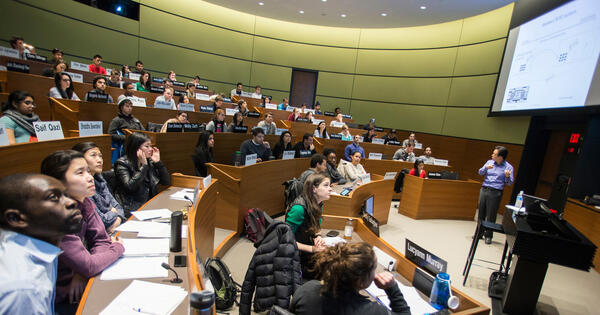
Tawhid Zaman, associate professor of operations management, will teach the new core course. Zaman, who has been offering an AI-focused elective for the past two years, said he has seen how technology can empower business students. “Our students have incredibly creative ideas,” he said. “They want to achieve big things, and they think broadly about business and society. AI gives them the power to create apps, businesses, and new processes that can help them achieve what they envision quickly, accurately, and cheaply. For me, that’s a Promethean moment.”
Outside of the classroom, Yale SOM continues to be a hub for rich discussions about how AI will transform work and culture. More than 40 talks, forums, seminars, panels, and other events related to AI were held during the Spring 2026 semester. The third annual Responsible AI in Global Business conference drew hundreds of attendees to campus. Student-organized conferences have become one of the important events of the academic year.
Meanwhile, teachers are leveraging AI in their classrooms and research. Informal discussion groups where faculty shared ideas and best practices grew rapidly. Participants built an AI agent that answered students’ questions about assignments, deepened student discussions about case studies, and helped them find materials to enrich their lessons. Some use it to sharpen research ideas.
The impact of AI on industry, organizations, and culture is a key topic of faculty research. Recent research considers how to train AI to perform better and more responsibly, whether AI can accelerate academic research, and when and where AI agents can outperform humans.
Sang Kim, professor of operations management and senior associate dean for centers and executive programs, led the faculty committee that proposed the new AI course. He said the increased expertise of Yale SOM faculty will benefit students across the school’s programs. “It is essential that our students graduate comfortable using these tools in their professional roles,” Kim says. “In that respect, we are responding to the demands of our students and employers. But we also believe it is important for SOM graduates to think broadly and critically about how AI tools can help improve their businesses and improve the world.”
Anjani Jain, associate dean for academic programs and professor of management practice, said she believes the new AI materials included in the core will help students use technology more competently and responsibly. “The careful embedding of AI content across the core of our school demonstrates our faculty’s commitment to keeping the school at the forefront of understanding. However, despite my enthusiasm for technology, I believe that judgment cannot yet be outsourced. Our approach to AI is not just about the technology, but also focuses on how students can leverage it in business decision-making to achieve the best outcomes for themselves and society.”