
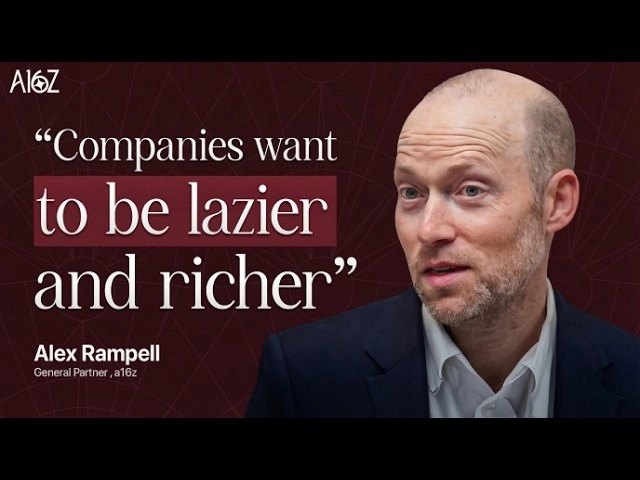
“Everyone wants two things: they want to be richer, and they want to be lazier. They want to work less and get more economic value. And that’s what GenAI will unlock.” This candid, actionable insight from Alex Rampell, general partner at Andreessen Horowitz (a16z) It cuts directly to the core themes of the company’s latest thinking on revolution. Rampell, along with fellow a16z partners Jen Kha and David Haber, spoke about the current AI application cycle, positioning it not as an isolated bubble but as the fastest and largest platform shift in software history, building on the foundation laid by the PC, Internet, cloud, and mobile eras.
Rampel began the discussion by comparing the speed of AI adoption to previous technological changes. Unlike the slow, gradual adoption curve of general AI over the past decade, the explosion of generative AI has created a hockey stick moment. Kha pointed out that just two years ago, tools like ChatGPT were limited to basic text and images, but now real-time audio, video, and complex inference capabilities are accelerating their use in enterprises. Lampel specifically cited data showing that enterprise AI spending will reach a sharp inflection point in 2024, confirming that “magic tricks are indeed making their way into enterprises and saving people time and money.” This rapid integration into business processes is what distinguishes the current moment from previous hype cycles.
The a16z team identified three core investment themes to guide their approach to AI applications, emphasizing the importance of defensibility over novelty. The first theme is “Making traditional software AI native”. This includes AI fundamentally reinventing existing software categories, from CRM and ERP to HR and payroll. Rampel argued that there is “rich room for new entrants” in these markets, as AI-native new entrants are unencumbered by legacy systems and can provide a better integration experience. He used an analogy from the cloud era, where companies like Salesforce and Shopify disrupted entrenched on-premises software vendors like Oracle and SAP by building cloud-native solutions. Similarly, new AI-native companies are looking to gain market share in existing categories by delivering superior product experiences that leverage AI from the ground up, rather than simply adding functionality to older software.
The second theme, which Rampel admitted is “personally the most exciting,” is “AI is making inroads into large labor-intensive industries,” where software directly replaces human labor. This transition targets multitrillion-dollar markets where software spending was previously minimal, such as legal, healthcare, and logistics, because the work was historically done by human labor. In these areas, the barrier to entry is not to compete with existing software, but to replace it with human effort. Mr. Haber provided a case study of Eve, an AI legal platform for plaintiffs’ lawyers, and highlighted a key feature of this trend: incentive alignment. Plaintiff lawyers work on a contingency basis and are only paid if they win the case. If Eve can make lawyers “5x more productive,” lawyers can take on more cases and increase their revenue without significantly increasing staff costs. This creates strong market traction for AI solutions that improve not only efficiency but outcomes.
The third and most important theme is establishing “proprietary data as a defensible moat.” Rampel emphasized that unique data inputs and integrated workflows are the ultimate source of defensive power in an era where fundamental models are becoming commoditized. He explained this with the analogy of a vegetable farm (AI model) and a restaurant (application). If a restaurant sources premium, high-quality vegetables, a competitor may be missing the ingredient and charge a premium for the final meal. In the software world, this means controlling obscure or private data sources. He cited examples such as Vlex in the legal field and OpenEvidence in the medical field, which aggregate specialized datasets that are not readily available to large research institutions. By digitizing, normalizing, perfecting and wrapping this unique data in an LLM, companies can create an “inference layer” that provides outputs that cannot be replicated by generic models. This unique access to inputs ensures that these vertical applications remain essential and highly defensible even as AI capabilities improve across the board.
The discussion concluded by reinforcing the idea that the best AI applications will be “systems of record.” The tool is so deeply integrated into an organization’s workflow that it is “nearly impossible” to remove it. The a16z team sees the current investment environment as a “golden age of AI apps,” characterized by “10x better, 10x bigger markets, [and] It’s 10x faster than before. ” The fundamental shift is from software that simply digitizes existing processes to software that fundamentally expands user capabilities and economic outcomes, driving value creation across large, previously untapped industries.


