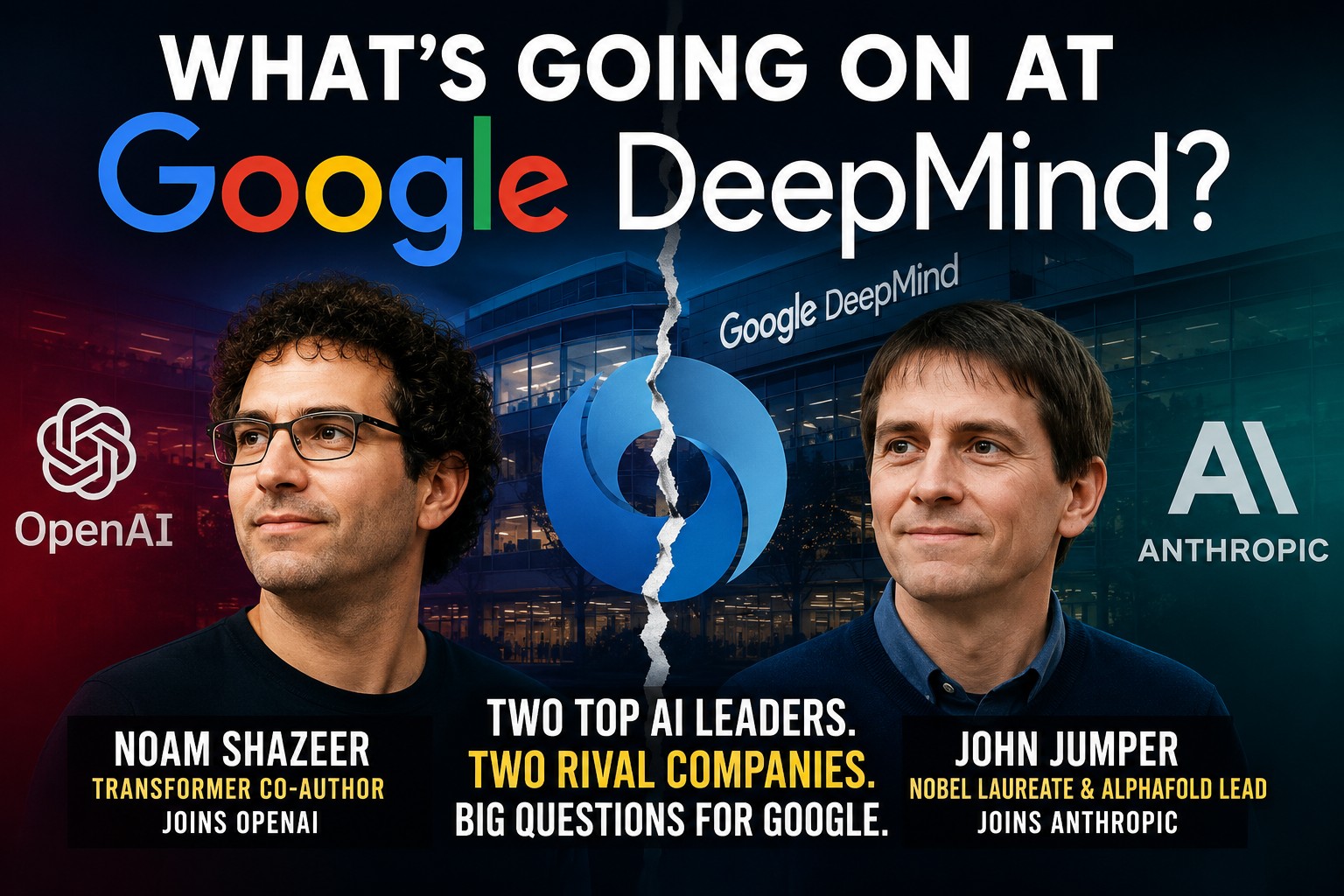

The AI industry is witnessing the most dramatic workforce change ever. Google DeepMind has lost two of its most prominent researchers to rivals in just a few days, increasing speculation about the company’s long-term strategy and priorities in the increasingly competitive AI race.
Noam Shazeer, co-author of Transformer, is reportedly leaving Google for OpenAI, while John Jumper, leader of Nobel Prize-winning AlphaFold, is joining Anthropic. Employee mobility between technology companies is nothing new, but the departures of two AI heavyweights in quick succession have sparked debate about whether Google is facing internal challenges in retaining top talent.
Tough week for Google DeepMind
Few organizations are contributing as much to modern artificial intelligence as Google DeepMind. The company has helped pioneer breakthroughs in machine learning, reinforcement learning, protein folding, and large-scale language models.
But the departures of Norm Shazer and John Jumper can no longer be ignored.
Shazeer helped create the Transformer architecture that powers today’s leading AI models, including ChatGPT, Claude, and Gemini. Meanwhile, Jumper’s leadership at AlphaFold transformed biological research and earned him a share of the Nobel Prize in Chemistry.
The loss of either researcher would be notable. Losing both in the same week amplified questions about DeepMind’s future direction.
AI talent war reaches new level
The competition between Google, OpenAI, Anthropic, Microsoft, and Meta is no longer just about model benchmarking. The competition for researchers who can build the next generation of AI systems is becoming more intense.
OpenAI has been aggressively expanding its ecosystem beyond AI chatbots. The company recently introduced a revamped scheduled task experience that makes ChatGPT even more useful for productivity workflows and automation. Click here for more information.
At the same time, Anthropic continues to enhance Claude with features aimed at enterprise and professional users. A recent update to Claude Design introduced real-world editing and syncing features to help bridge the gap between AI-generated ideas and production-ready designs. Click here for more information.
In this context, attracting elite researchers has become as important as launching new AI products.
Has Google gone too far?
One theory gaining traction among industry observers is that Google may be spreading its AI efforts across too many initiatives at once.
Currently, the company is making significant investments in:
- Gemini AI model
- search conversion
- Android AI features
- Cloud AI service
- robotics
- scientific research
- AI agent
- productivity tools
This broad strategy creates enormous opportunities, but it also creates challenges. Researchers often prefer organizations with clear, focused missions, especially when working on frontier technologies.
By comparison, OpenAI continues to focus on advancing fundamental models and consumer AI products, while Anthropic continues to focus on AI safety and developing next-generation models.
It’s unclear whether this difference played a role in the recent departures, but it’s one explanation being debated across the AI community.
Google is still actively investing in Gemini
While the departure made headlines, it would be inaccurate to suggest that Google is slowing its AI ambitions.
The company continues to rapidly improve Gemini and expand its capabilities. Recently, Google rolled out a new Gemini 3.5 Flash export after fixing a bug that caused loops in the output text. To facilitate testing, weekly Gemini quotas for all users will also be reset. Click here for more information.
This move shows that Google remains committed to improving the quality of its models and user experience despite increasing competitive pressures.
Competition drives rapid innovation
One of the positive outcomes of the AI talent war is faster innovation.
OpenAI, Anthropic, Google, and Microsoft are all competing to offer better products, more capable models, and more powerful developer tools.
Developers are already benefiting from this competition. GitHub recently made the Copilot app publicly available, giving users a centralized hub for managing their AI-assisted development tasks. Click here for more information.
The pace of AI innovation continues to accelerate as companies compete for both researchers and users.
What happens next?
The departures of Norm Shazer and John Jumper are definitely significant. Both researchers have helped shape modern AI, and future research at OpenAI and Anthropic could influence the direction of the industry for years to come.
But Google DeepMind remains one of the world’s strongest AI organizations, backed by massive infrastructure, deep research expertise, and some of the most influential scientists in the industry.
The bigger story may not be whether Google is losing focus, but rather how intense the battle for AI leadership is becoming.
As OpenAI, Anthropic, and Google continue to compete for talent, technology, and users, the winners may be those who benefit from increasingly powerful AI tools and faster innovation.
For now, all eyes are on Google DeepMind as it goes through one of the most high-profile periods in its history.
For more Google AI news, stay tuned to NPowerUser. Click here to read all Google AI news articles.
For all the latest news and updates from Google, follow our Facebook page and X account. android and Nokia related news.