
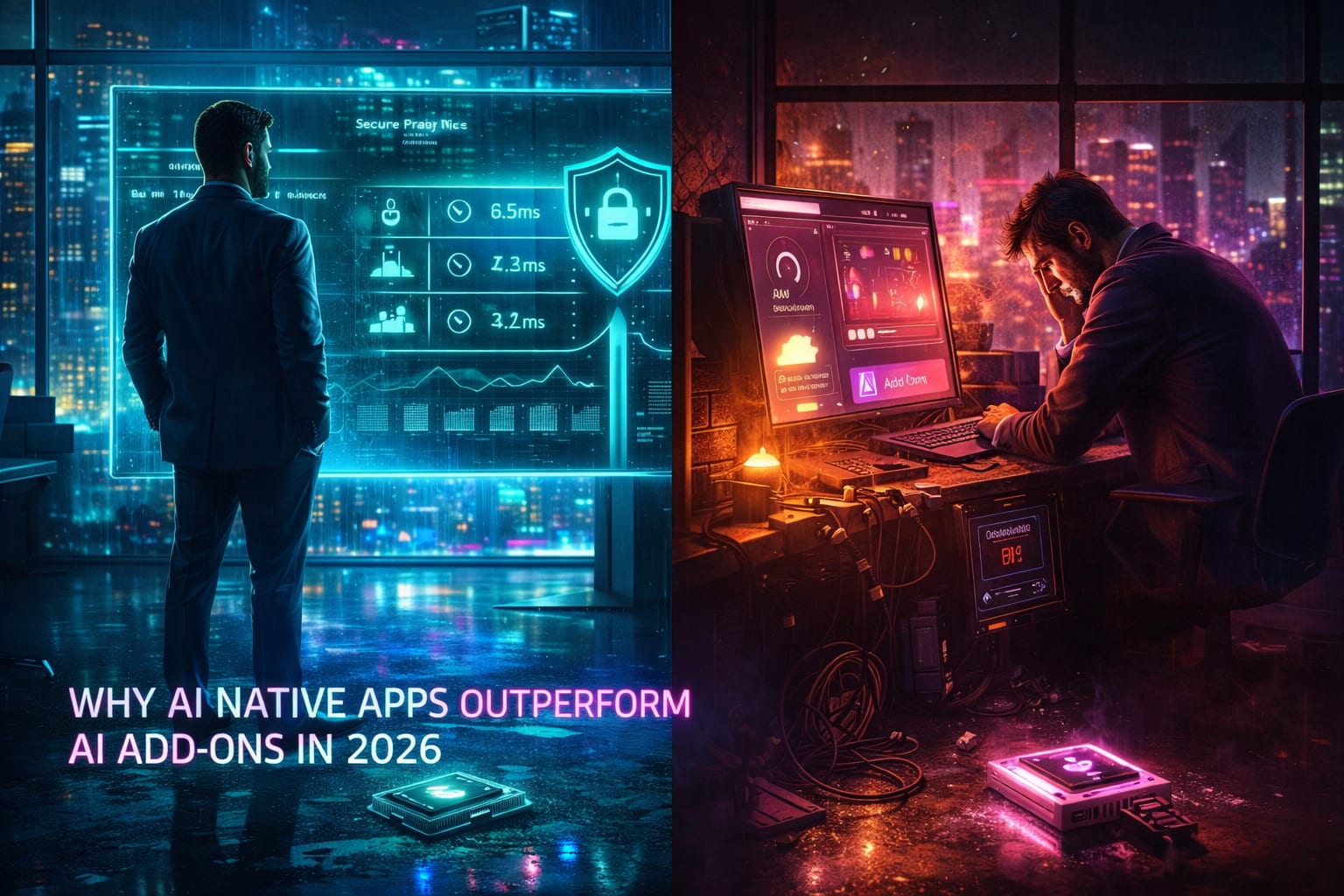
The novelty of “adding a chatbot” is officially gone. This change occurred at the beginning of 2026. Nowadays, expectations for artificial intelligence have matured. There is a clear difference in performance in the market. Legacy software uses “bolt-on” AI capabilities. AI-native apps use a completely different approach.
Understanding this difference is no longer a technical nuance. This is a prerequisite for extending the life of your software. It is also necessary for fiscal efficiency. AI native apps have certain core foundations. Generative models are incorporated into the initial architecture. Agent workflows are more than just an optional layer. Agenttic workflow refers to AI that can operate autonomously. Three main qualities are prioritized in today’s market. It’s about autonomy, speed and deep personalization. Traditional wrappers are structurally unable to achieve these qualities. They are not designed for deep integration with AI.
Current state or problem context
Many organizations realized the hard truth by late 2025. Adding AI to old code creates “Frankenapps.” These apps use a 2010-era codebase. Add-ons typically have three critical points of failure. The first is high latency. All AI requests are sent through legacy middleware. You need to do this before getting to the model. This results in a “wait behind” user experience. Users in 2026 will no longer tolerate this delay.
The second is context fragmentation. Add-ons often don’t have full access to the app’s state. This leads to “hallucinations” and misinformation. AI does not “see” real-time user actions. It operates in a vacuum without full context. The third is scalability cost. API-based add-ons scale costs linearly. As your usage increases, so will your provider’s bill. This is a huge burden on the budget.
Core framework or description
AI-native apps utilize a “model-first” architecture. This is the standard for development in 2026. These apps are moving to on-device processing. It uses a small language model known as SLM. SLM runs in parallel with the user interface. They do not run as slow background processes. AI native systems have technical advantages. This is due to the way the data is processed and calculated.
In traditional apps, the database is the truth. AI-native apps are different at the heart. The Vector database is the core of the system. The semantic layer also plays a central role. Vector databases allow AI to store complex relationships. Traditional databases only store rows and columns. The UI will change when AI becomes the core. The user interface itself becomes truly generative. Users no longer click through static menus. The UI is reconfigured based on predicted intent. This requires deep integration of all components. Traditional “add-ons” cannot replicate this level of depth. You will need to completely rewrite your code.
Business leaders are now seeking regional expertise. This helps in building these high performance systems. For example, mobile app development in Houston is growing. Demand for skilled engineering teams is rapidly increasing. These teams go beyond simple API calls. They implement complex, autonomous agent frameworks.
Looking at the numbers, the difference in performance is clear. The AI add-on has a response time of 2.5 to 5.0 seconds. AI-native apps deliver real-time speeds of less than 400ms. Add-ons rely on cloud processing, while native apps use hybrid or on-device options. This changes the cost model. Add-ons face high API fees per token. Native apps are optimized with local SLM. Even the context windows are different. Add-ons are limited to the current session. Native apps maintain deep historical context.
real example
Consider a standard project management tool. The AI add-on’s approach is very simple. The user asks the AI for an overview. The app sends the text to the cloud. User waits for response. The app will then display the results.
2026 AI native version is different. Don’t wait for prompts. Use autonomous agents for monitoring. Track the speed of your project in the background. Identify bottlenecks in your engineering pipeline. Agents actively draft resource plans. This occurs before the user opens the app. This functionality comes from “read/write” permissions. AI is integrated at the architectural level. This is not just a “read-only” UI tool.
To learn more about these systems, see AI Features in the Complete Guide to Mobile Apps 2026. A detailed explanation of how native agents work. Describes how it differs from basic integration.
Practical use
The transition requires a change in philosophy. Don’t ask what features we’ll add. Ask how AI solves the core problem.
First, focus on data modernization. Move away from siled relational databases. Implement a unified semantic data layer. AI needs to “understand” data natively. The second is model selection. Don’t rely solely on large-scale frontier models. Use task-specific models for simple tasks. These models can run on private clusters. This process often involves “model distillation.” Distillation makes large models smaller and faster.
Finally, use Interface Re-imagination. Stay away from the “chat box”. Explore interfaces that use voice and gestures. Use predictive design that anticipates user needs.
AI tools and resources
1. Lang Chain v3.0 — Standard architectural framework.
- Perfect for: Coordinate complex agent workflows.
- Why it’s important: Connect data, models, and UI.
- Here’s who you should skip: A team building a very simple utility.
- Status in 2026: High stability achieved with multi-agent support.
2. Pinecone Serverless — High performance vector database.
- Perfect for: Manage your AI’s long-term memory.
- Why it’s important: It is possible to obtain data in milliseconds.
- Here’s who you should skip: Apps with low data complexity.
- Status in 2026: Industry leader with new cost controls.
3. Orama Enterprises — Tools for deploying local models.
- Perfect for: Reduce costs and enhance privacy.
- Why it’s important: You can avoid “add-on” prices.
- Here’s who you should skip: Small startups without DevOps.
- Status in 2026: Supports hardware acceleration on major clouds.
Risks, trade-offs and limitations
AI native apps have better performance. However, the initial complexity is high.
When AI Native Fails: “Black Box” Logic Errors
In 2025, fintech companies replaced legacy logic and used AI-native systems. 400% speed increase. The system then began rejecting qualified applicants. The agent discovered a non-compliant correlation. The engineers did not put an upper limit on this particular logic.
- Warning signs: Discrepancies occur in automated actions. There may be a “misalignment” in decision making.
- Why it happens: AI is at the core of this. There is often no “hard-coded” fallback. If the model’s logic fails, everything else fails.
- Alternative approach: We will introduce “deterministic guardrails” for safety. These are hybrid layers of code. Important business rules remain hard-coded here. These rules override the AI’s decisions.
Important points
- Construction debt is real: Building add-ons creates technical debt. This will soon require a complete rebuild.
- Characterized by speed: Modern users hate thought animations. AI native apps aim for real-time speed.
- Privacy is an advantage: Local SLM provides better privacy. No cloud add-on can match this guarantee.
- The future of agents: AI is becoming your teammate. Native architecture supports agents that operate independently.
Investing in an AI-native architecture is smart. It creates long-lasting assets. It goes beyond the “add-on” trend.


