
Organizations are investing heavily in AI and often expect it to improve both performance and employee experience. These investments often happen quickly, with new tools and pilots emerging across the business.
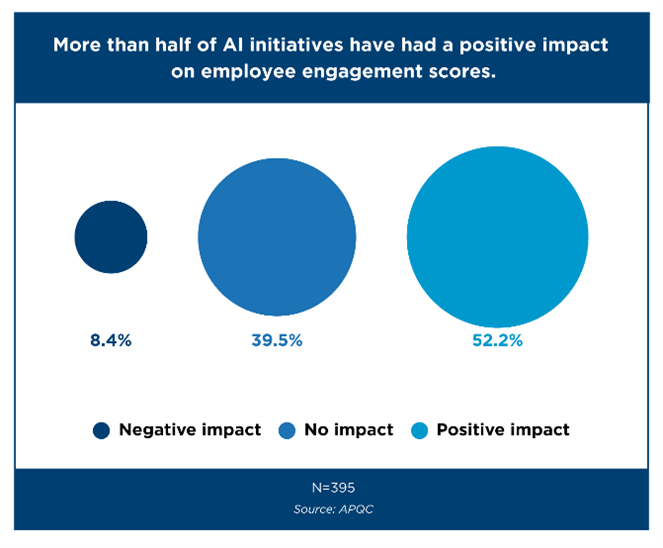
While much of the conversation around AI has focused on its potential to disrupt or demotivate employees, our research shows that the reality is more nuanced. Nearly half of leaders surveyed reported that AI has improved employee engagement, a key employee experience metric, while less than one in 10 said it has hurt engagement. The difference between these groups lies in how the AI is implemented.
See also: 4 surprising discoveries about how AI actually works — and what it doesn’t.
Same technology, different results
APQC found that approximately 40% of organizations surveyed did not see an impact from AI on engagement, and just over 8% reported a negative impact.

In some ways, this data is reassuring because it shows that engagement is not being broadly harmed by AI. But it also presents significant challenges. Almost half of organizations see little or no engagement benefit from their AI investments. How can the same technology produce such different engagement outcomes?
Organizations reporting stronger engagement outcomes are treating AI as a coordinated transformation of how work gets done. Tools, skills, and workflows evolve together, making it easier for employees to see how AI fits into their roles and see real improvements in their work.
Organizations with little or no impact tend to deploy AI in a more disaggregated manner. That means separate use cases, decoupled tools, and training separate from day-to-day work. Employees may experiment with AI, but they are often not clear how it will change their role or if it will make them more efficient.
Pause here before extending the AI further
Many organizations have already implemented AI and are now deciding how to scale it. Before going any further, it’s important to ask yourself whether you and other leaders are ready to allow AI to improve the way work actually gets done. When these conditions are missing, adoption and engagement suffer.
What does intentional AI implementation look like?
In organizations where AI improves engagement, some consistent patterns emerge in how work is prioritized, designed, and executed. The following sections provide an overview of these patterns and provide ways to assess how clearly they are implemented in your organization.
Tailor AI to the work that matters most to your business
AI has the greatest impact when applied to business-critical operations. This means focusing on use cases where improvements in speed, quality, and decision-making have a meaningful impact on outcomes.
When AI is clearly tied to tasks that are important to the business, employees understand how to use it to drive better results. If that connection is weak or unclear, the AI can feel disconnected from the priorities that define success in the role.
Ponder the questions below to clarify where this alignment is clear and where it is not.
- Where is AI being applied to tasks that are clearly important to the business?
- Where are AI initiatives active, but not clearly tied to each role’s most important job?
- Do employees see a direct link between using AI and improving job performance?
Redesign your work before applying AI
AI tends to augment already structured ways of working. When processes are clear, consistent, and well-defined, AI can enhance them and make them more effective. If you’re running on fragmented, ill-defined, or inconsistent data, those issues become more visible and harder to address.
These challenges manifest directly in how employees experience their day-to-day work. Instead of simplifying tasks, AI can introduce additional steps, surface contradictory outputs, and force employees to interpret when and how to rely on AI. When staff have to spend more time resolving exceptions and fixing discrepancies, their work becomes more tedious rather than more efficient, and engagement suffers over time.
To assess whether this is happening in your organization, consider the following:
- Where are existing processes clear and consistent enough to support AI-powered work?
- As AI is introduced, could inconsistency and ambiguity pose additional challenges?
- Do your employees have a shared understanding of how their work is expected to change with the introduction of AI?
Connect AI to specific roles and tasks
AI improves engagement when people have clear opportunities to apply AI to actual tasks, decisions, and workflows within their roles. When that connection is lost, AI remains abstract and disconnected from daily operations. Employees may have a general understanding of what a tool can do, but that knowledge doesn’t translate into better performance, increased productivity, or greater confidence in their role.
A few questions can help reveal where that connection is strong and where it’s broken.
- Where do employees have clear, role-specific ways to apply AI in their daily work?
- Where are employees expected to use AI, but lack clear guidance on how it fits into their responsibilities?
- Do your employees experience measurable improvements in the way they do their jobs when using AI?
Establish clear ownership and guardrails for AI
As AI expands across organizations, employees need a deployment that feels consistent. This requires clear ownership of how AI is deployed and supported over time, along with guidance on how to use it. Without that structure, employees are left with no choice but to interpret what is acceptable and where to turn for help.
Organizations also need shared guardrails around issues like ethics, security, and responsible use, and ways to measure what’s working and improve what isn’t. Once these elements are in place, AI feels like an organizational capability that companies are intentionally building. Without them, deployments feel disjointed and difficult for employees to trust.
Consider whether your organization provides a coordinated and consistent rollout to your employees.
- Do you have clear ownership of how AI is deployed, supported, and improved over time?
- Will AI efforts be measured and refined over time, or will they simply be launched and left to individual teams?
- Do your employees know where to turn for guidance and support when using AI?
Where your AI efforts start to pay off
When employees have a clear understanding of how AI relates to their role, know what is expected of them, and know where to go for guidance, AI can be a useful part of getting their jobs done. That lack of clarity leaves people guessing about how AI relates to their work. They may experiment with it, use it inconsistently, or even set it aside entirely. What is missing in these cases is a clear sense of how AI can make employees more efficient, more confident, and more connected to the value they are creating.
This is where engagement results start to diverge. Closing the gap means making the role of AI in work more visible and actionable. When employees understand how AI enhances their contributions, they will be more engaged.
Data in this content was accurate at the time of publication. For the latest data, please visit www.apqc.org.


