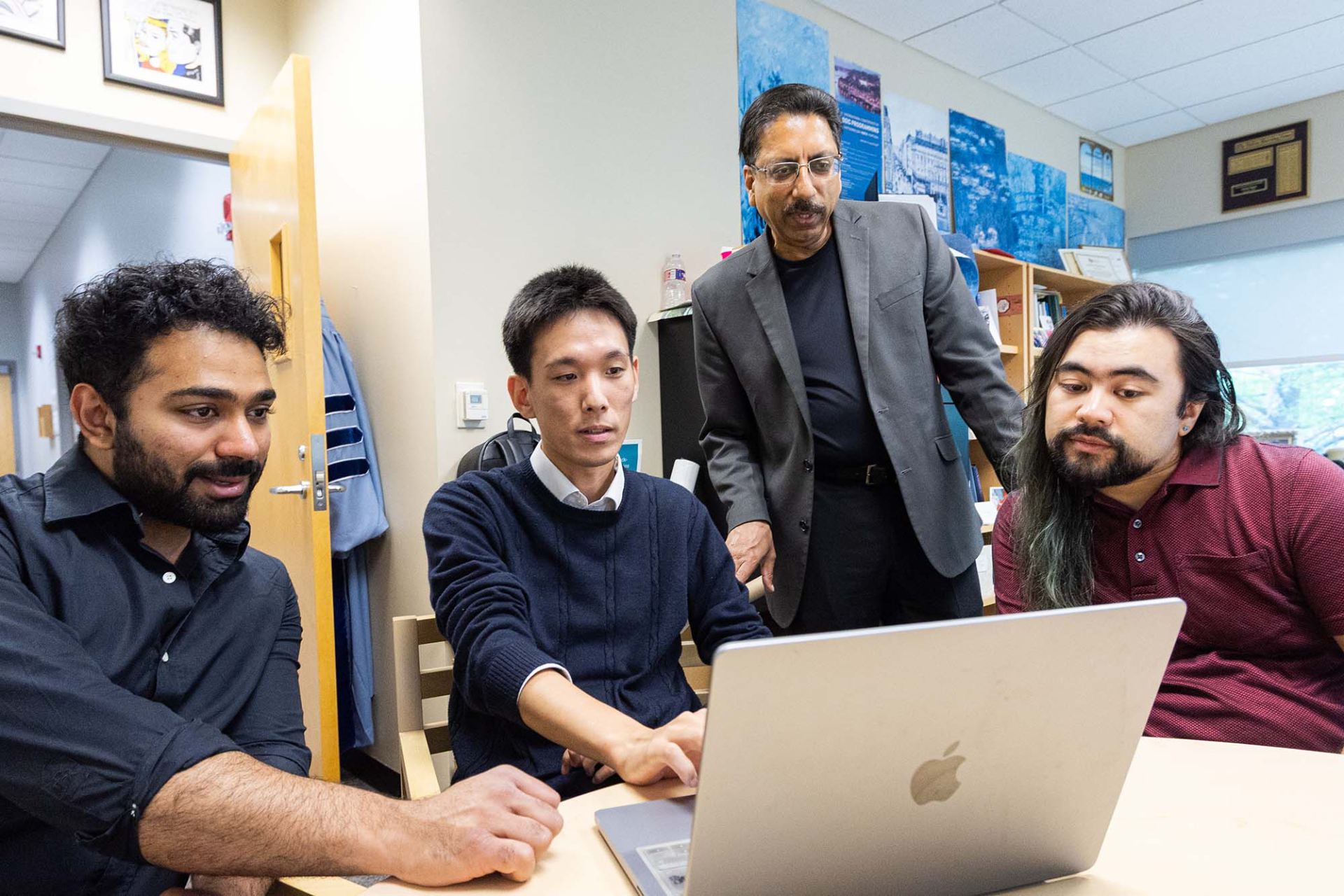

From left: Computer Science PhD student Abiramon Rajasekaran, NEXCO Central Japan developer Koshiro Mori, Center for Applied AI and Machine Learning Director Dr. Gopal Gupta, and Computer Science PhD student Keegan Kimbrel.
Artificial intelligence (AI) experts at the University of Texas at Dallas are partnering with a Japanese company through an Irving, Texas-based subsidiary to help local governments prioritize road repair.

The system builds on NEXCO’s existing technology to assess road conditions using a combination of artificial intelligence and video footage collected from mobile cameras to provide visibility into pavement conditions across the network.
Researchers at the UT Dallas Center for Applied AI and Machine Learning (CAIML), in collaboration with Japan’s NEXCO Central Japan, have developed an automated software system to help cities prioritize which roads to repair in the face of limited resources and competing interests. The company primarily serves customers in the North Texas region through its Irving-based subsidiary, NEXCO Highway Solutions of America Inc.
The system builds on the company’s existing technology, which combines AI and video footage collected from mobile cameras to assess road conditions and understand pavement conditions across the network. NEXCO approached UT Dallas to promote a system that would help the agency make complex road repair decisions.
“The new system emulates the mind of a city manager who must determine priorities for modifying various road segments,” said Dr. Gopal Gupta, CAIML director and professor of computer science in the Eric Jonsson School of Engineering and Computer Science.
About CAML
The Center for Applied AI & Machine Learning (CAIML) applies artificial intelligence and machine learning technology to solve problems for industry partners. CAIML works with companies around the world, and most of our projects result in companies owning the intellectual property. CAIML also provides AI and machine learning training to companies and has more than a dozen researchers with expertise ranging from deep learning, computer vision, and automated inference to natural language processing, constraint optimization, and statistical relational learning. Learn more about the center’s mission, projects, and researchers.
The resulting technology is integrated into NEXCO’s software and includes a scoring system to make the process more efficient.
“Pavement evaluation is extremely important for cities,” says Koshiro Mori, who is in charge of development at NEXCO Central Japan. “Our technology is aimed at optimizing complex decision-making to determine which roads are most in need of repair, anticipated financial investments, and prioritizing who gets the funding and when.”
This collaboration is made possible through an intellectual property transfer/sponsored research agreement that allows companies affiliated with UT Dallas to retain intellectual property arising from the project. In addition to Gupta, UT Dallas computer science doctoral students Abhiramon Rajasekharan and Keegan Kimbrell also contributed to the project.
“It’s important to have the technology to determine what segments you need to do within your budget and how much you need to spend on certain types of roads,” said Atsushi Onishi, vice president of NEXCO Highway Solutions of America.
Mori said, “When NEXCO Central researched academic institutions online, the name CAIML came up and caught our attention, as AI and machine learning are the core technologies we use in our business. We saw an opportunity for collaboration and are very happy with how the team handled this project.”
An added benefit, Mori said, is that the tool explains the factors behind each recommendation.
Mr. Gupta said this project is an example of how the University of Dallas can contribute to industry.
“We see ourselves as an R&D center for companies that don’t have an R&D department,” Mr. Gupta said. “NEXCO has partnered with us in this way to create an incredible product.”